
 GREEK & LATIN
~ CLASSICS
GREEK & LATIN
~ CLASSICS
GREEK & LATIN
~ CLASSICS
GREEK & LATIN
~ CLASSICS
 German
 RENAISSANCE Caesar — Lushly Illustrated
 Caesar, Julius. Julius der erst römisch Keiser von seinem Leben und Krieg, erstmals uss dem Latein in Tütsch gebracht vnd mit andrer Ordnung der Capittel und uil zusetz nüw getruckt. [Strassburg: Durch Joannem Grüninger, vff sant Adolffs des heiligen Bischoffss, 1508]. Folio (31 cm; 11.5"). A6 Aa8 B6 C4 D–N6 O4 P–Z6 Zz6; [148] ff., illus.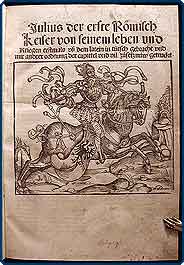
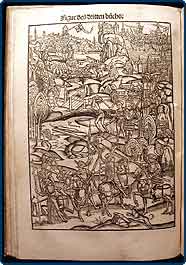
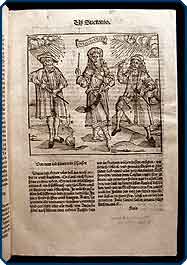
 All images of this book enlarge, via single-click.
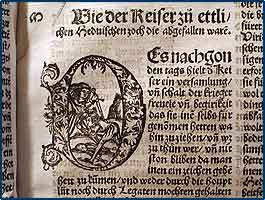
This handsome and  SCARCE book is famous for its woodcut illustrations: It has one quarter-page, four half-page, one three-quarter page, and
  eleven full-page woodcuts. These include battle scenes, the assassination, camp life, etc., all of the figures being dressed anachronistically in Renaissance garb.
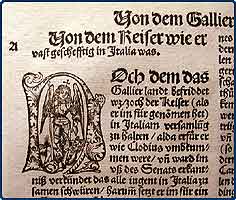 The text is printed in large gothic in double-column format.
 Of the first edition we find only two copies in the U.S. (Harvard and Stanford), and of the second we trace three (Brown, Duke, and Trinity College), all being incomplete except the Brown copy.
• Index Aurel. 128.654; Schmidt, Repertoire bibliographique Strasbourgeois, no. 91, p. 40–41; Schweiger, II, 51; not in Adams (who only lists much later editions in German). Recased in an 18th-century vellum-over-boards binding. Sophisticated copy in all likelihood, with several leaves apparently supplied from a different copy, those leaves being either slightly smaller than the others or more heavily sized. Occasional light waterstains in from a very few margins; two leaves with old scribbling in ink in margins; minor worming in lower margin of last six leaves.  A very nice copy of a very scarce book that is clearly difficult to find complete, incomplete, or sophisticated.
 For
more TRANSLATIONS,
For
more TRANSLATIONS,
 Incunable
Cicero with!Extensive
Evidence of Readership
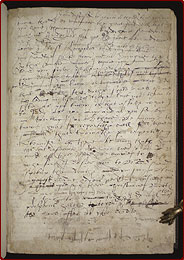
Cicero, Marcus Tullius. De officiis [and other works].
Venetiis [Venice]: Bernardinus Rizus, Novariensis & Bernardinus Celerius, 12 Oct. 1484. Folio. [180
of 182] ff., lacking b4–5.
Incunable
Cicero with!Extensive
Evidence of Readership
Cicero, Marcus Tullius. De officiis [and other works].
Venetiis [Venice]: Bernardinus Rizus, Novariensis & Bernardinus Celerius, 12 Oct. 1484. Folio. [180
of 182] ff., lacking b4–5.
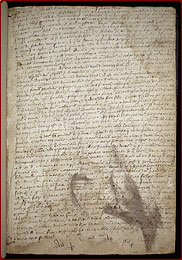
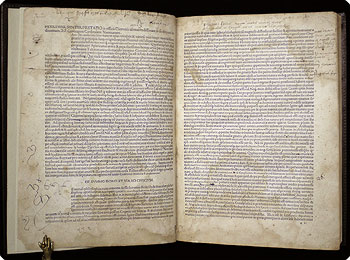
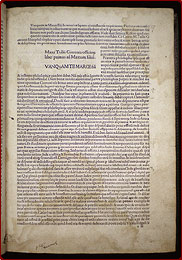 Click the interior images for enlargements.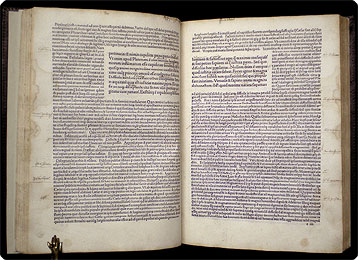
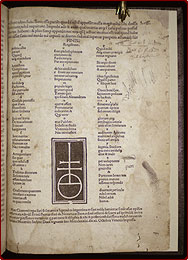
The recto of leaf a1 is blank, the text of the prefatory matter beginning on the verso.
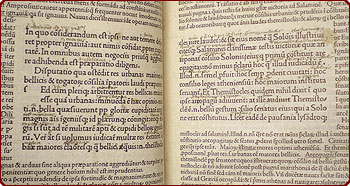
Provenance: Signature of “John Webb” in a 17th-century hand twice in margin of k3r.
Uncommon beyond the Continent: ISTC and Goff locate only two copies in the U.S. and ISTC locates only two copies in the U.K. (one incomplete), but there is a third copy at the British Library.
• ISTC ic00601000; Goff C601; HC 5274*; IGI 2910; Pr 4942; BMC,
V 400; GKW 6954. Full modern walnut calf old style: Spine with
raised bands, accented with gilt and blind rules, the latter extending onto
covers to terminate in trefoils with blind double fillets beyond. Gilt center
devices in the spine compartments. Red leather spine label lettered in gilt,
and date in gilt at base of spine. Lacking two leaves (b4–5). Upper
corners of leaves in gatherings & and [con] damaged with loss of paper.
Lower corner of i1 torn with loss of text of both sides of leaf. Waterstaining
and old dampstaining variously, this often faint and never really worse than
moderate (worst at beginning/end); some age-toning and dustsoiling. Though
an imperfect copy, a rarity; indeed, with its manuscript enhancements, a “uniquum.”
(25766)

Ciceronian Orations — Translated & with NotesCicero, Marcus Tullius. The principal orations of Cicero, translated with notes, classical and original by Captain John Rutherford. London: Pr. by H. Goldney for T. Cadell, 1781. 4to. Frontis., [1] f., xix, [1 (blank)], 499, [1 (blank)] pp. 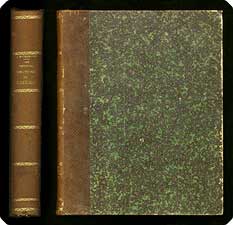
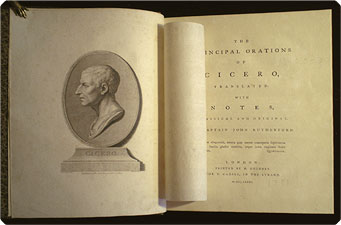
• ESTC T137815; Schweiger, II, 231. Contemporary quarter long-grained sheep over marbled paper; spine gilt. Marbled endpapers. All edges speckled brown. Sheep somewhat abraded and peeling, covers rubbed and chipped around the edges. Light foxing on frontispiece and title-page. Light soiling on last blank page. (11867)

Rare
Variant —
“WE” Binding Detail
— Sunderland
Copy
Diodorus Siculus. Diodorus Siculus. [Operum lib. vi. priores, Latine Poggio interprete.] [Paris]: [pr. by Jean Marchant for] Jean Petit, [ca. 1507]. 4to. a–v8.4x6y4; 123, [6] ff. [bound with] Justinus, Marcus Junianus. Justini historia ex Trogo Pompeio quattor & triginta epithomatis collecta; acc. Lucius Florus et Sextus Rufus. [Paris]: De Marnef, [ca. 1507]. 4to. A8B4C6a–y8.4z6&4; [18], 140 ff.

 Diodorus's work is here accompanied by Justinus’s abridged version of Trogus Pompeius’s history. Both books feature striking capitals and title-page devices. The typography of the first book is Jean Marchant’s, done for Jean Petit whose lion-and-leopard device is prominently displayed. The second book’s device shows initials of two of the three de Marnef brothers (E and G) beneath a pelican in her piety. This second book collates exactly like the Jean Petit edition of Justinus, printed sometime after December of 1507, and appears to differ from it solely in its title-page, probably reset only for insertion of the de Marnef device.
While one copy of Diodorus bound with Petit’s Justinus was found at Harvard, no record of the apparently extremely scarce de Marnef variant could be located.
Provenance: Charles Spencer, Third Earl of Sunderland, lot 3934 in the Sunderland Library sale (1882).
• Diodorus: Moreau 1508:64; not in Schweiger. Justinus: not in Moreau, not in Schweiger. On Diodorus, see: Oxford Companion to Classical Literature, 146. 17th-century English calf, panelled, with gilt fleurons and elaborate front and back gilt floral center motifs, each worked with a minute WE. (You need a magnifying glass, but this is THERE.) Overall, showing wear with
some leather chipped from spine, covers abraded, and joints starting. Pages mostly clean, with slight staining to inner margins from binding supports. Gilt cover lozenges still bright and the whole safe to be worked with.
Materia Medica — Ancient Knowledge Dioscorides Pedanius, of Anazarbos. Dioscoridis libri octo Graece et Latine. Castigationes in eosdem libros. Parisiis: Apud Petrum Haultinum (colophon: Excudebat Benedictus Prevost), 1549. 8vo (16.7 cm, 6.5"). [20], 392 ff. 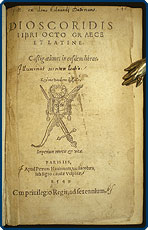
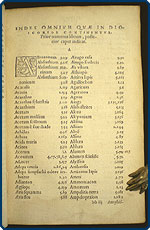
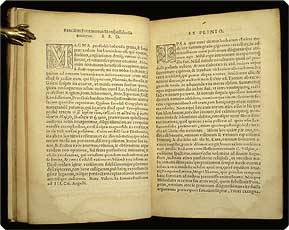 Click the interior images for enlargements.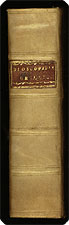
The work was edited by Jacques Goupyl, and is laid out with the Latin translation by Jean Ruel in side-by-side columns with the Greek text.
Provenance: Early title-page inscription, “F.M. ex dono Eduardi Davenant.”
• Adams D656; Durling 1135; Index aureliensis 154.341; Pritzel 2295. 18th-century speckled calf (front cover) and sheep (back cover) rebacked with lighter-colored sheep preserving original gilt-stamped leather title-label; boards scuffed and worn. Title-page with inked inscription as above (and in same hand, “Illuminat mentem Lectio.” First two leaves creased; first and last few leaves with light to moderate waterstaining. A very few marginalia in a tiny, neat, early inked hand. (20639)

 TO Part III TO Part III |