 MILITARY • NAVAL
MILITARY • NAVAL
MILITARY • NAVAL
 He Survived “La Noche Triste” & Much, Much More
 THE
CONQUEROR'S REWARD
THE
CONQUEROR'S REWARD
 Felipe II, King of Spain. Illuminated Document Signed (on his behalf by his sister/regent, “La Princesa”). In Spanish, on vellum. Valladolid, 17 March 1559. Folio (58 x 54.5 cm; 23" x 21.5"; h x w), 1 leaf.
  |
|
|
|
|
|
|
|
|
|
|
|
|
|
|
|
 |
| ||||||||||||||
 |
 |
 |
 |
 |
 |
 |
|
||||||||
 |
| ||||||||||||||
 |
| ||||||||||||||
 |
 |
| |||||||||||||
 |
 |
| |||||||||||||
 |
 |
| |||||||||||||
 |
 |
| |||||||||||||
 |
| ||||||||||||||
 |
 |
 |
 |
| |||||||||||
 |
 |
 |
 |
| |||||||||||
 |
| ||||||||||||||
 |
 |
| |||||||||||||
 |
 |
| |||||||||||||
 |
| ||||||||||||||
 |
 |
| |||||||||||||
 |
 |
| |||||||||||||
 |
| ||||||||||||||
 |
| ||||||||||||||
 |
| ||||||||||||||
 Move your mouse over the document above, and click,
to select and view details.
 Villanueva was among the small but grand “army” that marched into Tenochtitlán in the Spring of 1520 and in July of the same year were to flee the western world's largest city fighting for their lives, on the “Noche Triste.” He survived the hell and slaughter of the causeways and later returned with the greatly augmented force that destroyed the Aztec capital and its empire. Still later he was with Cortés in the exploration and conquest of Pánuco and following that with Nuño de Guzmán in the exploration and conquest of Zacatecas and Jalisco. He and his brother Fernando (also a member of the Saucedo contingent) jointly received an encomienda (Quechula) and settled in Puebla de los Angeles where Pedro served as a regidor on the town council in the 1540s and 1550s.

 The text of the grant of arms is elegantly
indited in a standard court semi-round gothic in sepia ink and is enclosed
on the left, right, and top sides by an illuminated and historiated sash-like
border. In the upper left and right corners are miniatures of Justice
and Knowledge in sylvan settings. Running between those two along the
top of the document is a decorative panel incorporating flowers, fruits, mythic
animals, and cherubs. Below this, the king's name is accomplished in
large letters of gold on a field of red accented with gold, and the “D”
of his honorific “Don” is given special treatment. This
is elaborated in an ornate, almost baroque style that comes close to obfuscating
the fact of its being a majuscule “d”: Wrought in gold,
the letter at first appears to be merely a “frame” for the royal
coat of arms that fills its center. The king's arms are accomplished
in gold, white, black, red, and blue; the whole being laid on a blue field
with white accents.
The text of the grant of arms is elegantly
indited in a standard court semi-round gothic in sepia ink and is enclosed
on the left, right, and top sides by an illuminated and historiated sash-like
border. In the upper left and right corners are miniatures of Justice
and Knowledge in sylvan settings. Running between those two along the
top of the document is a decorative panel incorporating flowers, fruits, mythic
animals, and cherubs. Below this, the king's name is accomplished in
large letters of gold on a field of red accented with gold, and the “D”
of his honorific “Don” is given special treatment. This
is elaborated in an ornate, almost baroque style that comes close to obfuscating
the fact of its being a majuscule “d”: Wrought in gold,
the letter at first appears to be merely a “frame” for the royal
coat of arms that fills its center. The king's arms are accomplished
in gold, white, black, red, and blue; the whole being laid on a blue field
with white accents.

The panels running down the left and right
sides of the document are accomplished in red, gold, green, pink, white, red,
blue, and brown, many in several shades. The decoration includes birds
of several varieties including a fine owl, animals including a watchful rabbit,
strawberries and other fruits, and flowers, ribbons, grotesques, and butterflies.

The document is signed in the king's name by Juana (Joanna Habsburg) de Austria, “princesa de Portugal.” Married to Prince Juan of Portugal, young Juana (b. 1537) was the regent of the Spanish crown from 1554 until her brother Philip's return to Spain in September of 1559. She had just lost her husband to death and borne his posthumous son, both in January, 1554, when she left Portugal and her child in the Spring of that year to assume the regency throne in Valladolid.

 In
format and content this document differs dramatically from the cartas executorias
de hidalguía that most collectors are familiar with. Here we have a
In
format and content this document differs dramatically from the cartas executorias
de hidalguía that most collectors are familiar with. Here we have a  single large sheet
of vellum handsomely engrossed, artfully illuminated, and exquisitely decorated
with a composite border containing miniatures. This is not a bound volume
of copies of documents created for storage in the family archive.
single large sheet
of vellum handsomely engrossed, artfully illuminated, and exquisitely decorated
with a composite border containing miniatures. This is not a bound volume
of copies of documents created for storage in the family archive.  This
was created for display in a prominent place of honor; and it is a magnificent
display item. This is not a grant of nobility nor
a confirmation of it based on something that some vague ancestor did; rather
it is a grant of a coat of arms to a man who himself performed significant
military and other service for the Crown and whom the Crown wishes to honor
both publicly and privately. Only a few hundred of Cortés's men
survived the Noche Triste, the reentry into and destruction of Mexico
City, and the subsequent conquests in Panuco and elsewhere. The number
of grants such as this to actual members of Cortés's original “army”
were few.
This
was created for display in a prominent place of honor; and it is a magnificent
display item. This is not a grant of nobility nor
a confirmation of it based on something that some vague ancestor did; rather
it is a grant of a coat of arms to a man who himself performed significant
military and other service for the Crown and whom the Crown wishes to honor
both publicly and privately. Only a few hundred of Cortés's men
survived the Noche Triste, the reentry into and destruction of Mexico
City, and the subsequent conquests in Panuco and elsewhere. The number
of grants such as this to actual members of Cortés's original “army”
were few.
 And surviving grants to those actual participants in the Conquest are extremely
rare, even more so in commerce.
And surviving grants to those actual participants in the Conquest are extremely
rare, even more so in commerce.  This
is the only royal grant of a coat of arms to an actual member of Cortés's
“army” that we have seen that has ever appeared in the marketplace.
Via published auction records and our extensive archive of dealer catalogues,
we trace no instance before this one of the offering for sale of a grant of
arms to a Conqueror of Mexico. Yes, there are examples in various libraries
and museums in Mexico and Spain, and probably in the U.S., but such examples
seem to have entered their institutional resting places via donation from
descendants of Conquerors, not via purchase.
This
is the only royal grant of a coat of arms to an actual member of Cortés's
“army” that we have seen that has ever appeared in the marketplace.
Via published auction records and our extensive archive of dealer catalogues,
we trace no instance before this one of the offering for sale of a grant of
arms to a Conqueror of Mexico. Yes, there are examples in various libraries
and museums in Mexico and Spain, and probably in the U.S., but such examples
seem to have entered their institutional resting places via donation from
descendants of Conquerors, not via purchase.

Provenance: It
is awesome to realize that this is no mere retained secretarial copy of Felipe's
grant of arms to Pedro de Villanueva. This gorgeous document not only
records the king's rewards to one of Cortés's men, but was that Conqueror's
personal property. It is the copy of the decree sent to him expressly,
by the Crown!

• On Villanueva, see: Icaza, Diccionario autobiográfico
de conquistadores y pobladores de la Nueva España, I, 88–89;
Thomas, Who's Who of the Conquistadors, 146; Himmerich y Valencia,
The Encomenderos of New Spain, 1521–1555, 262; Díaz
del Castillo, Verdadera historia de la conquista de la Nueva España,
chap. LIII. On Juana de Austria, see: the work of Dr. Kelli Ringhofer.
Overall in very good condition. Some fold tears, some minor rubbing
of small areas of images, stains as visible in our illustrations. The
wax seal and its silk cords no longer present.  Text
clear, not faded, and colors strong.
Text
clear, not faded, and colors strong.
 To review the pictures of this document more systematically than


 Napoleon,
Again
Napoleon,
Again Fernández,
Manuel. Broadside. Begins: "Ciudadanos. Es llegado ya el momento en que
el heroico pueblo Español...." [Cardona, 1823]. Folio. [1] f.
Fernández,
Manuel. Broadside. Begins: "Ciudadanos. Es llegado ya el momento en que
el heroico pueblo Español...." [Cardona, 1823]. Folio. [1] f.
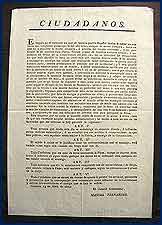
The five articles go so far as to proclaim that sharing of bad news is treason and
punishable as such.
• One fold.
 TRULY
International
Warfare, 1635
Fernando, el Infante.
Declaracion de sv alteza el serenissimo Infante Cardenal. Tocante à la
guerra contra la corona de Francia. [Madrid]: Herederos de la viuda de Pedro
de Madrigal, a costa de pedro Coello, 1635. Small 4to. [7] ff.
TRULY
International
Warfare, 1635
Fernando, el Infante.
Declaracion de sv alteza el serenissimo Infante Cardenal. Tocante à la
guerra contra la corona de Francia. [Madrid]: Herederos de la viuda de Pedro
de Madrigal, a costa de pedro Coello, 1635. Small 4to. [7] ff.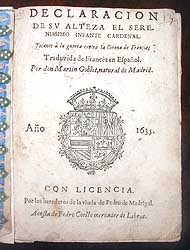
• Palau 69406. Old wrappers; some dustsoiling and age-toning.

 Memoirs ofthe Minister of Police Fouché, Joseph. The memoirs of Joseph Fouché, Duke of Otranto, minister of the general police of France. London: Charles Knight (William Clowes, pr.), 1825. 8vo. Frontis. port., viii, 357, [3], 329, [1] pp.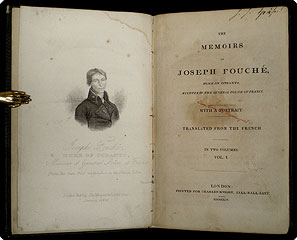
 Click the image for an enlargement.
 • NSTC 2F12262, 2J13268, & 2B13609. Green cloth over boards, gilt rules and lettering to spine; cloth worn away at spine extremities and corners and splitting over front joint; preliminary pages (including frontispiece) and pp. 1–2 separated from binding. Private ownership signature at top edge of title-pages; a (different) private owner's pressure- and rubber-stamps; institutional bookplate. Off-setting to six pages from old newspaper articles or leaves laid in; old newspaper article (a review of a much later biography of Fouché) still inserted; Inner margin of pp. 327–8 repaired, not affecting text. Spotting and staining of various sorts and a few dog-ears; not a swell copy but a perfectly serviceable one. (14222)
 Verse
for Volunteers — 8
Demonstration/PORTRAIT
Plates
Verse
for Volunteers — 8
Demonstration/PORTRAIT
Plates
 INTERESTING
for a BUNCH
of REASONS!Godfrey, John A. Rhymed tactics, by “Gov.” New York: D. Van Nostrand, 1862. 16mo (14.9 cm, 5.9"). Frontis., 144 pp.; 8 plts.
INTERESTING
for a BUNCH
of REASONS!Godfrey, John A. Rhymed tactics, by “Gov.” New York: D. Van Nostrand, 1862. 16mo (14.9 cm, 5.9"). Frontis., 144 pp.; 8 plts.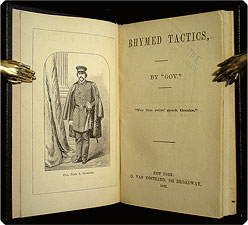
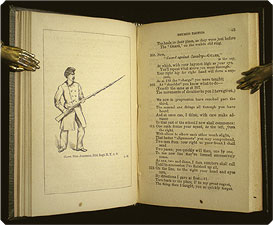
 Click the interior images for enlargements.
  Held in most of the expectable libraries but currently uncommon in commerce.
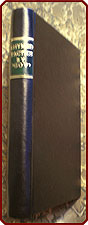
• Sabin 70769. Recent black moiré cloth, spine with gilt-stamped leather title-label. Title-page and several others rubber-stamped by a now-defunct institution. Pages clean.
 Reforming the Kingdom’s Finances Great
Britain. Parliament. A report from the commissioners
appointed to take, examine and state the publick accompts of the kingdom. [London]:
1703 [i.e., 1713]. 8vo (17.9 cm, 7.25"). [1] f., 104 pp.
Reforming the Kingdom’s Finances Great
Britain. Parliament. A report from the commissioners
appointed to take, examine and state the publick accompts of the kingdom. [London]:
1703 [i.e., 1713]. 8vo (17.9 cm, 7.25"). [1] f., 104 pp.
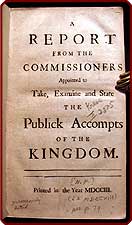
This is less dry than might seem, with notes being present as to which officials’ accountings were in revolting disarray, as to what bakers were scamming Navy purchasing officers, how much was spent on what at military hospitals—etc.
• ESTC T94705; Goldsmith’s-Kress 5055. 20th-century gray wrappers with title in blue ink on front wrapper. Wrappers with browning, fading, light soiling, a little shallow chipping, and a few shallow tears. Heavy pencilling on inside front wrapper and title-page. Pages with some shallow dog ears and traces of soiling. All edges speckled red.

He Never
Again Held OfficeGreat Britain. Parliament. House of Commons. Report from committee appointed to draw up articles of impeachment against Henry Lord Viscount Melville. [London, 1805]. Folio (32.5 cm, 12.75"). 11, [1 (blank)] pp.
Never
Again Held OfficeGreat Britain. Parliament. House of Commons. Report from committee appointed to draw up articles of impeachment against Henry Lord Viscount Melville. [London, 1805]. Folio (32.5 cm, 12.75"). 11, [1 (blank)] pp. 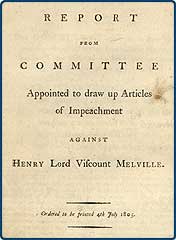
• NSTC ENG830. Removed from a nonce volume, now in a Mylar folder; sewing gone. Page edges slightly darkened, with occasional small edge chips; title-page dust-soiled. Two leaves with short tears from inner margins, just touching text on one leaf.
 Army ExpensesGreat Britain. War Office. Ireland. An account of the distribution of the sum of £.353,193.1.13/4. part of £.650,000. granted to his Majesty, to defray the extraordinary services of the army, in Ireland, for the year 1801. [London, 1802]. Folio (33 cm, 13"). 62 pp.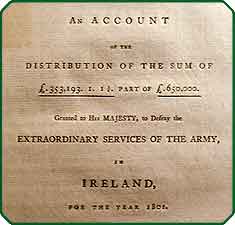
• Not in Goldsmiths’-Kress. Recent paper wrappers. Title-page with small section of offsetting from a now-absent laid-in item; a few pages stamped by a now-defunct institution.
A“TEXIAN” Survivor's Narrative — 13 Maps & Plates
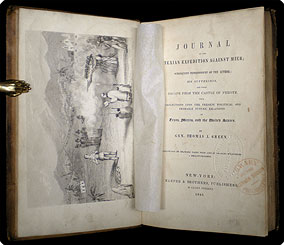
Green, Thomas Jefferson. Journal of the Texian expedition against Mier; subsequent imprisonment of the author; his sufferings, and final escape from the castle of Perote. With reflections upon the present political and probable future relations of Texas, Mexico, and the United States. New York: Harper & Brothers, 1845. 8vo (22.6 cm, 8.9"). Frontis., 487, [1] pp.; 10 plts., 2 maps (1 fold.).
 Click the images for enlargements.
 The volume is illustrated with a total of 13 steel-engraved plates, including a frontispiece and two maps, most taken from drawings done by Charles McLaughlin, “a fellow prisoner.”
• Howes G371; Sabin 28562; Streeter, Texas, 1581. Publisher's speckled sheep, spine with gilt-stamped leather title-label; worn and stained, spine head reinforced with dark cloth tape extending onto boards. Ex–social club library: 19th-century bookplate on front pastedown, call number on front endpapers, rubber- and pressure-stamps on title-page. Plates variously lightly waterstained; folding map of Rio Alcantra with outer half torn away and edge tattered. Pages with minor age-toning and occasional stains. (26394)
 "The
Military Service Publishing
Co." (1945)Greene, Graham. This gun for hire. Harrisburg,
Pa.: The Military Service Publishing Co., [1945]. Small 8vo. [6 (2 blank)],
216, [2 (blank)] pp.
"The
Military Service Publishing
Co." (1945)Greene, Graham. This gun for hire. Harrisburg,
Pa.: The Military Service Publishing Co., [1945]. Small 8vo. [6 (2 blank)],
216, [2 (blank)] pp.
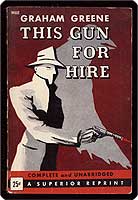
• Original wrappers, all edges stained red. Spine slightly cocked and lightly rubbed, covers with a little faint creasing. Mildly age-toned. No tears, internally clean. Very good. (7179)


Grotius on THE LAW of War & of the Sea, & on Natural Law Grotius, Hugo. Hugonis Grotii De jure belli ac pacis libri tres, in quibus jus naturae & gentium, item juris publici praecipua explicantur. Cum annotatis auctoris, ejusdemque dissertatione de Mari libero, ac Libello singulari de aequitate, indulgentia, & facilitate, nec non Joann. Frid. Gronovii v.c. notis in totum opus De jure belli ac pacis. Amstelaedami: Apud Janssonio-Waesbergios, 1720. 8vo (20 cm; 8"). Frontis., engr. title-page, [13] ff., xxxv, [1] pp., [2] ff., 483, [1] pp., [1] f., [483!]–936 pp.; 43, [1] pp., [42] ff.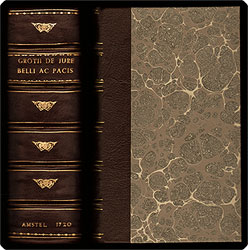
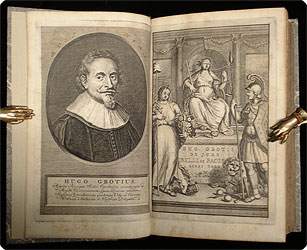
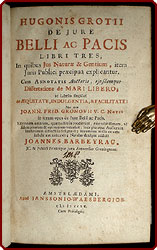 Click the images for enlargements.
 Grotius saw his book published for the first time in 1625 at Paris: It studies the legality of war and immediately established itself as a foundational work on the topic. Modern scholars regard it asfoundational in international law.
This edition contains added scholarship from Joannes Fredericus Gronovius (1611–71) and Jean Barbeyrac (1674–1744). In addition to De jure belli ac pacis the reader will find two other important Grotius tracts at the rear of the volume: Mare liberum and Libellus singularis de aequitate, indulgentia et facilitate, meaning the volume treats not just of law of war, but natural law, international law, maritime law, and law of the sea.
There are two issues of this edition, the other having “Ex Officina Wetsteniana” on the title-page in place of “Apud Janssonio-Waesbergio.” In both editions the title-page is printed in black and red, and of course, they have the same pagination. The work has side- and shouldernotes, an engraved portrait of Grotius, and an added engraved title-page.
• Meulen & Diermanse (1950 ed), Grotius, 602. Modern quarter claret-colored morocco with gilt-accented raised bands; gilt center device in each spine compartment. Marbled paper sides. Library pressure-stamps on title-page, no other markings; light age-toning and occasional spotting or foxing. A very nice copy with all edges decorated — more than “speckled,” not quite “marbled,” definitely attractive. (26526)
A
Radical
Republican's
CONTROVERSIAL
Civil War
Critique
Gurowski, Adam,
count. Diary, from March 4, 1861, to November 12, 1862 [and]
from November 18,1862, to October 18, 1863. Boston: Lee & Shepard; & New York: Carleton, 1862–64.
8vo (19.5 cm, 7.7"). 2 vols. I: [4], 315, [1 (blank)] pp. II: [4], [7]–348
pp.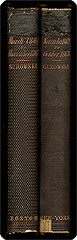
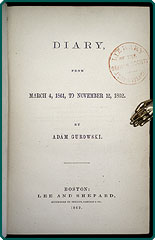
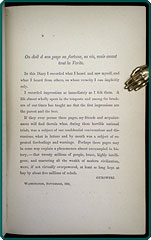 Click the images for enlargements.
 • Sabin 29319; Howes G465. Publishers' brown cloth very close in color but Boston's textured while New York's is smooth; covers framed in blind, spines with gilt-stamped author, title, and variant place information in parallel places and in typestyles not exactly matching but very close; corners rubbed, spine extremities chipped, spine heads with small strip of brown cloth tape, vol. I with binding very slightly cocked and cloth starting to split at front joint. Ex–social club library: call number on endpapers, rubber-stamp on title-pages and two others, no other markings. Front free endpaper of vol. I lacking. Pages slightly age-toned, otherwise clean and paper good. (26252)
Britain isLosing Her Lead!Hawker, Edward. The Navy. Letter to His Grace the Duke of Wellington, K.G., upon the actual crisis of the country in respect to the state of the Navy. By a flag officer. London: James Nisbet & Co., Hatchard & Son, and Simpkin, Marshall, & Co., 1838. 8vo (19.8 cm, 7.75"). 50 pp. 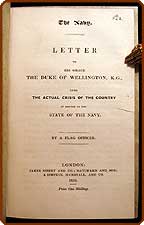
 Included herein is a summary of the state of the U.S. Navy at the time.
Uncommon: We trace only three U.S. library copies.
• NSTC 2H12871. Recent speckled brown wrappers. Lightly age-toned with traces of soiling. Inked numeral in margin of title-page.
An Attempt at Peace during the Wars of the Huguenots Henry III, King of France (1551–89). Edictum Henrici regis Galliæ de pace, nuper a typographo regio Lutetiæ editum cum priuilegio regis, è Gallico in Latinum sermonem fideliter conuersum. Inscriptio hæc suit: Edictum regis ad compositionem tumultuum huius regni pertinens. [Paris: Frédéric Morel], 1576. 4to (19.5 cm; 7.75"). [1] f., 38 pp.
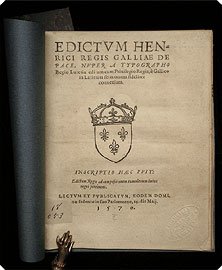
Click the image for an enlargement. WorldCat locates only three copies in North America.
• Lindsay & Neu 884; VD16 F2427. In modern wrappers. Small 19th-century library label on title-page. Pressure-stamp on title- and three other leaves; strip of heavy paper adhered to inner margin of last leaf. (3190)
Praising theWinter King Hermann, Zacharias. Huldigungspredigt Als Der Durchlauchtigste Grossmächtigste Fürst und Herr, Herr Friedrich König zu Böhmen, Pfaltzgraff beym Rhein und Churfürst ... zu Bresslaw/ den 27.Tag Februarii dieses 1620. Jahres die Huldigung empfangen. n der Kirchen zu S. Elisabeth gehalten. Bresslaw: Durch Georgium Bawman, 1620.
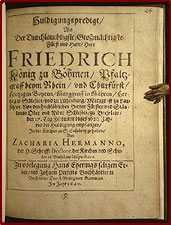
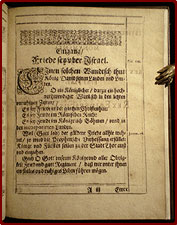
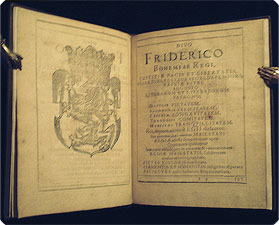 Click the interior images for enlargements.
 Uncommon: VD17 locates only four copies in Europe and OCLC locates no copies.
• Modern plain brown calf, old style. Very good copy. (22422)
The Amazon & Its “Aborigines” — 52 Lithographed PlatesHerndon,
William Lewis; & Gibbon, Lardner. Exploration of the valley
of the Amazon, made under direction ofthe
Navy Department.... Washington: Robert Armstrong, 1853, &
A.O.P. Nicholson, 1854. 8vo (23.2 cm, 9.1"). 2 vols. I: 414, [2], iii, [1]
pp.; 16 plts. II: x, [2], 339, [1] pp.; 36 plts.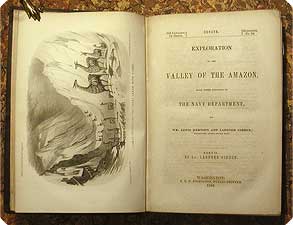
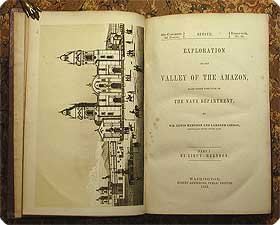 Click the images for enlargements.
 Many of the 52 lithographed plates are in duotone; some were done by Ackerman Lithography and some by P.S. Duval & Co., after views of scenery, buildings, and natives drawn by Lieut. Gibbon.
• Sabin 31524; Palau 113897. Publisher’s textured cloth, covers blind-stamped, spine with gilt-stamped title; vol. I with spine sunned and cloth chipped at spine extremities; vol. II with corners bumped, cloth peeling away from spine and chipped at spine extremities, spine with gilt dimmed and small area of unobtrusive discoloration from now-absent label. Front pastedowns each with pencilled owner’s name and institutional rubber stamp (no other markings); front free endpaper of vol. II starting to tear along inner margin. Mild to moderate foxing and spotting; a few text gatherings unopened. One plate in vol. I with short tear from outer margin, turning into a narrow scrape extending about halfway into the upper portion of the image; one leaf in vol. II with tiny portion (less than one word) affixed to opposing plate. Not a perfect set, but a perfectly fascinating one.
 For more SETS, click here.
First-Person
AMERICAN
Account of
the Boer WarSigned
by THE AUTHORS
Hiley, Alan Richard Illeigh, & John Arthur Hassell.
The mobile Boer being the record of the observations of two burgher officers. New York:
Grafton Press, (© 1902). 8vo (19.3 cm, 7.6"). Frontis., xvii, [1], 277, [5 (adv.)] pp.; 1 fold. map,
41 plts.
For more SETS, click here.
First-Person
AMERICAN
Account of
the Boer WarSigned
by THE AUTHORS
Hiley, Alan Richard Illeigh, & John Arthur Hassell.
The mobile Boer being the record of the observations of two burgher officers. New York:
Grafton Press, (© 1902). 8vo (19.3 cm, 7.6"). Frontis., xvii, [1], 277, [5 (adv.)] pp.; 1 fold. map,
41 plts.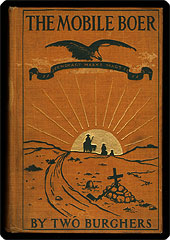
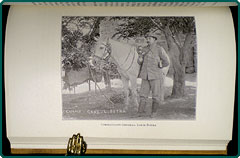
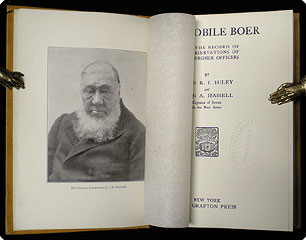 Click the images for enlargements. illustrated
with an oversized, color-printed map (affixed to the back pastedown) and with
a total of 42 plates, mostly photographic, including a frontispiece
portrait of Paul Kruger, president of the South African Republic (Transvaal).
Click the images for enlargements. illustrated
with an oversized, color-printed map (affixed to the back pastedown) and with
a total of 42 plates, mostly photographic, including a frontispiece
portrait of Paul Kruger, president of the South African Republic (Transvaal).
• Publisher's orange cloth, front cover pictorially stamped in green and gilt, spine with gilt-stamped title; edges and extremities lightly rubbed, sides with small areas of minor discoloration, spine sunned. Ex–social club library: call number in 19th-century hand on front pastedown, pressure-stamp on title-page, no other markings. Pages and plates clean and fresh. (26364)
A
Popular-at-Home History
of Virginia
Howison, Robert Reid. A history of Virginia, from its discovery and settlement by Europeans to the present time. Philadelphia: Carey & Hart. Richmond: Drinker & Morris; New York & London: Wiley & Putnam, 1846 & 1848. 8vo (23.3 cm, 9.2"). 2 vols. I: 496 pp. II: 528 pp.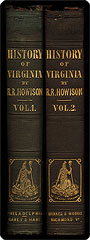

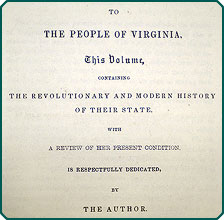 Click the images for enlargement.
 • Sabin 33370; Howes H739. Publisher's cloth, vol. I (now) olive and vol. II brown, covers blind-stamped, spines with gilt-stamped title and gilt-stamped seal of Virginia (“Sic semper tyrannis”); corners and spine extremities rubbed, sides with areas of light discoloration, endpapers darkened. Ex–social club library: 19th-century bookplate on front pastedowns, call number inked on front free endpaper of vol. I and front fly-leaf of vol. II, vol. II lacking front free endpaper. No other markings. Upper margins of vol. I with small areas of light waterstaining, extending to touch top lines of text at back of volume only; vol. II with similar light waterstaining never touching text. Vol. II with occasional lightly pencilled marginalia and marks of emphasis, many pertaining to the perceived value of the footnotes and references. (26452)
Advice to Guerrero on the Day He DeposedPres. Gomez Pedraza Ibar, Francisco. Hoy se echan los cimientos al templo de la paz; o, Felicitacion al segundo presidente. [colophon: Mexico: Impr. á cargo de T. Urbide y Alcalde, 1829]. Folio. [2] ff.
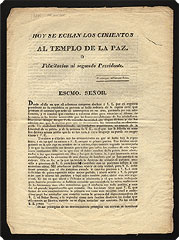
Click the image for an enlargement. Rare: We locate only the copy at the Bancroft Library.
• Folded, as issued. A slim wormtrack in the foremargin, not touching any text; one pin-type wormhole in the text touching or costing one letter on each page. Clean, a nice copy. (25814)
The
Surrender ofValladolid,
now, MORELIA
Iturbide,
Agustín de. [drop-title] Contestaciones
que precedieron a la capitulacion de la ciudad de Valladolid, entre los señores
coronels d. Agustin de Iturbide, y d. Luis Quintanar. [colophon: México:
en la oficina de Alejandro Valdes, 1821]. Small 4to (19.5 cm; 7.5"). 15, [1
(blank)] pp.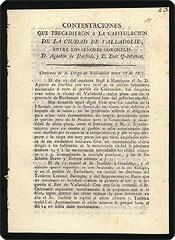 Click the image for an enlargement.
 Uncommon. We trace only three copies in the U.S.
• Garritz 4724; Sutro, Supplement, 145. Not in Medina, Mexico. Removed from a nonce volume. Very good condition. (24785)
Important
(Grey Side)
Civil
War Journal
Jones, John Beauchamp. A rebel war clerk's diary at the Confederate States capital. Philadelphia: J.B. Lippincott, 1866. 8vo (21 cm, 8.35"). 2 vols. I: 392 pp. II: 480 pp.
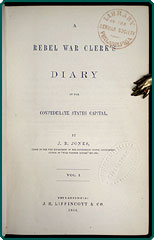
 Click the images for enlargements.
 A successful novelist and journalist, Jones was wholeheartedly loyal to the Confederacy, and convinced right up until the end that the North would never conquer a united, determined South; he was also notably anti-Semitic, and there are a number of references here to the Jews being largely responsible for the country's economic woes.
• Howes J220; Nevins I, 115 & II, 173. Publisher's brown cloth, spines with gilt-stamped title; sunned and with some discolorations; corners rubbed and spine heads pulled/chipped. Ex–social club library: front pastedown with inked numerals in a 19th-century hand (partially obscured), title-page pressure- and rubber-stamped, a few other pages rubber-stamped. Front free endpaper of vol. I lacking. Pages with light waterstaining to upper inner portions in vol. I One leaf in vol. II with tear extending into text, without loss. (26297)
Irish Insurgency — American Imprint & Provenance Jones, John, of Dublin. An impartial narrative of the most important engagements which took place between His Majesty's forces and the insurgents, during the Irish Rebellion, in 1798; including very interesting information not before published. Carefully collected from authentic letters. Second edition, with additions and corrections. South Newberlin, NY: Levi Harris, 1834. 12mo (18.3 cm, 7.2"). Frontis., 227, [1] pp.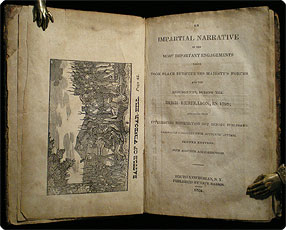
 Click
the interior image for an enlargement.
Click
the interior image for an enlargement.
Provenance: Inked inscriptions of James Mack of Windham, VT (1784–1860) on front free endpaper and rear fly-leaf. Although both inscriptions are dated 1840, one gives “Col. James Mack” and the other “Major James Mack.”
• American Imprints 25154. Contemporary treed sheep, spine with gilt-stamped leather title-label; joints, edges, and extremities rubbed, spine leather darkened and cracked, boards very slightly sprung. Inscriptions as above. Light to moderate age-toning and foxing, more pronounced to frontispiece and title-page. Now housed in a cloth clamshell case with gilt-stamped leather spine label. (25116)
First Edition — Uncut Copy Jones, John Paul. Life and correspondence of John Paul Jones, including his narrative of the campaign of the Liman. New York: Stereotyped by A. Chandler [pr. by D. Fanshaw], 1830. 8vo (25.7 cm, 9.9"). Frontis., 8, [13]–555, [1] pp.
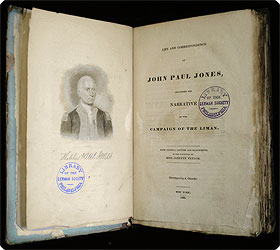 Click the images for enlargements.
 This is an uncut copy; uncut, however, though it may have been, this was carefully opened. It was read cover to cover!
• American Imprints 2078; Howes S91; Sabin 36551. Publisher's quarter brown cloth and light blue paper–covered sides, spine with printed paper label; binding rubbed and moderately stained, with front hinge (inside) reinforced some time ago. Ex–social club library: 19th-century bookplate, call number on endpaper, frontispiece, title-page, and last page rubber-stamped. Inside the occasional spot or blot; page edges uncut. (27106)
“Oh,
what terrible sights met my view!”
Kelly, Fanny. Narrative of my captivity among the Sioux
Indians. Hartford, CT: Mutual Publishing Co., 1871. 8vo. Frontis., 285, [1] pp., 11 plts.
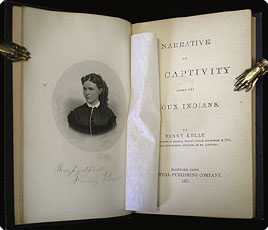 Click the images for enlargements.
 A later issue of the first edition, with a different title-page but printed from the same stereotype plates as the first edition, which was published in Cincinnati in 1871.
Provenance: “Presented by / D. Johnstone to his / son Washington. / Brantford Setp. 12 '77.”
• Howes K62; Newberry Library, Indian Captivities, 170; Graff 2296. Publisher's blue cloth, salmon endpapers, title in gilt on spine with top and bottom of spine pulled; blind-stamped image of an Indian within borders on each cover, covers spotted. Interior clean and with remarkably little foxing; indeed, this appears only (and minimally) to the frontispiece. (25972)
“I owe no apology to Your Grace . . .”Kinnaird, Charles, 8th Baron. A letter to the Duke of Wellington on the arrest of M. Marinet. London: Pr. [by Charles Wood] for James Ridgway, 1818. 8vo (18.8 cm, 7.375" ). [1] f., 40 pp.
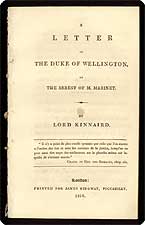 • Charles Kinnaird (1780–1826), a Scots peer and a Bonapartist,
was falsely implicated with a M. Marinet in an 1818 attempt to assassinate Wellington,
and he here defends himself and protests against the violation of Marinet’s
safe-conduct. Marinet was a protegé of Kinnaird’s who claimed to
be able to reveal details of an assassination plot against the Duke, it turning
out that he himself was likely the would-be assassin. This is the first of two
1818 editions.
• Charles Kinnaird (1780–1826), a Scots peer and a Bonapartist,
was falsely implicated with a M. Marinet in an 1818 attempt to assassinate Wellington,
and he here defends himself and protests against the violation of Marinet’s
safe-conduct. Marinet was a protegé of Kinnaird’s who claimed to
be able to reveal details of an assassination plot against the Duke, it turning
out that he himself was likely the would-be assassin. This is the first of two
1818 editions.
• NSTC 2K6435, Imprint 1. Removed from a nonce volume. A few light brown spots.
For
OVER 100 items of Scottish interest
offered
By anEye-Witness to the Action Knowles, Charles. An account of the expedition to Carthagena, with explanatory notes and observations. London: M. Cooper, 1743. 8vo (20 cm, 7.99"). [2] ff., 58 pp.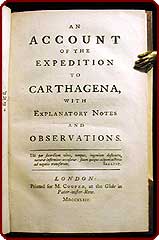
 Click the interior image for an enlargement.
 The Appendix here provides a fairly comprehensive exposition of the enemy's defensive position at the time of the English arrival, while the main body describes ship movements and land fortifications in detail.
• ESTC T18830; Sabin 11128; Alden & Landis 743/1. On Knowles, see: The Dictionary of National Biography. Recent half calf with paper-covered sides; spine with gilt-stamped title. A clean and very good copy. (24824)
The Smolensk War IsOverLas continuas vitorias que ha tenido el serenissimo, y potentissimo Vlasdilao Quarto Rey de Polonia, Sbecia, &c. Y las capitulaciones que admitò para la paz perpetua entre los Moscouitas, y su Reyno de Polonia en este año de 1634. [Seville, 1634]. Folio (28.2 cm, 11.1"). [2] ff. 
Click the image for an enlargement. • Palau 60707; not in Almirante. Removed from a nonce volume. Creased, with holes along creases causing loss of some letters; lower inner margins waterstained. Leaves trimmed closely, second leaf with first line lost and second line partially shaved.
Bohemian
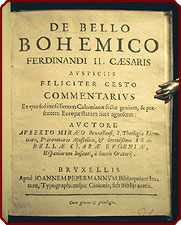
HistoryLe Mire, Aubert Miraeus. De bello Bohemico Ferdinandi II. caesaris auspiciis feliciter gesto commentarius ex quo seditiosissimum Caluinianae sectae genium, & praesentem Europae statum licet agnoscere .... Bruxellis: Ioannem Pepermannum, [colophon: 1621]. 4to (18.5 cm, 7.25"). (∴)6A–G4; [12], 44, [12] pp.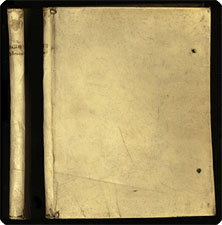
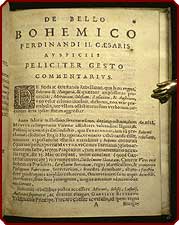 Click the interior images for enlargements.
 The printing privilege and the colophon of this edition both give the date 1621; a revised edition was printed in Cologne in 1622.
Very uncommon. Searches of OCLC, RLIN, and NUC Pre-1956 find no U.S. institutional holdings, and only one overseas location.
• Not in Brunet; not in STCV. Contemporary vellum, spine with hand-inked title; ties now lacking, back cover showing minor abrasions. Title-page with early inked inscription mostly shaved away from lower margin. Pages of different signatures variously browned or age-toned; clean.
Illustrated Admiration Life of General Scott. [New York?: 1852?]. 8vo. 32 pp.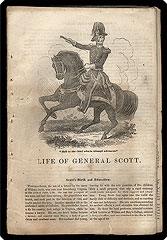
Click
the image for an enlargement.
• Sabin 78417. Stitched originally, but this now perished and leaves separating; irregularly trimmed, in the case of two leaves to touch text; some foxing/staining, and chipping. (26006)
Cortés Malinche & Montezuma López de Gómara, Francisco. Historia, di Don Ferdinando Cortes, marchese della Valle, capitano varlorosissimo. In Venetia: per Giouanni Bonadio, 1564. 8vo. [8], 354 of 356 ff. (lacking fol. 1 and final blank).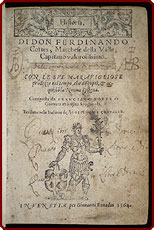
The Historia general de las Indias (first published in 1552) is divided into two parts which stand on their own although clearly written as two parts of a whole. Part I is a history of events concerning the discovery and conquests of the New World exclusive of those involving Cortés. Part II is entirely dedicated to the telling of Cortés's role in the conquest of Mexico and subsequent discoveries.
Click the images for enlargements. In this Italian translation from the pen of Agostino di Cravaliz, López's “all-Cortés” volume stands as part III of the three-volume Historia, delle nuove Indie Occidentali, with parts I and II being translations of Cieza de Leon's Historia, over Cronica del gran regno del Peru and the previously mentioned part I of Gómara's Historia general de las Indias.
The text here is printed in italic type except the capitals, which are roman. The title-page is printed in roman and italic and has the woodcut printer's device.
• Alden & Landis 564/25; Sabin 27741; Medina, BHA, 159n; Wagner, Spanish Southwest, 2v. 18th-century vellum over paste boards, soiled and a bit rubbed; red leather spine label, with a chip, and an old circular paper shelf-label. Title-page dust-soiled, mounted; small, narrow, oblong portion of blank area of title-page excised and filled in at an early time. Lacks folio 1 and final blank. Top margins closely trimmed, sometimes costing the running heads and folio numbers. (25767)
EarlyENGLISH
TranslationLucanus,
Marcus Annaeus [Lucan]. Lvcans Pharsalia: Or the civill warres of Rome,
betweene Pompey the great, and Ivlivs Cæsar. The whole tenne bookes, Englished
by Thomas May...the second edition, corrected, and the annotations inlarged by
the author. London: Thomas Iones (pr. by Aug. Mathews), 1631. 8vo (14.5 cm,
5.75"). π1a8A–S8T2; engr.
frontis., [146] ff. [with] May, Thomas. A continvation of the subiect of Lucan’s historicall poem
till the death of Ivlivs Cæser the 2d edition corrected and amended. London:
James Boler, 1633. 8vo. A–K8(-K8); [79 of 80] ff.
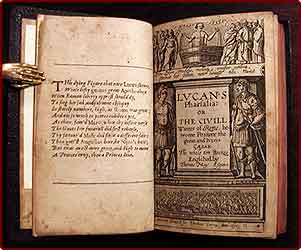
The editio princeps of the Pharsalia was printed in Rome by Sweynheym and Pannartz in 1469; Christopher Marlowe published the first English translation of any part of the Pharsalia, his rendition of the first book, in 1600, with a 1614 effort by Sir Arthur Gorges being the only other such to precede May’s standard-setting 1626 English version of books one through three.
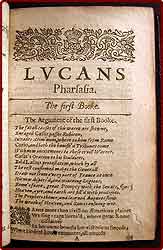 In
the present volume, this great epic poem in May’s translation is
accompanied by its translator’s English rendition of his own sequel,
originally written in Latin verse. This Continuation advances the
action through Cleopatra’s seduction of Caesar (May depicts the Egyptian
queen with “snowie necke” and “golden tresses”),
the death of Cato, and various additional battles before arriving at Caesar’s
death. At the time, May’s work was thought highly enough of that Charles
I allowed the Continuation’s dedication to bear his name.
In
the present volume, this great epic poem in May’s translation is
accompanied by its translator’s English rendition of his own sequel,
originally written in Latin verse. This Continuation advances the
action through Cleopatra’s seduction of Caesar (May depicts the Egyptian
queen with “snowie necke” and “golden tresses”),
the death of Cato, and various additional battles before arriving at Caesar’s
death. At the time, May’s work was thought highly enough of that Charles
I allowed the Continuation’s dedication to bear his name.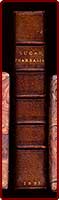
• Pharsalia: STC 16888; Schweiger, II, 567; ESTC
S108868. Continuation: STC 17712; ESTC S108892. 20th-century
black morocco in imitation of early, severe style, with raised bands from
which blind-tooling extends onto covers; spine with gilt-stamped title and
date, and turn-ins elaborately tooled in blind. Moderately worn, spine faded
not unattractively, and leather rubbed over joints. Front pastedown with
bookplate, inked date of 1986; front free endpaper with inked gift inscription
dated
1944. T1-2 trimmed differently and possibly surviving from another copy;
A3 of the continuation also possibly supplied. Occasional instances of very
minor staining; mostly clean. Pleasant
on shelf and in hand.
 TO Part
III TO Part
III |