 MANUSCRITOS

 For our NON-HISPANIC MSS: Click here.
MANUSCRITOS
For our NON-HISPANIC MSS: Click here.
For our NON-HISPANIC MSS: Click here.
MANUSCRITOS
For our NON-HISPANIC MSS: Click here.
 Partial
Payment for
Her Majesty's
Partial
Payment for
Her Majesty's Tapestry
 Isabel
I, Queen of Spain.
Document on paper, in Spanish, signed "Yo la Reyna." Granada,
8 May 1501. Folio (31.2 cm, 12.25"). [1] p.
Isabel
I, Queen of Spain.
Document on paper, in Spanish, signed "Yo la Reyna." Granada,
8 May 1501. Folio (31.2 cm, 12.25"). [1] p. 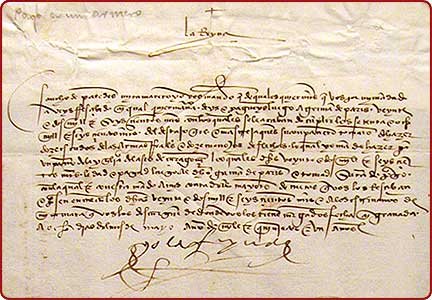
On the bottom half is a signed receipt, in Spanish, dated Granada 8 May 1501, wherein Germán de Paris and Jacques acknowledge receiving the above mentioned payment.
• The usual slash of cancellation (faintly visible above), indicating that this has been entered into the account books. Remnant of stiff paper at top of verso indicating it was once mounted in an album.
 A Patron of the Art
of Printing (on
PROPERTY)
Lorenzana,
Francisco Antonio de. Letter Signed,
in Spanish, on paper, to Marcos Argaiz. Toledo: 19 February 1784. Small 4to
(20.5 cm; 8"). 4 pp.
A Patron of the Art
of Printing (on
PROPERTY)
Lorenzana,
Francisco Antonio de. Letter Signed,
in Spanish, on paper, to Marcos Argaiz. Toledo: 19 February 1784. Small 4to
(20.5 cm; 8"). 4 pp.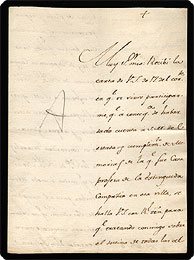
 Click the image for an enlargement.
 Lorenzana's interests in printing and history were magisterially combined in his editions of the Cortes letters, the Mozarabic Mass, and the accounts of the first three Mexican concilia.
• Very good condition. (27069)
 For
ART REFERENCE, click here.
For
ART REFERENCE, click here.

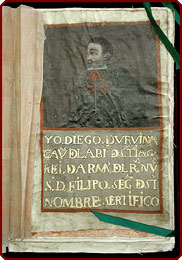
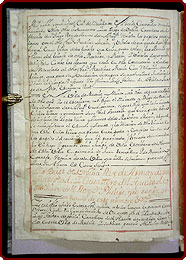
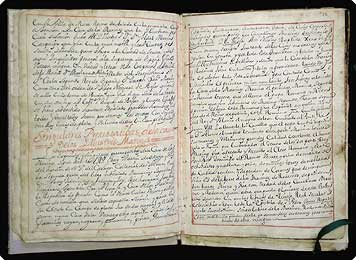
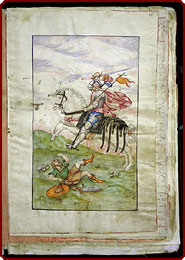
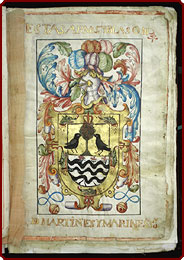
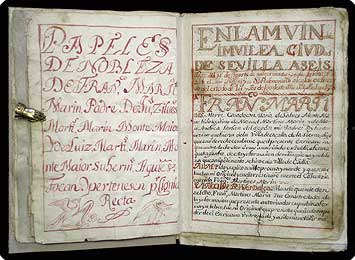
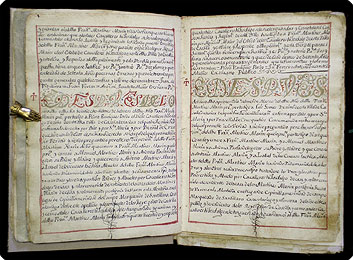
Mexican Hidalgo — Meaty Matter — Vivid Full-Page PaintingsMEXICAN Binding Available for Analysis Martínez, Marín, Montemayor, & Almonazi families. Manuscript carta confirmatoria de hidalguía. On paper and vellum. Madrid, Seville, Puebla, Mexico: ca. 1583–1706. Folio. Ca. 170 folios.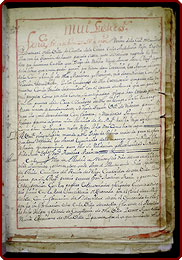
 Click the images for enlargements.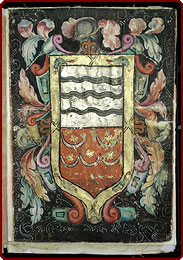
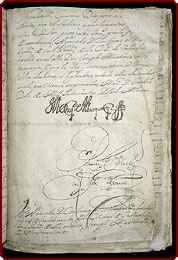
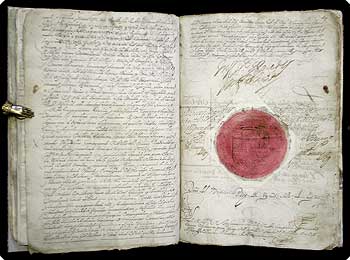
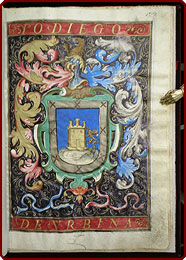
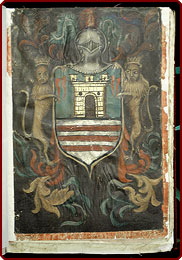
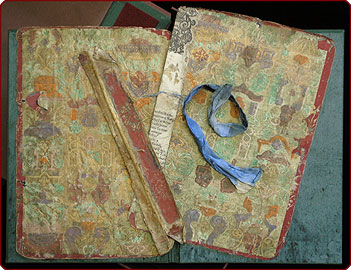 signed by Viceroy Albuquerque in his own large, distinctive hand, and a third document confirming an appointment of the Alferez Silvestre Martínez de Montemayor is signed by the Marques de la Laguna (i.e., the viceroy in 1685).
The Six Illustrations: Four full-page, full-color, illuminated coats of arms on vellum of the Marín, Martínez, Almonazir, and Montemayor families; a full-page full-color miniature of a Martínez on horseback slaying a Moor (a strangely garbed Moor, but by his curved sword a Moor nonetheless), and a half-page portrait of Diego de Urbina, the king of arms under Felipe II, with his name and title illumined below. Salmon silk guards are present for several of these.
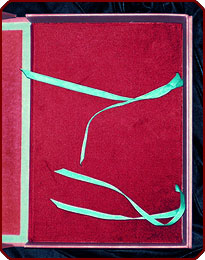
• New binding in traditional style as above, with green ribbon ties, in a clamshell box; elements of original binding preserved in box compartment. Some text leaves torn with loss of text at outer margin, leaves repaired; one vellum leaf with top half excised and a neighboring paper one with its bottom half taken. Otherwise, only some few tears, none serious.  A production and survival both treasurable and studyable. (25787)

 Fishy Tale ofTax
Collecting Mendez Chavez, Diego. Manuscript file of approximately 90 original and contemporary copies of documents, and one printed royal decree. In Spanish, on paper. Madrid, 12 June 1637 – 19 Januay 1650. Folio, 184 pp.
Fishy Tale ofTax
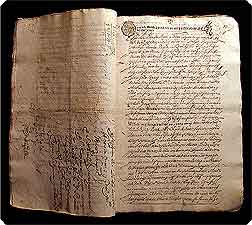
Collecting Mendez Chavez, Diego. Manuscript file of approximately 90 original and contemporary copies of documents, and one printed royal decree. In Spanish, on paper. Madrid, 12 June 1637 – 19 Januay 1650. Folio, 184 pp.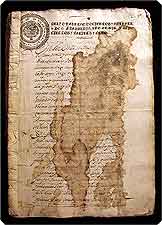
 Single-click
any image of this, for an enlargement.
Single-click
any image of this, for an enlargement.
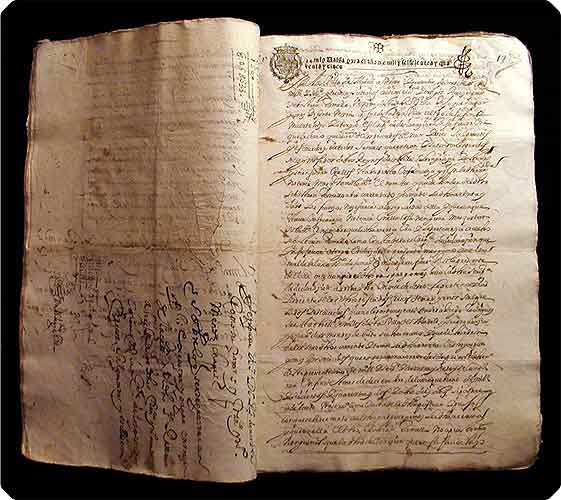
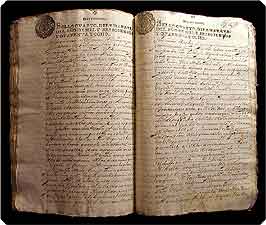
In 1637 Diego Mendez Chavez was the successful bidder for the ten-year right to collect the royal tax on fresh and salted fish (with a few types of fish, doubtless already assigned to others, excepted). This compilation of documents relates to Mendez Chavez’s travails in collecting the tax and paying his monthly stipend.
An interesting and complicated file of primary economic data during Spain’s century of decline.
• Good/Good+ condition. Sewn. Written in several hands, all notarial in style. First 10 leaves with stain from water having spilled on the cahier; only the first leaf is affected to the extent of making reading difficult (but NOT impossible). Some tattering to edges of final three leaves.
For
more COMMERCE / TRADE / For
a FISHING item or
Daily Business Life — International! New Orleans 1831 Moctezuma, A.M. Autograph Letter Signed, to Francisco Pizarro Martínez. In Spanish, on paper. New Orleans: 22 October 1831. Small 4to (25 cm x 10"). [1] p. with integral address leaf; and [2] p. translation into English, ca. 1837.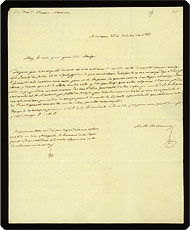
Click the image for enlargement. • Very good condition. Written in a small but clear hand. (24650)

 Supreme Court Documents
Olañeta, Casimiro. Five MS. Letters Signed, to the Secretary of State at the Office of Justice. Sucre, 11 March – 12 May 1858. On paper, in Spanish. Folio, 8 pp.
Supreme Court Documents
Olañeta, Casimiro. Five MS. Letters Signed, to the Secretary of State at the Office of Justice. Sucre, 11 March – 12 May 1858. On paper, in Spanish. Folio, 8 pp.
The Court had just come through a period during which a military ruler had systematically dismantled the courts and undercut their authority and dignity. Olañeta had assumed his presidency only days before the first document in the collection was penned.
• Very good condition. A few small tears at folds.
For
more FOR ANDEANISTS, click here.
 A Woman & Her WoesOriguela, Elvira de, & others. Manuscript documents. On paper, in Spanish. Los Reyes [i.e., Lima], Peru, and Seville, Spain, 23 April 1620 – 26 November 1662. 4 cahiers. Folio (31.5 cm; 12.5"). 7, [1 (blank)] ff; 5, [1 (blank)] ff.; 12 ff.; 16, [4 (blank)] ff.
• Sewn. All four in very good condition.
Franciscan Missions Among the Indians of Querétaro Pérez de Mesquía, Pedro. Manuscript, untitled, in Spanish, on paper. [Mexico: 1744]. Small 4to. [4] pp.

 In sum, a great snapshot of missionary activity in a specific place at a known time. Listed missions include Santiago de Jalapa, Luz de Tancoyol, Purísima Concepción de Landa, Francisco de Tilaco, and San Miguel Concá el Viejo.
• Written in a clear ecclesiastical hand. Very good condition. (25816)
A Cryptic Royal Appointment Philip II, King of Spain. Letter signed to Vicente Frigola Virreyes, in Spanish, on paper. Pardo: 3 November 1591. Folio (30 cm; 12.875"). 1 p. Click
the image for an enlargement.
Click
the image for an enlargement.
• Written in a clear court hand. Paper browned, with several large holes: one hole costing three words of text, another touching the flourish of the king’s signature, and the third taking part of the name of a notary; some “lace action” of the iron gall ink of the king's signature, with resultant loss of portions of it. Priced accordingly. (27068)


“You
will Stop Disinheriting
the Indians!”
Philip IV, King of Spain. Manuscript Signed (“Yo El Rey”). In Spanish, on paper. Madrid: 20 June 1628. Folio (30.3 cm; 11.875"). [1] p. 
The king orders the bishops of the New World to see that the practice is ended.
This copy sent to the bishop of Guadalajara, Mexico.
• Light waterstaining; one short fold tear and a small hole piercing the top line of text without loss of sense. Written in a small and legible hand. (25890)
The Pope Appointsa New Grand Inquisitor for Spain Pope Paul V (1552–1621; pontificate 1605–21). Letter to King Philip III of Spain, in Latin, on vellum. Rome: 4 January 1619. Narrow strip (10 x 40.5 cm; 4" x 16"). [1] leaf. Click the image for enlargement.
 This contemporary file copy was retained in Rome and signed “S. Card. S. Susannae” (i.e., Cardinal Scipione Cobelluzzi, who was also at this time the Librarian of the Vatican Library).
• Written in a very handsome italic on very good quality vellum. Light discoloration along lower edge, below the writing. (26978)
Dominican Missions inCalifornia Quiñones, Baltasar de. Autograph Letter Signed in Spanish to Fray Ignacio Gentil. Rome: 7 April 1789. Tall 8vo (26.5 cm; 10.5"). [2] pp., with integral address leaf.
 Click the images for enlargements.
 The main question at hand is the appointing of a new attorney/solicitor (i.e., procurador) for the California missions. He says, “quiero que ahora y siempre que ocurra [la necesidad de un nuevo procurador], se haga el nombramiento por la Provincia misma despues de haber oido al Presidente de las Misiones, el cual es mi voluntad que en cuanto sea posible camine con acuerdo de la mayor parte a lo menos de los demas misioneros, antes de hacer su propuesta a la Prov[inci]a.”
He also makes appointments to the positions of “Depositarios del Deposito” and the names of the four appointees are given.
• Written in a clear large hand and with the paper and wax closure in evidence. (25329)
For more PRE-1820 AMERICANA, click here. For more of CALIFORNIA interest, click here. For more CATHOLICA, click here. For EUROPEAN (Heritage!) This also appears in the HISPANIC
 TO Part
V . . . TO Part
V . . . |