
 MANUSCRITOS

 For our NON-HISPANIC MSS: Click here.
MANUSCRITOS
For our NON-HISPANIC MSS: Click here.
For our NON-HISPANIC MSS: Click here.
MANUSCRITOS
For our NON-HISPANIC MSS: Click here.
 This Very Famous Conqueror of Mexico
 SIGNED
 Díaz del Castillo, Bernal. Document Signed ("Bernal Díaz"). Santiago de Guatemala, 24 July 1556. Folio, 2 1/2 pp.
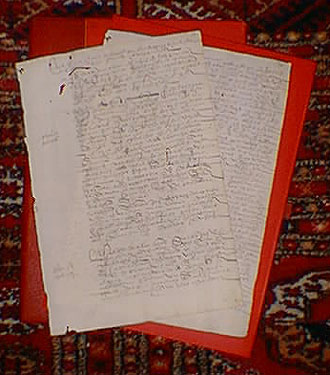
The document we here offer is a cabildo (i.e., town council) act. Bernal Díaz served as a member of the cabildo of Santiago de Guatemala for a number of years, an honor bestowed on him as a conqueror and early settler of the region. In this document the cabildo acknowledges receipt of a royal decree, reads it verbatim into its minutes, and formally agrees to comply. The king writes that he is informed that the post of notary public and "del número" in Santiago is vacant because Juan Núñez de Soria, who held the royal appointment to that position, "is gone to Our kingdoms of Peru." On the advice of the Royal Audiencia (i.e., High Court) the king appoints Juan de Rojas to be notary public and "del número."
• The document is housed in a red half morocco slipcase with an internal corset. Six small wormholes in each leaf affect one or two letters each, but not the signature of Bernal Díaz.
MEXICO is
one of our great specialties.
 Troublesome Deserters(Discipline — Military). Manuscript
documents. On paper, in Spanish. Nueva Guatemala, 1778–91. Folio. [16]
ff.
Troublesome Deserters(Discipline — Military). Manuscript
documents. On paper, in Spanish. Nueva Guatemala, 1778–91. Folio. [16]
ff. 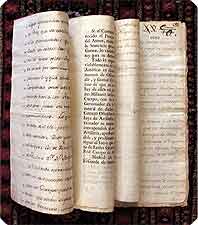
• Very good condition. Sewn.
For
more of MILITARY/NAVAL interest, click
here. This
also appears in the HISPANIC
This
also appears in the HISPANIC

Comunero Revolt Echauri, Martín José. Document Signed. In Spanish, on paper. San Miguel (Argentina): 14 May 1735. Folio (31 cm x 12.25"). [1] p.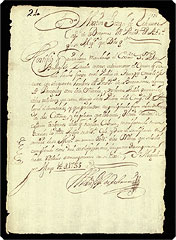
 Click the image for an enlargement.
 The Comunero Revolt in Argentina (ca. 1723–35) was a prolonged episode of uprising against the colonial government by residents in northeastern Argentina (Corrientes) and an adjacent part of Paraguay who felt marginalized by the Jesuit domination of the Guarani Indian labor pool and the Society of Jesus’s near monopoly of the yerba mate and tobacco trade with Buenos Aires.
• Very good condition. Margins a little irregular; paper a little rumpled. Written in a clear, easy to read hand. (24647)
For more SOUTH AMERICANA, click here. For more of NATIVE AMERICAN interest, click here. For more of MILITARY/NAVAL For more COMMERCE / TRADE /For more JESUITANA, click here. For more MANUSCRIPTS, click here. This also appears in the HISPANIC & it appears in the GENERAL
Masses,
Lands, &
Messuages —(Endowed chaplaincy).
Dossier of original and certified copies of documents, on paper in Spanish.
Tehuacán, Mexico; Puebla, and elsewhere, 1747–1858. About 200 ff.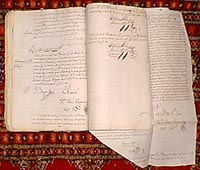
This is the file relating to that chaplaincy and its various holders during the first 100 years of its existence. It also contains a detailed listing of the lands and messuages of the hacienda and their value as of March 1748, and a certain amount of information about the development of the hacienda in the years prior to 1748.
• Sewn, dusty, tattered, incomplete at end. Written in a variety of easy-to-read hands. Some tears. Now housed in a simple phase box.
For
more CATHOLICA, click here.
 Chile, 1593 — A
 Woman Presses Her CaseEscobedo, Francisca de. Two documents signed. In Spanish, on paper. Santiago, Chile, 7 January 1593. Folio, [2] pp.
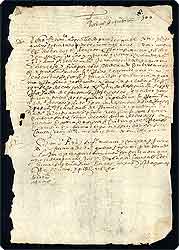
Click the image to the left • Written in a small notarial hand and slightly difficult to read. All edges tattered with some loss of paper and of an occasional word or end of word, not impairing sense.
For more of WOMEN's interest, click here. For more SOUTH AMERICANA, click here. This also appears in the HISPANIC
 He Survived “La Noche Triste” & Much, Much More
 THE
CONQUEROR'S REWARD
THE
CONQUEROR'S REWARD
 Felipe II, King of Spain. Illuminated Document Signed (on his behalf by his sister/regent, “La Princesa”). In Spanish, on vellum. Valladolid, 17 March 1559. Folio (58 x 54.5 cm; 23" x 21.5"; h x w), 1 leaf.
  |
|
|
|
|
|
|
|
|
|
|
|
|
|
|
|
 |
| ||||||||||||||
 |
 |
 |
 |
 |
 |
 |
|
||||||||
 |
| ||||||||||||||
 |
| ||||||||||||||
 |
 |
| |||||||||||||
 |
 |
| |||||||||||||
 |
 |
| |||||||||||||
 |
 |
| |||||||||||||
 |
| ||||||||||||||
 |
 |
 |
 |
| |||||||||||
 |
 |
 |
 |
| |||||||||||
 |
| ||||||||||||||
 |
 |
| |||||||||||||
 |
 |
| |||||||||||||
 |
| ||||||||||||||
 |
 |
| |||||||||||||
 |
 |
| |||||||||||||
 |
| ||||||||||||||
 |
| ||||||||||||||
 |
| ||||||||||||||
 Move your mouse over the document above, and click,
to select and view details.
 Villanueva was among the small but grand “army” that marched into Tenochtitlán in the Spring of 1520 and in July of the same year were to flee the western world's largest city fighting for their lives, on the “Noche Triste.” He survived the hell and slaughter of the causeways and later returned with the greatly augmented force that destroyed the Aztec capital and its empire. Still later he was with Cortés in the exploration and conquest of Pánuco and following that with Nuño de Guzmán in the exploration and conquest of Zacatecas and Jalisco. He and his brother Fernando (also a member of the Saucedo contingent) jointly received an encomienda (Quechula) and settled in Puebla de los Angeles where Pedro served as a regidor on the town council in the 1540s and 1550s.

 The text of the grant of arms is elegantly
indited in a standard court semi-round gothic in sepia ink and is enclosed
on the left, right, and top sides by an illuminated and historiated sash-like
border. In the upper left and right corners are miniatures of Justice
and Knowledge in sylvan settings. Running between those two along the
top of the document is a decorative panel incorporating flowers, fruits, mythic
animals, and cherubs. Below this, the king's name is accomplished in
large letters of gold on a field of red accented with gold, and the “D”
of his honorific “Don” is given special treatment. This
is elaborated in an ornate, almost baroque style that comes close to obfuscating
the fact of its being a majuscule “d”: Wrought in gold,
the letter at first appears to be merely a “frame” for the royal
coat of arms that fills its center. The king's arms are accomplished
in gold, white, black, red, and blue; the whole being laid on a blue field
with white accents.
The text of the grant of arms is elegantly
indited in a standard court semi-round gothic in sepia ink and is enclosed
on the left, right, and top sides by an illuminated and historiated sash-like
border. In the upper left and right corners are miniatures of Justice
and Knowledge in sylvan settings. Running between those two along the
top of the document is a decorative panel incorporating flowers, fruits, mythic
animals, and cherubs. Below this, the king's name is accomplished in
large letters of gold on a field of red accented with gold, and the “D”
of his honorific “Don” is given special treatment. This
is elaborated in an ornate, almost baroque style that comes close to obfuscating
the fact of its being a majuscule “d”: Wrought in gold,
the letter at first appears to be merely a “frame” for the royal
coat of arms that fills its center. The king's arms are accomplished
in gold, white, black, red, and blue; the whole being laid on a blue field
with white accents.

The panels running down the left and right
sides of the document are accomplished in red, gold, green, pink, white, red,
blue, and brown, many in several shades. The decoration includes birds
of several varieties including a fine owl, animals including a watchful rabbit,
strawberries and other fruits, and flowers, ribbons, grotesques, and butterflies.

The document is signed in the king's name by Juana (Joanna Habsburg) de Austria, “princesa de Portugal.” Married to Prince Juan of Portugal, young Juana (b. 1537) was the regent of the Spanish crown from 1554 until her brother Philip's return to Spain in September of 1559. She had just lost her husband to death and borne his posthumous son, both in January, 1554, when she left Portugal and her child in the Spring of that year to assume the regency throne in Valladolid.

 In
format and content this document differs dramatically from the cartas executorias
de hidalguía that most collectors are familiar with. Here we have a
In
format and content this document differs dramatically from the cartas executorias
de hidalguía that most collectors are familiar with. Here we have a  single large sheet
of vellum handsomely engrossed, artfully illuminated, and exquisitely decorated
with a composite border containing miniatures. This is not a bound volume
of copies of documents created for storage in the family archive.
single large sheet
of vellum handsomely engrossed, artfully illuminated, and exquisitely decorated
with a composite border containing miniatures. This is not a bound volume
of copies of documents created for storage in the family archive.  This
was created for display in a prominent place of honor; and it is a magnificent
display item. This is not a grant of nobility nor
a confirmation of it based on something that some vague ancestor did; rather
it is a grant of a coat of arms to a man who himself performed significant
military and other service for the Crown and whom the Crown wishes to honor
both publicly and privately. Only a few hundred of Cortés's men
survived the Noche Triste, the reentry into and destruction of Mexico
City, and the subsequent conquests in Panuco and elsewhere. The number
of grants such as this to actual members of Cortés's original “army”
were few.
This
was created for display in a prominent place of honor; and it is a magnificent
display item. This is not a grant of nobility nor
a confirmation of it based on something that some vague ancestor did; rather
it is a grant of a coat of arms to a man who himself performed significant
military and other service for the Crown and whom the Crown wishes to honor
both publicly and privately. Only a few hundred of Cortés's men
survived the Noche Triste, the reentry into and destruction of Mexico
City, and the subsequent conquests in Panuco and elsewhere. The number
of grants such as this to actual members of Cortés's original “army”
were few.
 And surviving grants to those actual participants in the Conquest are extremely
rare, even more so in commerce. This
is the only royal grant of a coat of arms to an actual member of Cortés's
“army” that we have seen that has ever appeared in the marketplace.
Via published auction records and our extensive archive of dealer catalogues,
we trace no instance before this one of the offering for sale of a grant of
arms to a Conqueror of Mexico. Yes, there are examples in various libraries
and museums in Mexico and Spain, and probably in the U.S., but such examples
seem to have entered their institutional resting places via donation from
descendants of Conquerors, not via purchase.
And surviving grants to those actual participants in the Conquest are extremely
rare, even more so in commerce. This
is the only royal grant of a coat of arms to an actual member of Cortés's
“army” that we have seen that has ever appeared in the marketplace.
Via published auction records and our extensive archive of dealer catalogues,
we trace no instance before this one of the offering for sale of a grant of
arms to a Conqueror of Mexico. Yes, there are examples in various libraries
and museums in Mexico and Spain, and probably in the U.S., but such examples
seem to have entered their institutional resting places via donation from
descendants of Conquerors, not via purchase.

Provenance: It
is awesome to realize that this is no mere retained secretarial copy of Felipe's
grant of arms to Pedro de Villanueva. This gorgeous document not only
records the king's rewards to one of Cortés's men, but was that Conqueror's
personal property. It is the copy of the decree sent to him expressly,
by the Crown!

• On Villanueva, see: Icaza, Diccionario autobiográfico
de conquistadores y pobladores de la Nueva España, I, 88–89;
Thomas, Who's Who of the Conquistadors, 146; Himmerich y Valencia,
The Encomenderos of New Spain, 1521–1555, 262; Díaz
del Castillo, Verdadera historia de la conquista de la Nueva España,
chap. LIII. On Juana de Austria, see: the work of Dr. Kelli Ringhofer.
Overall in very good condition. Some fold tears, some minor rubbing
of small areas of images, stains as visible in our illustrations. The
wax seal and its silk cords no longer present.  Text
clear, not faded, and colors strong.
Text
clear, not faded, and colors strong.
 To review the pictures of this document more systematically than


The
King Aids a WidowFernando
VII, King of Spain. Document
Signed (“Yo El Rey”), on paper, in Spanish. “En Palacio”
[i.e., Madrid], 1 March 1815. Folio (29.8 cm, 12.75"), 4 pp.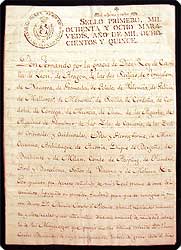
• Written in a very clear hand, with the paper and wax seal below the king’s signature (wax desicated and paper loose, but present). Two blank leaves at end. Very good condition.
For
more of WOMEN's interest, click here.
17th-Century Spanish America from
anEnglishman’s
PerspectiveGage, Thomas. Manuscript on paper, in English. [New Survey of the West Indies]. Philadelphia?, mid 19th-century? 8vo (18.8 cm, 7.375"). [3 (blank)], [81], [1 (blank)] ff. 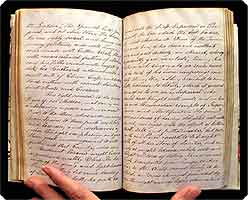
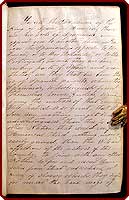 Single-click
either image for an enlargement.
Single-click
either image for an enlargement.
• On Gage, see: The Dictionary of National Biography,
XX, 353–55. Recent marbled paper over light boards. Second and third
blank leaves pasted together. Some light soiling, and some chipping and tears
without apparent loss of text. Rubber-stamps from a now-defunct library.  The
paper here is decidedly blue; the hand is very readable.
The
paper here is decidedly blue; the hand is very readable.
For
our MSS in ENGLISH: Click here. Or for VOYAGES,
TRAVELS, & books on"EXOTIC" PLACES, click
here.
 The
King &
the High Court
of Guatemala — A Manuscript(Guatemala, Audiencia of). An unpublished collection of 56 royal decrees signed by Felipe III (some with a stamp) to the Royal Audiencia of Guatemala. Valladolid, Madrid, San Lorenzo, etc., 18 May 1600 - 15 June 1628. Folio. 100 ff. (some blank).
The
King &
the High Court
of Guatemala — A Manuscript(Guatemala, Audiencia of). An unpublished collection of 56 royal decrees signed by Felipe III (some with a stamp) to the Royal Audiencia of Guatemala. Valladolid, Madrid, San Lorenzo, etc., 18 May 1600 - 15 June 1628. Folio. 100 ff. (some blank).
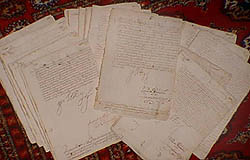
The first audiencia was established in Santo Domingo in 1508 with others springing up as the Spaniards discovered and settled North and South America. The Audiencia of Guatemala came into existence on 20 November 1542 through the New Laws and had a troubled and peripatetic beginning: The documents that compose this collection do not deal with things quite as dramatic as either the judicial insanity or the big-time smuggling of those earliest years, but they do, nonetheless, document various unstudied aspects of the presidencies of Dr. Alonso Criado de Castilla (1598-1611), Don Antonio Pérez Ayala Castilla y Rojas (1611-26), and Dr. Diego de Acuña (1626-33). The royal cedulas fall into three broad categories: requests for information, demands for action, and orders ending existing practices.
An example of the Crown's requests for information is a decree of 4 December 1601. The king would sometimes receive complaints that were best handled extrajudicially, often involving political activities of clerics, over whom the civil and criminal courts did not have jurisdiction and with whom, the authorities felt, the ecclesiastical courts would deal ineffectively. In one case, the governor of Honduras had complained to the king that the dean of the church in Comayagua was disrupting attempts to recruit men for the defense of the port of Trujillo: The king, investigating, expects that the audiencia's information will be unbiased because of its physical and emotional distance from Honduras and its local politics and squabbling.
Another, much more ominous, request was handed down on 28 June 1621. The king has "discovered" that "foreigners" are living in the New World. Since they are there illegally, he wants a list of them and correlated inventories of their possessions and land holdings. This was the beginning of the oppression of Portuguese settlers who had moved to the New World during the "Babylonian captivity" of Portugal by Spain.
The royal demands for action were usually grants of royal patronage or largesse. On 10 July 1600 the king orders the audiencia to administer the terms of his decree granting a one-time-only gift of money to the cathedral in Santiago, and on 4 July 1601 he orders the court to give the mission church in Trinidad de Sonsonate a chalice and a bell.
The Crown was fully aware that the physical distance between it and its New World provinces would result in the development of local customs and practices, and to a l arge extent it tolerated these deviations from "the norm." For example, on 31 May 1600, Felipe III officially accepts the local custom of the audiencia's appointing the majordomo of the Royal Hospital. But at other times the Crown felt put upon and ordered the end of "local practices." On 12 December 1619 the king orders the audiencia to stop subdividing encomiendas and parcelling the subsections out as parts of government pensions.
The documents in this remarkable collection are unpublished.
They are an important unused source for the history of the high court during the first quarter of the 17th century. Through them we find out what the "local customs" of patronage and of usurpation of royal prerogative were. Through the reiteration of previously issued decrees we discover which decrees the court was ignoring, using the famous doctrine of "obedezco pero no cumplo." Through these decrees we glimpse royal patronage and royal displeasure.
• Clarence H. Haring, The Spanish Empire in America, pp. 126, 75-76, and 113-14; Murdo J. MacLeod, Spanish Central America, pp. 390-91, on the audiencia's earliest years. The decrees have been very carefully removed from a bound volume and, now stored in Mylar sleeves, are housed in a blue cloth slipcase with blue morocco spine labels. This major source for the study of the Royal Audiencia of Guatemala is in very good condition.
 For details, please e-mail us.
For
a collection of COLLECTIONS, click here.

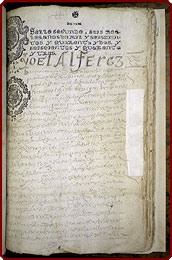
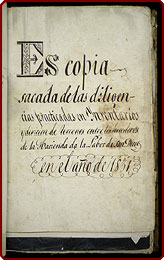
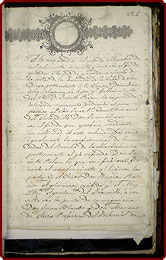
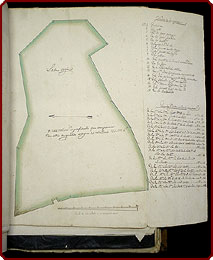
The Growth of a Great Estate — A LATIFUNDIUM Hacienda San Diego, San Luis Potosí (Mexican State). Manuscripts, in Spanish, on paper. Two thick volumes of certified copies of land titles and estate records. Mexico City, Mines of San Luis Potosí, and elsewhere: 1634–1902. Folio (I: 33 cm; 12.75" II: 36.5 cm; 14.25"). 2 vols. Approximately 1000 pages.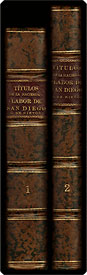
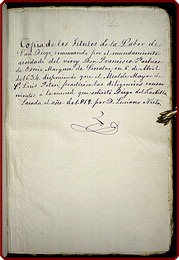
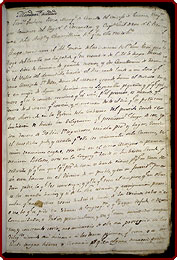
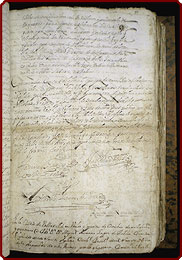
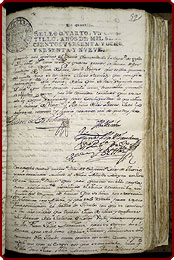 Click the images for enlargements.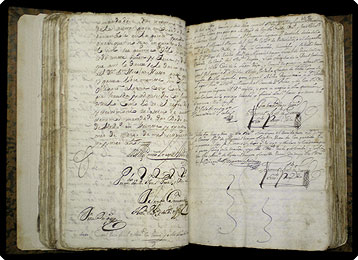
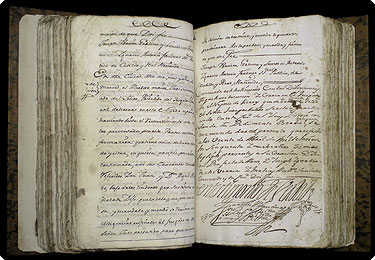
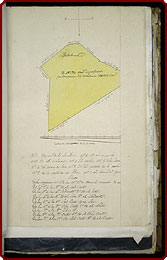
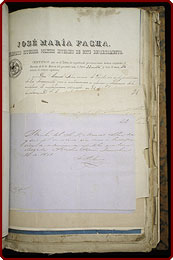
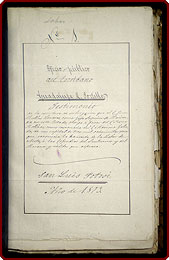 George W. Brackenridge, a citizen of San Antonio, Texas, bought the estate. In 1905 Brackenridge sold the estate to Edwin Chamberlain for 95,000 pesos. Brackenridge was a prominent citizen of San Antonio, donor of the land that is now Brackenridge Park, and Chamberlain was the president of the San Antonio Loan and Trust Company.
• Modern sheep in Spanish “Valenciana” style. Bindings and documents in very good condition. (24697)
The
Mining Revival &
The Father of Mexican
Independence
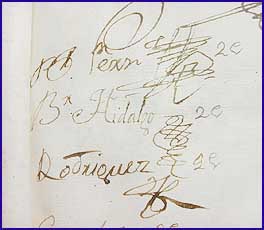
Hidalgo,
Miguel de, Father of Mexican Independence. Document
Signed (Br. Hidalgo), on paper, in Spanish. No place [mining region of Real de
Bolaños or Aguas Calientes], no date [1780]. Folio, 1 p., bound in a dossier
of documents relating to the execution of the provisions of the will of Augustina
Velázquez. [with] A number of other collateral documents relating
to the Condes de Vivanco. On paper, in Spanish. Mexico City, Real de Bolaños,
Aguas Clientes, Valladolid (now Morelia), and elsewhere in Mexico. Folio (31 cm,
12.25") and smaller. Approximately
350 ff.
Mexican
Independence
Hidalgo,
Miguel de, Father of Mexican Independence. Document
Signed (Br. Hidalgo), on paper, in Spanish. No place [mining region of Real de
Bolaños or Aguas Calientes], no date [1780]. Folio, 1 p., bound in a dossier
of documents relating to the execution of the provisions of the will of Augustina
Velázquez. [with] A number of other collateral documents relating
to the Condes de Vivanco. On paper, in Spanish. Mexico City, Real de Bolaños,
Aguas Clientes, Valladolid (now Morelia), and elsewhere in Mexico. Folio (31 cm,
12.25") and smaller. Approximately
350 ff.
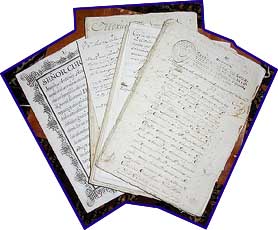
 This
is a fine, extremely early example of Father Hidalgo's signature.
This
is a fine, extremely early example of Father Hidalgo's signature.
 The woman who provided the money for the above mentioned masses was the wife
of Antonio de Vivano (also spelled Bibano) Gutiérrez and mother of
Antonio Guadalupe de Vivano, the first two Condes de Vivanco. Cambridge scholar
David Brading credits Antonio de Vivanco with restoring the mining region
of Bolaños to prosperity in the early 1770s, following the region's
sharp decline in silver ore production during the first two-thirds of the
18th century — whereby he became very wealthy.
The woman who provided the money for the above mentioned masses was the wife
of Antonio de Vivano (also spelled Bibano) Gutiérrez and mother of
Antonio Guadalupe de Vivano, the first two Condes de Vivanco. Cambridge scholar
David Brading credits Antonio de Vivanco with restoring the mining region
of Bolaños to prosperity in the early 1770s, following the region's
sharp decline in silver ore production during the first two-thirds of the
18th century — whereby he became very wealthy.
In addition to payment for masses for her soul, Doña Augustina's will provides for large sums of money to be spent on construction work on the chapel of Our Lady of Guadalupe in the bishopric of Guadalajara. The paperwork, including receipts, associated with the distribution of her largesse is weighty and detailed.
Among
the collateral documents in this offering are copies of the last wills and
testaments of Antonio de Vivanco Gutiérrez (1796), Augustina Velázquez
(1780), and Antonio Guadalupe de Vivanco (1800); the inventory of the younger
Vivanco's massive estate (1801); and a marvelouscalligraphic
manuscript in which the bishop of Guadalajara grants
a special privilege to Vivanco the elder. All are notarially certified copies
of the originals.
• All documents in very good condition, sewn, in contemporary vellum bindings.
For
18TH-CENTURY BOOKS, click here.For
more of MINING interest, click here.
For
more of WOMEN's interest, click here. For
more CATHOLICA, click here. MEXICO is
one of our great specialties.
 TO Part
IV . . . TO Part
IV . . . |