 For
your consideration:
For
your consideration:
 A
QUARTET FOR “BANNED BOOKS WEEK”
A
QUARTET FOR “BANNED BOOKS WEEK” For
your consideration:
A
QUARTET FOR “BANNED BOOKS WEEK”
For
your consideration:
A
QUARTET FOR “BANNED BOOKS WEEK”
 A BANNED BOOK, a
 DErailed Scholar
 Opstraet, Jan. Pastor bonus seu idea officium spiritus et praxis pastorum. Leodij: Henrici Hoyoux, [1689]. 8vo (16.3 cm, 6.45"). *6A–Z8Aa–Ii8Kk2; [12], 495, [21] pp.


Scarce: Not traced via STCV and only one copy of this edition located via RLIN and OCLC (at Harvard).
• Not in STCV. Early 18th-century mottled calf, spine gilt extra, with gilt-stamped leather title-label; leather markedly acid-pitted over sides and chipped over spine extremities, spine with gilt dimmed. Title-page with early inked inscription from a seminary. Pages slightly age-toned, otherwise clean.
 A
Banned (Burned!!)
Book
Toland, John. Christianity not mysterious: Or, a treatise
shewing, that there is nothing in the Gospel contrary to reason, nor above it: And that no Christian doctrine can be properly call'd a mystery ... the second edition enlarg'd. London: Sam. Buckley, 1696. 8vo (17.8 cm, 7"). xxxii, 174 pp.
A
Banned (Burned!!)
Book
Toland, John. Christianity not mysterious: Or, a treatise
shewing, that there is nothing in the Gospel contrary to reason, nor above it: And that no Christian doctrine can be properly call'd a mystery ... the second edition enlarg'd. London: Sam. Buckley, 1696. 8vo (17.8 cm, 7"). xxxii, 174 pp. 

 Click
the interior image for an enlargement.
Click
the interior image for an enlargement.
The present work argues that the various seeming “mysteries”
of Christianity resulted from the contributions of different early Christian
sects, and makes use of ideas found in Locke's Essay to dismiss the
Trinity on logical and rational grounds; it was highly influential on the
continent, although burned in Dublin in 1697
by order of Parliament.
burned in Dublin in 1697
by order of Parliament.
• ESTC R7180; Wing (rev.) T1763; Lowndes 2692. Recent period-style speckled calf, covers framed and panelled in gilt rolls with gilt-stamped corner fleurons, spine with gilt-stamped leather title and author labels, gilt-ruled raised bands, and gilt-stamped compartment decorations (signed by Grace Bindings in blind at inner area of rear cover, lower turn-in). Preface with inked numeral in lower margin. Some ink smudges to outer margins of first few leaves, pages otherwise clean. (20723)

 A
PAIR of
These Indexes
A
PAIR of
These Indexes ACTUALLY
USEDIndex librorum prohibitorum. Index et catalogvs librorum prohibitorum, mandato...D.D. Gasparis a Qviroga...denuò editus. Madriti: Apud Alphonsum Gomezium regium typographum, 1583. 4to. A4 *2 2A8 B–M8; [6], 96 ff. [bound with] Index expurgatorius librorum. Index librorvm expurgatorum, illustrissimi ac reuendis. D.D. Gasparis Qviroga...iussu editus. Madriti: Apud Alfonsum Gomezium regium typographum, 1584. 4to. π2 A–B8 C10 D–S8 T10 V–Z8 Aa–Bb8 (-Bb8, a blank); [2], 194 [ie., 198], [6 (last 2 blanks)] ff. (lacks final blank).
ACTUALLY
USEDIndex librorum prohibitorum. Index et catalogvs librorum prohibitorum, mandato...D.D. Gasparis a Qviroga...denuò editus. Madriti: Apud Alphonsum Gomezium regium typographum, 1583. 4to. A4 *2 2A8 B–M8; [6], 96 ff. [bound with] Index expurgatorius librorum. Index librorvm expurgatorum, illustrissimi ac reuendis. D.D. Gasparis Qviroga...iussu editus. Madriti: Apud Alfonsum Gomezium regium typographum, 1584. 4to. π2 A–B8 C10 D–S8 T10 V–Z8 Aa–Bb8 (-Bb8, a blank); [2], 194 [ie., 198], [6 (last 2 blanks)] ff. (lacks final blank).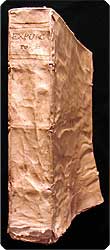
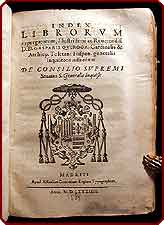
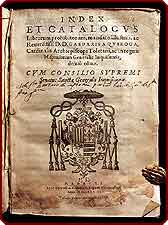 Single-click any image above where the hand appears on
Copies of the Indexes that can be proved to have been used in colonial Mexico are virtually unknown. This is the first such pairing of 16th-century printings that we have seen in our 30 years of dealing in colonial Mexicana.
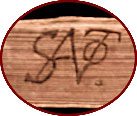
Provenance:
Marca de fuego on top and bottom edges of the Convento of San Antonio
Sultepec; later in the library of Santa Barbara of Puebla according to a 17th-century
notation on the title-page of the first work (“Es de Sta. Barbara de
la Puebla, por n[uest]ro her[man]o fr[ay] Juan de Santa Ana, g[uardi]an”).
• Aed.I: Palau 118926 Aed. II: 118927 & 118928. Contemporary limp and cockled vellum, a little shrunken and with remnants of ties. Lower margins sometime exposed to water and with arrested mildew damage, causing loss of paper that has been repaired in heavy-handed fashion. Good copies, but not very good ones, of these remarkable survivors!

Wisdom,
Censored —
Post-PURCHASE?!Charron, Pierre. De la sagesse. Paris: Jean-François Bastien, 1783. 8vo (20 cm, 7.9"). Frontis., xviii, 768 pp.; 1 plt. (damaged/censored).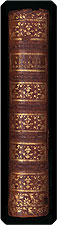
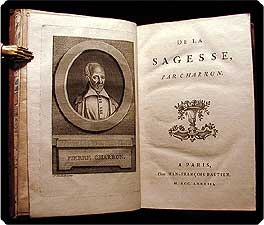
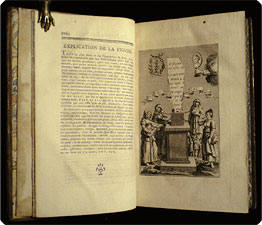 Click the interior images for enlargements. This
particular copy seems to have incurred someone’s personal wrath, as the
plate illustrating the allegory of Wisdom has had its central (nude) female
figure excised. The much more staid frontispiece
portrait of the author, done by Pruneau, is undamaged.
Click the interior images for enlargements. This
particular copy seems to have incurred someone’s personal wrath, as the
plate illustrating the allegory of Wisdom has had its central (nude) female
figure excised. The much more staid frontispiece
portrait of the author, done by Pruneau, is undamaged.
• Contemporary mottled calf framed in triple gilt fillets, spine gilt extra, all page edges marbled; binding with expectable acid-pitting and minor cracking of the leather over the spine and joints. One (and only one) signature foxed, leaves otherwise clean. A handsome book, defaced in a way that is depressing but also interesting.
 For more 17TH-CENTURY BOOKS, click
here.
For more 18TH-CENTURY BOOKS, click
here.
For more 17TH-CENTURY BOOKS, click
here.
For more 18TH-CENTURY BOOKS, click
here. For more RELIGION, click
here.
For more CATHOLICA, click
here.
For more BOOKS IN FRENCH, click
here.
For more RELIGION, click
here.
For more CATHOLICA, click
here.
For more BOOKS IN FRENCH, click
here. |
|
For more of IRISH interest,
click here.
For more WING BOOKS, click
here.
For BOOKS ABOUT BOOKS, click
here.
For more Books with SPECIAL PROVENANCE, click here. |
MEXICO
is one of our great specialties.
Or for a short “shelf”
devoted to
|
MISCELLANY, |
|
AND/OR CLICK THIS LINK FOR OTHER “FEATURED |
|
