 PROVENANCE!
 . . . the history of ownership of an object . . .
PROVENANCE!  Stolen Letters! Damage Control! — The Reformation
  Capito, Wolfgang [a.k.a., Wolfgang Köpfel]. Der nüwen zeytu[n]g vnd heymlichen wunderbarlichen offenbarung so D. Hans Fabri jungst vfftriben vnd Wolffgang Capitons brieff gefälschet hat bericht vnd erklerung. Strassburg: No publisher/printer, 1526. Small 4to. [32] ff.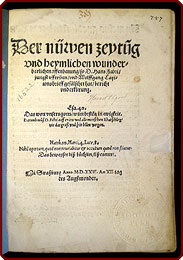
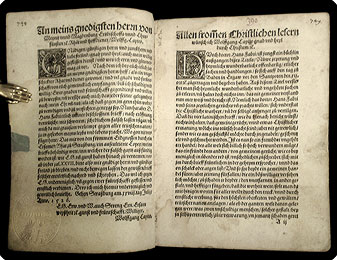
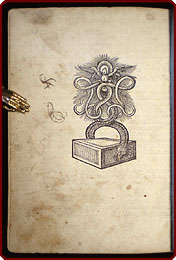
 Click the images for enlargements.
 In his capacity as a leader of the early Reformation he was present at several important “conferences” (the second Zürich and that at Marburg). He coauthored, with Martin Bucer, the Confessio Tetrapolitana.
Capito's archenemy was a Dominican named Hans Faber (a.k.a. Johannes Faber), the vicar general of the bishop of Constance, who at every turn sought to undermine Capito and his relations with authorities and other Reformers, Zwingli in particular. Der nüwen zeytu[n]g is Capito's rebuttal of Faber's Newe Zeittung vnd heimliche wunderbarliche Offenbarung etlicher sache[n] vnd handlungen so sich vff dem tag der zw Baden, in which Faber published distorted versions of letters his agents had stolen that were addressed to Zwingli by Capito and relate to the disputation at Baden in 1526, which Zwingli had decided not to attend.
Schrodt and Vogelstein summarize: “Capito's defense in this tract suggests that he was not altogether comfortable with the language he had used, intended as it was for the eyes of a friend and spiritual comrade in arms. By presenting his original text passage by passage together with Faber's published German version of the same, Capito shows that it given the most offensive turn through the opponent's manner of translation.”
This proffers a large, interesting woodcut device on the verso of its last leaf and two small but nice woodcut initials in text.
Provenance: Ownership signature on title-page of Howard Osgood, noted late 19th- and early 20th-century collector and scholar; old circular pressure-stamp on same page of a seminary (properly released).
WorldCat finds no copies in North America and COPAC finds none in Great Britain.
• Panzer, II, 3051; Kuczynski 381; Index Aurel.; 131.648; VD16 C828; Schrodt & Vogelstein 28–29. In later plain wrappers; title-page torn with small loss of blank foremargin, repaired. Two different sequences of manuscript pagination, one in red, indicating the opusculum was bound at least twice in different sammelbands. Provenance indications as above, and a five-digit number in ink in the inner corner of the title-page; dust-soiling and old staining. (25953)

 A Nun's Copy
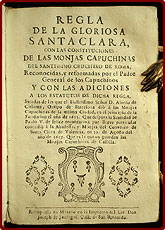
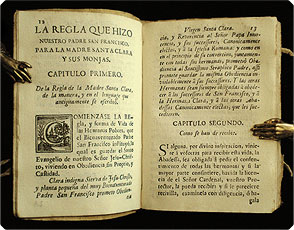
 Then Another Nun's Capuchin Nuns. Regla de la gloriosa santa Clara,con las constituciones de las monjas Capuchinas del santissimo crucifixo de Roma, reconocidas, y reformadas por el Padre General de los Capuchinos y con las adiciones a los estatutos de dicha regla ... Mexico: Reimpressa en la Imprenta del Lic. Don Joseph de Jauregui, n.d. [ca. 1760–75]. 16mo (15 cm; 6'). [4] ff., 234 pp.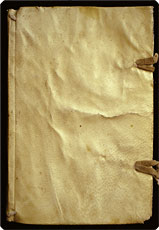
 Click the interior images for enlargements.
  As part of the last, they pray for intervention in medical and mental matters for those suffering from maladies.
Provenance: On front free endpaper in 18th-century hands: “del uso de Sor Maria Coleta,” lined through; below which, “del uso de Sor M[ari]a Juan Nep[umacen]a.
The printer has supplied two charming initials, an “I” and a “C.”
• Medina, Mexico, 9208. Publisher's limp vellum with remnants of ties. Occasional light foxing. Ownership signatures as noted. (23966)
 A FAMED but UNLUCRATIVE
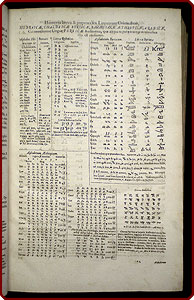
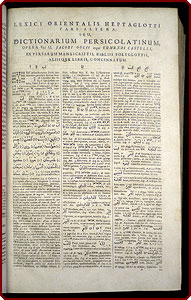
 Polyglot Dictionary Castell, Edmund. Lexicon heptaglotton, Hebraicum, Chaldaicum, Syriacum, Samaritanum, Æthiopicum, Arabicum, conjunctim; et Persicum, separatim. London: Thomas Roycroft, 1669. Folio (44.9 cm, 17.6). 2 vols. in I. Frontis., [8] pp., 44 columns (43 & 44 repeated in numbering), [2] pp., 573 columns (402, 403, 421 & 422 repeated in numbering; 340, 341, 399, & 400 skipped), [1] p., 4008 columns (376–78 & 391–93 incorrectly numbered; 484–86, 538, 1936–38, 3220–25, 3773–78, & 3950–51 repeated in numbering; 487–89, 535, & 3226–3231 skipped).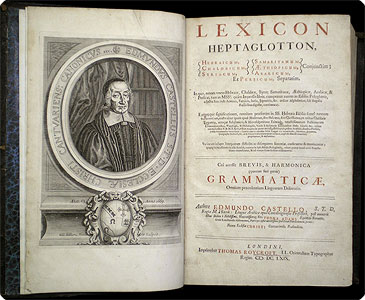
 Click the images for enlargements.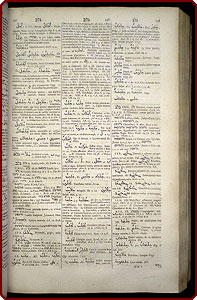
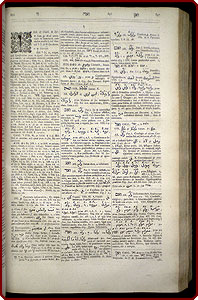
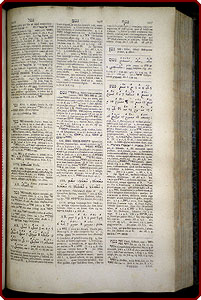
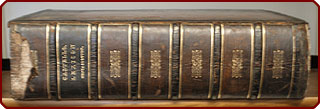
• ESTC R16460; Wing (rev. ed.) C1225; Vancil 46; Lowndes 386; Dibdin, I, 31–35. On Castell, see: Oxford Dictionary of National Biography online. 18th-century speckled calf, covers bordered with a darker calf band blind-rolled and then framed with single gilt fillet; spine with gilt-stamped leather title-label, darker-leather raised bands gilt-stamped/blind-tooled, and compartments gilt- and blind-tooled enclosing gilt-stamped floral decorations. Binding rubbed, with leather significantly lost in top compartment and and lost also at foot. All edges marbled. Front fly-leaf with inked ownership inscription as above dated 1837; title-page with old institutional pressure-stamp. Frontispiece with outer margin reinforced some time ago. One leaf slightly oversized and creased, intermittent soiling in many upper margins, one leaf with text affected but not obscured, small sections with light waterstaining to outer or upper margins; over all, a book both impressive and pleasant. Columns erratically numbered, text complete. (25792)
Presentation Copy Signed by ABOLITIONIST Maria Weston Chapman Chapman, Maria Weston, ed. The Liberty bell. By friends of freedom. Boston: Massachusetts Anti-Slavery Fair, 1844. 12mo (19.5 cm, 7.75"). Frontis. (incl. in pagination), viii, 232 pp.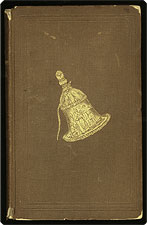
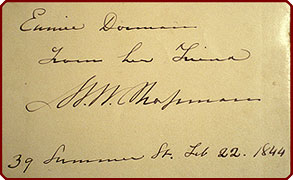
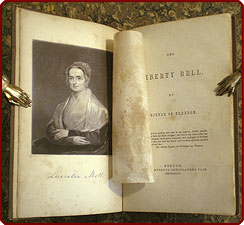 Click any image where the hand appears on
 Chapman, along with several of her sisters, founded the Boston Female Anti-Slavery Society and was one of the staunchest supporters of the abolitionist cause, braving mob scenes and social condemnation to attend anti-slavery meetings, circulate petitions, organize the Anti-Slavery Fair, and publish the present annual. Not many solid, presentable copies of the Liberty Bell make their way to the market, and this one is especially notable for its having been inscribed by Chapman herself.
Provenance: Front free endpaper with presentation inscription reading “Eunice Dorman [?] from her friend M.W. Chapman,” dated February, 1844 (“39 Summer St.”).
• On Chapman, see: McHenry, Famous American Women, 68–69, and DAB, IV, 19. Publisher’s brown cloth, front cover with gilt-stamped bell vignette, spine with gilt-stamped title and blind-stamped decorative bands; cloth worn along board edges and corners and chipped away at spine extremities, exposing underlying boards or support. Front cover and outer edge with a few small dents, back cover with line of light, unobtrusive staining. Pages lightly foxed, otherwise clean, with some corners dog-eared.
 A desirable copy. (21279)

Paine
Was aDIRTY
Man!Cheetham, James. The life of Thomas Paine, author of Common sense, The crisis, Rights of man, &c. &c. &c. New York: Southwick & Pelsue, 1809. 8vo (22.2 cm, 8.75"). 347, [1] pp.
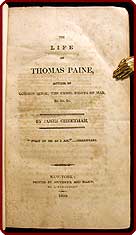 Click either image for an enlargement.
 Provenance: Pencilled note on endpaper, “From Ralph E. McCoy’s Library”; McCoy, emeritus Dean of Libraries at Southern Illinois University, Carbondale, published widely on the First Amendment freedoms.
• Howes C336; Sabin 12379; Shaw & Shoemaker 17193. Later quarter plain brown paper over contemporary tan paper–covered sides; edges and corners rubbed. Front free endpaper (modern) with pencilled note of McCoy’s ownership; front fly-leaf with pencilled gift inscription dated 1849. Offsetting and foxing throughout. A very sound copy.
 The
FIRST Complete
Church of
England Liturgy
inGREEK
Church of England. Book of Common Prayer. Greek. [in Greek, romanized as ] Leitourgia Brettanikē ēgoun Biblos dēmosiōn euchōn kai diakonēseōs mystēriōn kai tōn allōn thesmōn kai teletōn en tē Ekklēsia hēmōn Anglikanē eis t[ēn] tōn philhellēnōn neōn charin hellēnisti ekdotheisa. Liber precum publicarum ac celebrationis sacramentorum reliquorumq[ue]; rituum & caeremoniarum in Ecclesiâ nostrâ Anglicanâ, in studiosae juventutis gratiam nunc primùm graecè editus. Operâ & studio Eliae PetilI presbyteri. Londini: Typis Tho. Cotes pro Richardo Whitakero, 1638. 8vo (16.1 cm, 6.5"). [262] pp. (lacking prelim. blank f.). [π1A4α4(-α1) β4γ4 ¶4¶¶4¶¶¶1 B–N4 A–04 P2].
The
FIRST Complete
Church of
England Liturgy
inGREEK
Church of England. Book of Common Prayer. Greek. [in Greek, romanized as ] Leitourgia Brettanikē ēgoun Biblos dēmosiōn euchōn kai diakonēseōs mystēriōn kai tōn allōn thesmōn kai teletōn en tē Ekklēsia hēmōn Anglikanē eis t[ēn] tōn philhellēnōn neōn charin hellēnisti ekdotheisa. Liber precum publicarum ac celebrationis sacramentorum reliquorumq[ue]; rituum & caeremoniarum in Ecclesiâ nostrâ Anglicanâ, in studiosae juventutis gratiam nunc primùm graecè editus. Operâ & studio Eliae PetilI presbyteri. Londini: Typis Tho. Cotes pro Richardo Whitakero, 1638. 8vo (16.1 cm, 6.5"). [262] pp. (lacking prelim. blank f.). [π1A4α4(-α1) β4γ4 ¶4¶¶4¶¶¶1 B–N4 A–04 P2].
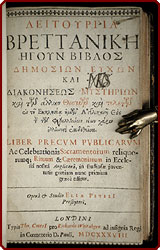
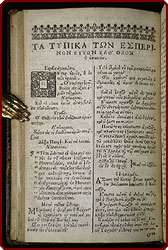
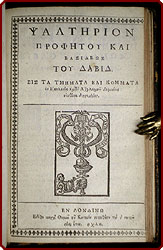
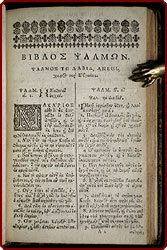 Click the images for enlargements.
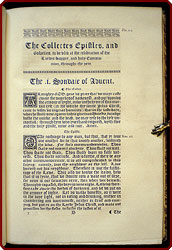
 The main title-page is printed in red and black; the separate title-page for the Psalter has a neat woodcut printer's vignette and blazons (in Greek type) Psalterion prophetou kai basileos tou Dabid. The elegant Greek type is set in double columns, with some nicely laid in typographic ornaments and decorated capitals. The signing is erratic, but the collation of this example matches most recorded descriptions: Leaf α1, apparently a cancel in a few copies but lacking in most reported examples and not present here, was a supplemental title-page giving Biblos dēmosiōn euchōn, kai leitourgēseōs mystēriōn; Griffiths calls for only one preliminary leaf, as is found here, with the other leaf in the gathering being a blank. Leaf 1C2 is a cancel.
Provenance: Front pastedown with armorial bookplate of Twistleton Fiennes, with that family's motto: “Fortem posce animum”; front free endpaper rubber-stamped “Birch” and front fly-leaf inked “Tho.s Birch e Coll. Herts. Oxon.” (apparently neither the historian nor the marine painter); title-page with inked monogram (obscure).
• ESTC S108726; STC (rev. ed.) 16432 & 2353; Griffiths, Bibliography of the Book of Common Prayer, (Other Languages) 45/2. Psalter: Darlow & Moule 4683. See: Oxford Guide to the Book of Common Prayer 57. Contemporary speckled calf, covers framed in gilt double fillets, rebacked with speckled calf quite plainly (without labels but with gilt-dotted raised bands); corners rubbed, original leather showing expectable acid-pitting. One preliminary blank (only) lacking; title-pages trimmed closely at outer edge, affecting typographical border and (on main page) one letter of publication information. Ownership marks as above. Pages lightly age-toned, otherwise clean; tiny spot of worming in lower inner margin, not affecting text. A handsome and evocative little book. (26373)
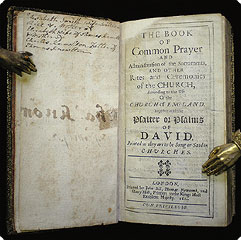
Restoration Binding — Painted Fore-Edge Church of England. Book of Common Prayer. The book of common prayer and administration of the sacraments, and other rites and ceremonies of the church, according to the use of the Church of England. Together with the Psalter or Psalms of David, pointed as they are to be sung or said in churches. London: John Bill, Thomas Newcomb, & Henry Hills, 1680. 12mo (14.7 cm, 5.75"). [432] pp. (lacking A1, blank or licence). [with] Bible. English. Authorized (i.e., “King James Version”). 1679. The Holy Bible, containing the Old Testament and the New ... appointed to be read in churches. London: John Bill, Thomas Newcomb, & Henry Hills, 1679. 12mo. [870] pp. [and with] Bible. O.T. Psalms. English. Sternhold & Hopkins. 1679. The whole book of Psalms, collected into English metre, by Thomas Sternbold, John Hopkins, and others. London: Pr. for the Company of Stationers, 1679. 12mo. [72] pp. 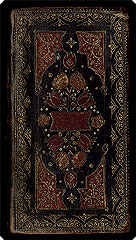
 Click the images for enlargements.
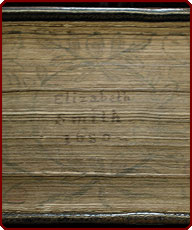
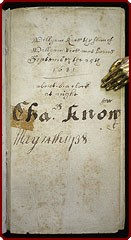
 Provenance: Fore-edge painted with “Elizabeth Smith, 1680"; front fly-leaf with inscription recording the birth of William Rice in 1681 and with inscription of Charles Knowlton, dated 1738; fly-leaf verso with early inked genealogy describing the Smith-Rice-Knowlton descent.
Binding: Elaborate Restoration binding: black morocco framed in gilt semi-circle and strawberry rolls surrounding a broken panel design of red-inlaid scalloped corners decorated with floral-dotted volutes, containing a bouquet of tulips and other flowers with red and citron morocco inlays; the upper- and lowermost tulips each with a smaller gilt-stamped flower and leaf tool inside, spaces filled with small flowers and dots. Spine gilt extra using cover rolls and additional floral decorations, with two decorated compartments of red morocco; board edges and turn-ins with gilt rolls. The tools used do not appear to be an exact match to any binder represented in Bennett, Nixon, or Maggs: Bookbinding in the British Isles, although the tulip with superimposed small flower is reminiscent of the binder Nixon identifies as the Small Carnation Binder. All edges gilt. Fore-edge painted with name as above, surrounded by hand-painted floral decorations.
• BCP: Wing (rev. ed.) B3659B. Not in ESTC; not in Griffiths (see 1680/5 for a very close example). Bible: ESTC R215858; Wing (rev. ed.) B2308A; Herbert 758. Psalms: Not in ESTC, not in Wing. Binding as above, front joint cracked (sewing holding) with corners/edges rubbed; spine leather with small cracks and head chipped, small area darkened. BCP lacking A1, either a blank or a licence and much more likely an initial blank; title-page repaired at one corner. Elsewhere, one leaf with tear from outer margin, extending across one column without loss; page edges with occasional small smudges from fore-edge decorations; some faint spotting and foxing. Now housed in a café au lait morocco slipcase mistakenly giving 1630 as year of publication, based on misleading print impression on title-page. A good and interesting book apart from its extraordinary binding, charming fore-edge treatment, and multi-generational provenance. (25925)
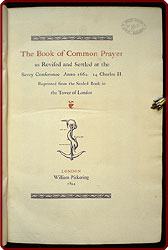
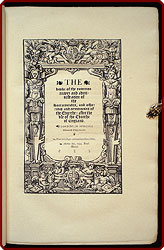
 Pickering & Whittingham'sSEVEN BCPs Church of England. Book of Common Prayer. [Seven editions of the Book of Common Prayer, 1549–1844 ]. London: William Pickering (pr. by Whittingham), 1844. Folio (35.8 cm, 14"). 7 vols. I: [264] ff. II: [314] ff. III: [134] ff. IV: [130] ff. V: [142] ff. VI: [140] ff. VII: [154] ff.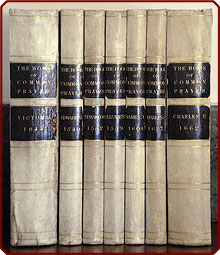
 Click the images for enlargements.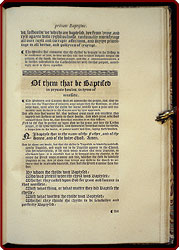
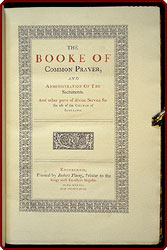
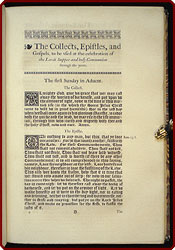
Provenance: Elegant old lozenge-shaped ink-stamp on title-pages: “John Brymer Heir-Loom.”
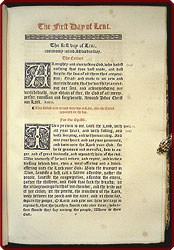
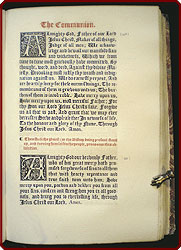
 For more SETS, click here.
 A Double Fore-Edge Painting on
 Treasured & TreasurableChurch
of England. Liturgies. Book of common prayer. Book of common prayer, and administration of the sacraments, and other rites and ceremonies of the Church, according to the use of the Church of England: Together with the
Psalter or Psalms of David, pointed as they are to be sung or said in churches. Oxford: Clarendon Press, 1791. 8vo (25.5 cm, 10"). [196] ff. [bound with] Bible. O.T. Psalms. English. Sternhold and Hopkins. The whole book of psalms, collected into English metre. Oxford: Clarendon Press, 1793. 8vo (25.5 cm, 10"). [60] ff.
Treasured & TreasurableChurch
of England. Liturgies. Book of common prayer. Book of common prayer, and administration of the sacraments, and other rites and ceremonies of the Church, according to the use of the Church of England: Together with the
Psalter or Psalms of David, pointed as they are to be sung or said in churches. Oxford: Clarendon Press, 1791. 8vo (25.5 cm, 10"). [196] ff. [bound with] Bible. O.T. Psalms. English. Sternhold and Hopkins. The whole book of psalms, collected into English metre. Oxford: Clarendon Press, 1793. 8vo (25.5 cm, 10"). [60] ff.

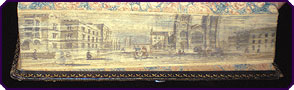
striking double fore-edge painting depicting (in one direction) the medieval Abbey Church of St. Albans in Hertfordshire, with a horse-drawn carriage in the foreground, and in the other direction the western facade of Westminster Abbey, with passing pedestrians.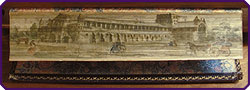
 Single-click any image where the hand appears on
Provenance: The front fly-leaf bears an inked inscription reading “From this Book our 4 Dear Children were Babtized [sic] by the Rev. S. Good, Rector of St. Anns Blk. Friars, And afterwards Christened by their Dear Uncle the Rev. Charles Brown, Rector of Whitestone, near Exeter, Devon.” The children's baptismal dates range from 1806 through 1814.
• ESTC T93069; Griffiths, Bibliography of the Book of Common Prayer, 1791/7. Binding as above, leather slightly worn over joints and extremities. Front fly-leaf with collector's small bookplate, reverse with inscription as above, title-page with owner's name and date (1806) inked in upper margin. Pages clean.
McMurrin Copy — Mormon Provenance Church of Latter-day Saints. The book of Mormon: An account written by the hand of Mormon, upon plates taken from the plates of Nephi ... fifth electrotype edition. Liverpool: George Teasdale, 1889. 12mo (17.2 cm, 6.75"). xii, 623 pp.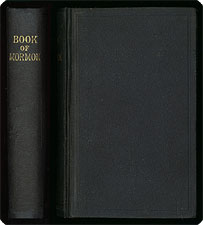
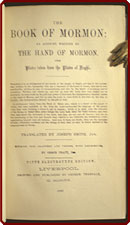 Click the interior image above for an enlargement.
 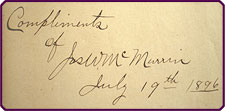 Provenance: Front free endpaper with inked gift inscription reading “Compliments of Jos. W. McMurrin / July 19th 1896.” Joseph William McMurrin (1858–1932), a Mormon missionary and general authority, served as one of the seven presidents of the First Quorum of Seventy.
• Crawley 688 (for 1852 stereotyped ed.); Flake & Draper 626; Sabin 83067. Publisher's textured blue cloth, framed in blind, spine with gilt-stamped title; binding unobtrusively rebacked, showing virtually no wear. Hinges (inside) reinforced. Front free endpaper with inscription as above. (20999)
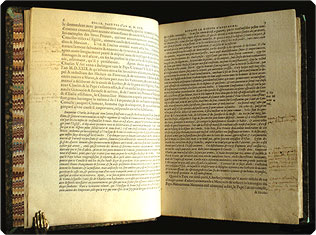
The Augsburg Confession — 51 DocumentsThe First Much Annotated Chytraeus, David. Histoire de la confession d'Auxpourg, contenante les principauls traittez & ordonnances, faittes pour la religion, quand l'electeur Iehan, duc de Saxe auec les citez & autres princes protestants presenterent leur confession de foy (icy inserée) a l'Empereur Charles V. os estats generauls de l'empire, tenus a Auxpourg, 1530. Anvers: Chez Arnould Coninx, 1582. 4to (24.3 cm, 9.55"). [8], 835, [5] pp.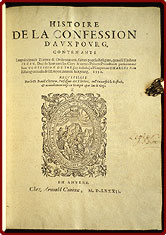
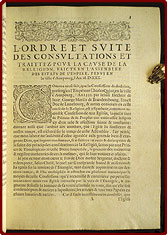
 Click the interior images for enlargements.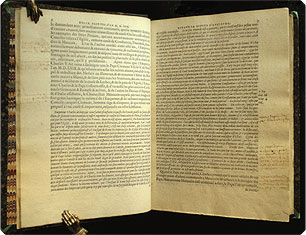
Rare. OCLC lists only four U.S. holdings and one deaccessioned copy (the present example).
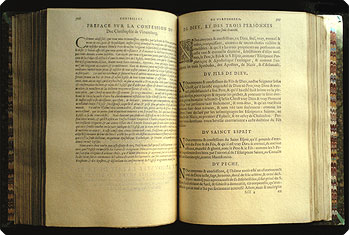
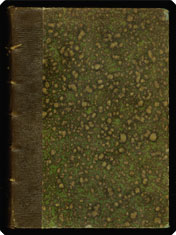
• Brunet 22420; Graesse, II, 154. Not in Adams. 19th-century quarter olive morocco with marbled paper–covered sides, spine with gilt-stamped author/title; edges and extremities rubbed. Top edge gilt. Front pastedown with bookplate as above; title-page and first text page each with early inked ownership inscription. Four leaves with small repaired tears from outer margins and three likewise from upper margins, not touching text in any case. Extensive early inked marginalia in first document, scattered examples elsewhere. (23536)
Incunable Cicero with!Extensive Evidence of Readership Cicero, Marcus Tullius. De officiis [and other works]. Venetiis [Venice]: Bernardinus Rizus, Novariensis & Bernardinus Celerius, 12 Oct. 1484. Folio. [180 of 182] ff., lacking b4–5.
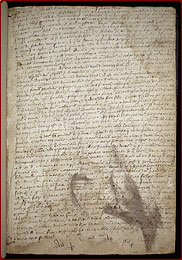
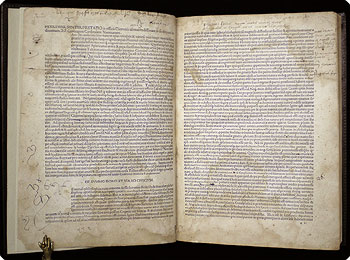
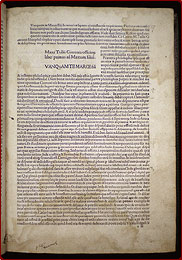 Click the interior images for enlargements.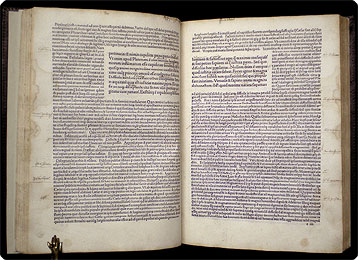
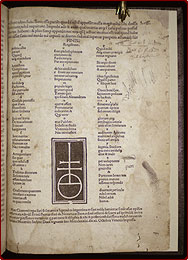
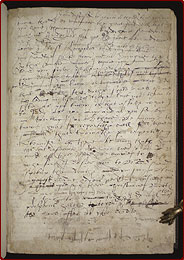
The recto of leaf a1 is blank, the text of the prefatory matter beginning on the verso.
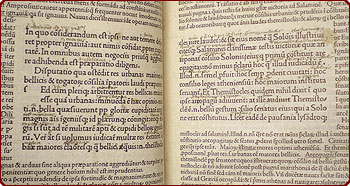
Provenance: Signature of “John Webb” in a 17th-century hand twice in margin of k3r.
Uncommon beyond the Continent: ISTC and Goff locate only two copies in the U.S. and ISTC locates only two copies in the U.K. (one incomplete), but there is a third copy at the British Library.
• ISTC ic00601000; Goff C601; HC 5274*; IGI 2910; Pr 4942; BMC, V 400; GKW 6954. Full modern walnut calf old style: Spine with raised bands, accented with gilt and blind rules, the latter extending onto covers to terminate in trefoils with blind double fillets beyond. Gilt center devices in the spine compartments. Red leather spine label lettered in gilt, and date in gilt at base of spine. Lacking two leaves (b4–5). Upper corners of leaves in gatherings & and [con] damaged with loss of paper. Lower corner of i1 torn with loss of text of both sides of leaf. Waterstaining and old dampstaining variously, this often faint and never really worse than moderate (worst at beginning/end); some age-toning and dustsoiling. Though an imperfect copy, a rarity; indeed, with its manuscript enhancements, a “uniquum.” (25766)
False Imprint Claude, Jean. Les plaintes des Protestans, cruellement opprimez dans le royaume de France. Cologne: Chez Pierre Marteau, 1686. 12mo (13.7 cm, 5.4"). [2], 192 pp.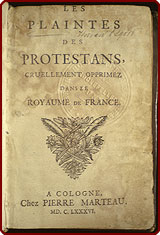
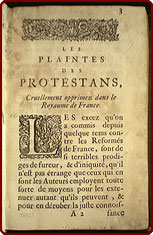
 Click the interior images for enlargements.
 Provenance: Howard Osgood.
• Brunet, IV, 683. Contemporary calf, spine elegantly gilt extra, board edges with gilt rolls; leather acid-pitted, edges and extremities a bit rubbed. Title-page with small inked owner's name and institutional pressure-stamp. Damp-spotting to first and last few pages; some leaves starting to separate, many with lower outer corners crumpled. Intermittent underlining and marks of emphasis in red pencil throughout. (20861)
Privileges
& Exemptions
Cofradía
de Nuestra Señora del Carmen (Mexico). Sumario de las
indulgencias, gracias y concesiones que los sumos pontifices han dispensado
a la Cofradia de Nuestra Señora del Carmen. Mexico: Impr. de la Calle
de Santo Domingo y esquina Tacuba, 1802. Samll 8vo (14.5 cm; 5.75"). [26] ff.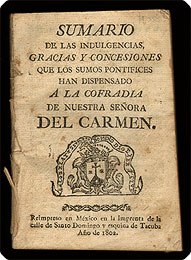 Click the image for an enlargement.
 Provenance: A copy of this work was given to each member upon admission and the last page of this copy indicates that it belonged to Joaquín Gorospe who was admitted to membership on 20 April 1803.
Uncommon: No U.S. library reports owning this edition.
• Medina, Mexico, 9488. Lacking the wrappers. Soiling to title-page and verso of last leaf. A few age spots. (26871)
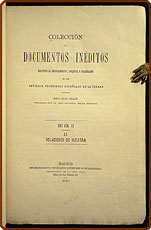
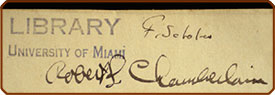
The Yucatan Franz Scholes & Robert Chamberlain Colección de documentos inéditos relativos al decumbrimiento, conquista y organización de las antigua posesiones españolas de ultramar. Segunda serie. Tomo num. 13, II Relaciones de Yucatán. Madrid: Impresores de la Real Casa, 1900. 8vo. xvi, 414 pp.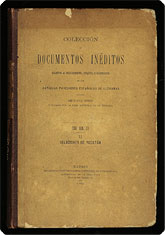
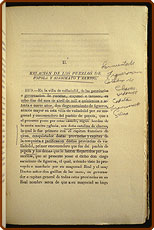 Click the interior images above for enlargements. extensively annotated in pencil by Robert Chamberlain and with occasional notes by Franz Scholes!
Provenance: First in the University of Miami Library, deacessioned; then in the library of Robert Chamberlain and later in that of Franz V. Scholes, both noted scholars of the Yucatán. Their signatures are on the front free endpaper and their notes are penciled in the margins of many pages.
“I am anxious you should do a writing portrait . . . ” Cook, Eliza. A.L.s. (“Eliza”) to “My dear Sec.” London: 6 June 1860. 12mo (7.25" x. 4.5"). 1 p.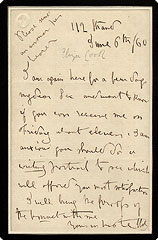 Click the image for an enlargement. a Chartist poet, author, and proponent of political and sexual freedom for women. She writes, “I am again here for a few days . . . and want to know if you can receive me on Friday about eleven. I am anxious you should do a writing portrait to see which will afford you most satisfaction. I will bring the proofs of the sonnet with me.”
Provenance: Residue of the stock of Seven Gables Bookshop (1930–79), via the son of Michael Papantonio (2009).
• Very good condition. Tipped onto a slightly larger sheet. With the integral blank. (25726)

 Bridgewater
Library Set
Corneille, Pierre. Le theatre de P. Corneille.
Paris: Gandouin, 1738. 8vo. 5 vols. in 6.
Bridgewater
Library Set
Corneille, Pierre. Le theatre de P. Corneille.
Paris: Gandouin, 1738. 8vo. 5 vols. in 6.

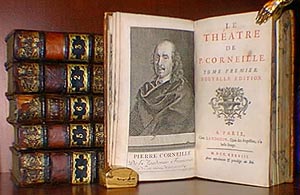
• Contemporary calf. Gilt spines, rebacked and original spines reapplied. Spines very dry, chipped with some loss and lacking title labels, but with new volume labels.
For Books for the BUSTED

Pretty Binding / Sweet Illustrations Crockett, Samuel R. Sweetheart travellers. A child's book for children, for women, and for men. New York & London: Frederick A. Stokes Co., (copyright 1895). 8vo. [4], ix-xv, [1], 314 pp.; 14 plts. (incl. in pagination), illus.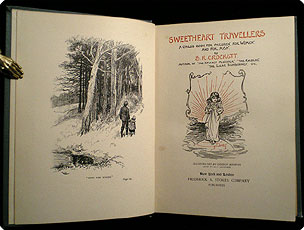
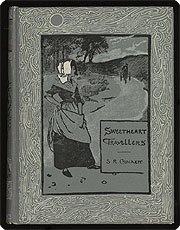
Provenance: Bookplate of Ruth and Loring Dodd on front pastedown.
Click the interior image for an enlargement. • Publisher's grey-blue cloth, covers and spine stamped in white and black, spine with gilt-stamped title; extremities lightly rubbed, with a small spot to the back cover. Front pastedown with bookplate, front free endpaper with inked gift inscription. (12990)

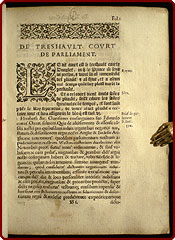
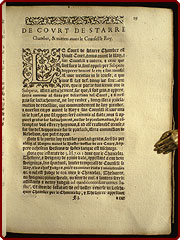
ELIZABETH Must Have Loved HisThinking on Monarchy Crompton, Richard, ed. L'authoritie et iurisdiction des
courts de la maieste de la Roygne: nouelment collect & compose, per R. Crompton del milieu Temple esquire. Apprentice del ley. Londini: Caroli Yetsweirti, 1594. 4to. [4], 232 ff.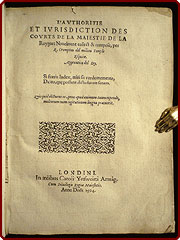
 Single-click any image where the hand appears on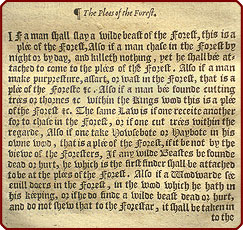
Written in Law French with some Latin, and with extended passages entirely in English in the section on “forrest” law; printed in black letter.
Provenance: Contemporary inked signatures to fly-leaf of Henry Wynn/Wine (Middle Temple?).
• ESTC S109077; STC (2nd ed.) 6050; Lowndes, I, 558. Contemporary limp vellum with remnants of ties. Pinhole or small worming throughout to top margins, touching a few letters in headings; light waterstaining to margins/corners of first/last leaves; one preliminary with just a very little bug-spotting. Paper flaws in margins of ff. 45, 164, and 172; last leaf a little tattered. Overall, very good. (21344)
Anti-Superstition, Wherever it Might Lurk — Great ProvenanceLurking Here Dale, Antonius van. Dissertationes de origine ac progressu idololatriae et superstitionum: De vera ac falsa prophetia; uti et de divinationibus idololatricis judaeorum. Amstelodami: Apud Henricum & Viduam Theodori Boom, 1696. 4to (21.1 cm, 8.3"). [52], 762, [14], pp.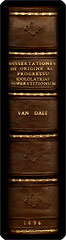
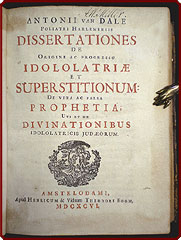
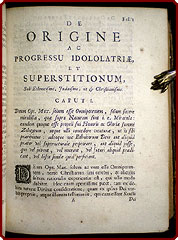 Click the images for enlargements.
 This volume is also of interest typographically; some of the Greek, Syriac, and Arabic types subsequently used in productions by Hendrik Wetstein and others make their first appearances here. The text is predominantly in Latin, with quotations in Hebrew and the above languages. The title-page is printed in black and red.
Provenance: Front pastedown with inked inscriptions of the Rev. A.W. Miller of Charlotte, N.C., dated 1871, and of H. Ader of Assumption Hills, dated [18]92; front free endpaper with early inked inscription of Henry Joseph Thomas Drury. Drury was a master at Harrow School (where he taught Byron), and an original member of the Roxburghe Club. His inscription notes the book's passage from the Bibliotheca Heathiana “thro' Dr. Raine's hands, and Cuthell's to mine”; Drury's mother was Louisa Heath, daughter of the great collector Benjamin Heath, but most of Heath's library had originally gone either to his two sons or to auction following the death of his wife.
• Rosenthal, Bibliotheca magica et pneumatica, 1614. Not in Caillet, Manuel bibliographique des sciences psychiques ou occultes; not in Coumont, Demonology & Witchcraft. Contemporary speckled calf framed and panelled in blind with blind-tooled corner fleurons, inner edges of covers ruled in gilt double fillets, neatly rebacked; spine with gilt-stamped title, gilt-stamped raised bands, and blind-tooled compartment decorations; original leather with edges abraded, corners repaired. Hinges (inside) reinforced some time ago. Lower (closed) edges institutionally blind-stamped. Front pastedown and free endpaper with inscriptions as above, title-page with small ownership inscription in upper portion. Pages age-toned with small amounts of light foxing. Nice margins, all edges (once) saffron. (25848)
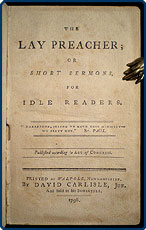
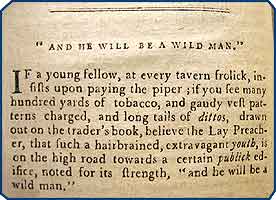
Representing the Farmer's Weekly Museum — 1796 [Dennie, Joseph]. The lay preacher; or short sermons, for idle readers. Walpole, NH: David Carlisle, Jr., 1796. 12mo (17 cm, 6.75"). 132 pp. 
Provenance: Front fly-leaf is inscribed "P Doddridge to his sister Harriett" in an early hand. There is a Doddridge County in New Hampshire, but who "P" and "Harriett" were, we cannot say.
• ESTC W20627; BAL 4633; Evans 30335; Sabin 19585. On Dennie, see: Dictionary of American Biography, V, 235–37. Contemporary mottled sheep rebacked with plain cloth, abraded (most notably over edges and corners); hinges taped (inside) some time ago. Some offsetting and a few scattered light spots; one page with portion of text insufficiently inked during printing. Chip out of one page margin, just touching but not obscuring outermost letters. (4706)
Bodoni Printing: Texts of the Hebrew Old Testament De Rossi, Giovanni Bernardo. Variae lectiones Veteris Testamenti, ex immensa mss. editorumq. codicum congerie haustae et ad Samar. textum, ad vetustiss. versiones, ad accuratiores sacrae criticae fontes ac leges examinatae [and] Scholia critica in v.t. libros seu supplementa ad varias sacri textus lectiones. Parmae: Ex Regio typographeo, 1784–88. Folio (I & II: 29.8 cm, 11.75"; III: 28.8 cm, 11.25"). 5 vols. in 3. I: [8], clx, 116, xiv, [2], 264 pp. II: viii, [2], 268, xxxii, [2], 242 (pp. 241/42 misbound), [16] pp. III: xvi, 144 pp.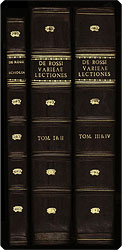
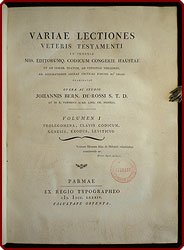
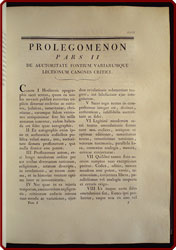 Click the interior images for enlargements.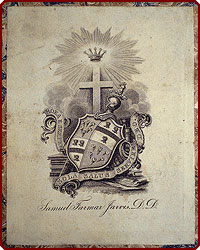
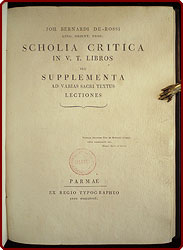
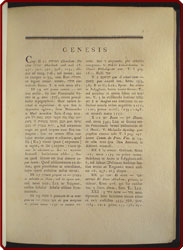
• Brooks, Compendiosa Bibliografia di Edizioni Bodoniane, 279; Steinschneider, Catalogus hebraeorum in Bibliotheca Bodleiana, 2152. Binding on vols. I–IV: Contemporary calf, covers framed and panelled in blind rolls with original leather cracked, chipping, and darkened (III–IV especially severely); rebacked, spines with gilt-stamped title, gilt-dotted raised bands, and gilt-stamped compartment decorations. Hinges (inside) reinforced. Binding on the Scholia: Recent, full period-style calf framed and panelled in blind rolls; spine with gilt-stamped title, gilt-dotted raised bands, and gilt-stamped compartment decorations. All title-pages with very old institutional rubber-stamps; early portions of vol. I with lightly pencilled annotations and bracketing, and vol. II with small pencilled marks of emphasis. Old soft corner creases or mild cockling variously throughout to vols. I–IV and, where these things (or a natural paper flaw) are most notable, a grey soil has entered at the loose or open places to mark the margins at their edges. Otherwise, scattered light foxing, golden, not brown; and the occasional old spill (e.g., I Samuel) or smudge only. Not “fresh” — but substantial, impressive, and with its lovely typography still lovely. (25513)
Who's In Charge of What & How Much They Are Paid Díez de la Calle, Juan. Memorial informatorio al rey nuestro señor, en su real y supremo Conseio de las Indias, Camara, y Junta de Guerra. [Madrid: No publisher/printer], 1645. Small 4to. [11 (of 12)], 31 (of 32) ff. (lacks pi4 and a1).
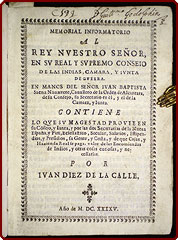
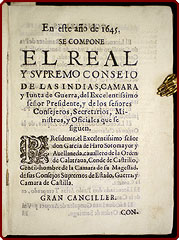
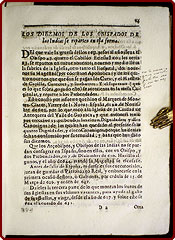 Click the interior images for enlargements.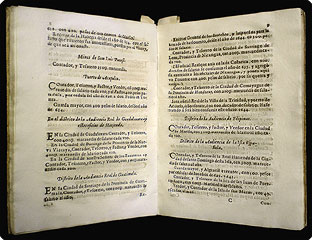
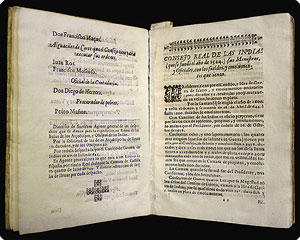
To aid in getting a refreshed grip on the administration of the New World, Philip IV of Spain asked Juan Díez de la Calle, a member of the Consejo de Indias, to produce a concise administrative handbook for use solely by the Council of the Indies, the King, and his close advisors. Here one finds all of the administrative divisions with dates of creation; office holders and their salaries and when the office was created; differences existing between administrative districts; and an interesting section on the various “annual” convoys (“armadas”) and the general in charge of each.
Provenance: Ownership signature at top of title-page of “Guill[er]mo Godolphin,” i.e., Sir William Godolphin.
• Alden & Landis, European Americana, 645/45; Palau 73741; Sabin 20133. Early limp vellum. Lacking two leaves: “Al Lector” leaf and the sectional title-leaf. A very good copy. (25808)

Rare
Variant — “WE”
Binding Detail —
Sunderland
Copy
Diodorus Siculus. Diodorus Siculus. [Operum lib. vi. priores, Latine Poggio interprete.] [Paris]: [pr. by Jean Marchant for] Jean Petit, [ca. 1507]. 4to. a–v8.4x6y4; 123, [6] ff. [bound with] Justinus, Marcus Junianus. Justini historia ex Trogo Pompeio quattor & triginta epithomatis collecta; acc. Lucius Florus et Sextus Rufus. [Paris]: De Marnef, [ca. 1507]. 4to. A8B4C6a–y8.4z6&4; [18], 140 ff.
 Diodorus's work is here accompanied by Justinus’s abridged version of Trogus Pompeius’s history. Both books feature striking capitals and title-page devices. The typography of the first book is Jean Marchant’s, done for Jean Petit whose lion-and-leopard device is prominently displayed. The second book’s device shows initials of two of the three de Marnef brothers (E and G) beneath a pelican in her piety. This second book collates exactly like the Jean Petit edition of Justinus, printed sometime after December of 1507, and appears to differ from it solely in its title-page, probably reset only for insertion of the de Marnef device.
 While one copy of Diodorus bound with Petit’s Justinus was found at Harvard, no record of the apparently extremely scarce de Marnef variant could be located.
Provenance: Charles Spencer, Third Earl of Sunderland, lot 3934 in the Sunderland Library sale (1882).
• Diodorus: Moreau 1508:64; not in Schweiger. Justinus: not in Moreau, not in Schweiger. On Diodorus, see: Oxford Companion to Classical Literature, 146. 17th-century English calf, panelled, with gilt fleurons and elaborate front and back gilt floral center motifs, each worked with a minute WE. (You need a magnifying glass, but this is THERE.) Overall, showing wear with
some leather chipped from spine, covers abraded, and joints starting. Pages mostly clean, with slight staining to inner margins from binding supports. Gilt cover lozenges still bright and the whole safe to be worked with.
Printed D.C. 1901
— Purchased Y.T. 1907 Dunham, Samuel C. Goldsmith of Nome and other verse. Washington: Neale Publishing Co., 1901. 8vo. 80 pp.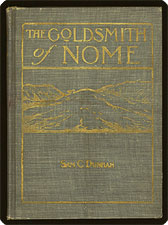
• Publisher's cloth, front cover with gilt-stamped title and landscape vignette, spine with gilt-stamped title; binding worn over extremities, with gilt showing some rubbing. Pages clean. (5701)
 TO
Part IV TO
Part IV |