 PROVENANCE!
 . . . the history of ownership of an object . . .
PROVENANCE!  Scholarly
Highlights of Southern
Germany, Plus
Scholarly
Highlights of Southern
Germany, Plus
 Great
Universities of Medieval
Europe
Great
Universities of Medieval
Europe
 Mabillon, Jean; & Jean de Launoy. ... Iter Germanicum et Io. Launoii De scholis celebribus a Carolo M. et post Carolum M. in Occidente instauratis liber.... Hamburgi: Christiani Liebezeit, 1717. 8vo (17.5 cm, 6.9"). Frontis., [22], 103, [1], 507, [5] pp.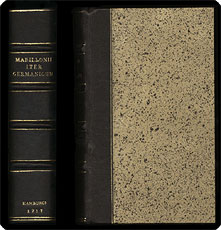
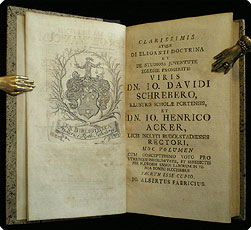
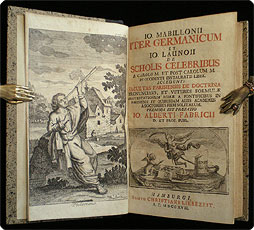
 Click the interior images for enlargements.
 An engraved frontispiece of Ptolemy done by Menzel opens the volume; the main title-page is printed in red and black, with an engraved allegorical vignette.
Provenance: Title-page verso with intaglio-printed armorial ex libris, printed directly on the leaf (not a bookplate that was glued on): “Ex Bibliotheca Friederici Roth-Scholtzii.” Friedrich Roth-Scholtz (1687–1736) was a prominent Nuremberg printer and publisher, as well as the author of Icones bibliopolarum et typographorum de republica litteraria and the Bibliotheca chemica; there are several reported examples of such bookplates in his books.
• Recent quarter calf and speckled paper–covered sides, spine with gilt-stamped author, title, place, date and gilt-ruled raised bands. Volume a little cocked. Endpapers soiled; some pages with mild offsetting, and text otherwise clean. (25490)

 Presentation
Copy of
the
Presentation
Copy of
the “Greatest
Poem EVER
WrittenMarkham, Edwin. [drop-title] Lincoln, the man of the people. No place [United States]: No publisher/printer, © 1919 [ but printed ca. 1925–30]. Folio (35.5 cm, 14"). [1] f.
“Greatest
Poem EVER
WrittenMarkham, Edwin. [drop-title] Lincoln, the man of the people. No place [United States]: No publisher/printer, © 1919 [ but printed ca. 1925–30]. Folio (35.5 cm, 14"). [1] f.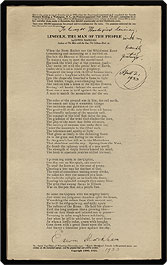 Click the image for an enlargement.
 Author's presentation copy: Signed by Markham, with an inscription “with my friendly greetings” to a theological seminary, dated 1933.
• Mounted on cardboard. Age-toned, edges darkened; clean and unchipped. (26119)

Marmontel's Political-Philosophical Novel with Gravelot's Illustrations Marmontel, Jean François. Bélisaire. Paris: Chez Merlin, 1767. 8vo (19.9 cm, 7.8"). [4], x, 340, [6] pp.; 4 plts.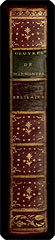
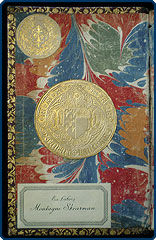
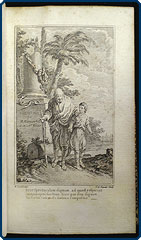
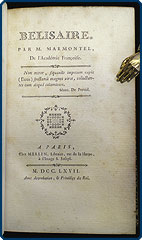
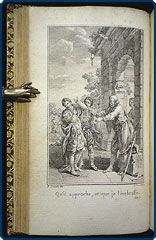 Click the images for enlargements.
 Merlin also printed a duodecimo edition in 1767; in the present edition, “Fragmens de philosophie morale” is found on pp. 273–340, followed by the Addition and Approbation.
Provenance: Front pastedown with gilt-stamped armorial bookplate of notable 19th-century book collector Edward Hailstone, gilt-stamped “I.T.” bookplate with motto “Inter folia fructus,” and bookplate of Sir Montague Shearman.
Binding: Contemporary crimson morocco, covers framed in gilt triple fillets; spine gilt extra with gilt-stamped leather labels, board edges and turn-ins with gilt rolls. This volume (complete in itself) seems at one time to have been part of a set of Marmontel's works, and bears an (unnumbered) spine label reading “Oeuvres de Marmontel.”
• Brunet, III, 1440; Cohen de Ricci, Guide de l’amateur de livres à gravures du XVIIIe siècle, 688; Graesse 406; Tchermezine 455. Binding as above, with edges, extremities, and joints showing minor rubbing. Front pastedown with bookplates as above; front free endpaper with affixed slip of early cataloguing; rear pastedown with small chip out of paper. Light spots of foxing, slightly heavier around plates. All edges gilt. (25776)
 First English-Language Edition — Pr. by
 Bradford, 1795Martens, [Georg Friedrich von]. Summary of the law of nations, founded on the treaties and customs of the modern nations of Europe...translated from the French by William Cobbett. Philadelphia: Thomas Bradford, 1795. 8vo. XIX, [1], 379, [1 (blank)] pp.
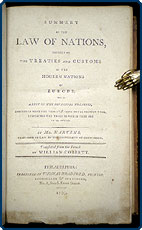
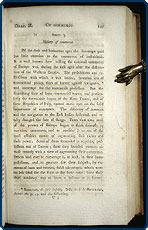
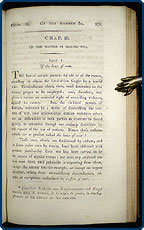 Click the images for enlargements.
 Provenance: 19th-century ownership signatures on front pastedown or front fly-leaf of John T. Wait (Dec. 14, 1839), Luther Spalding (undated), and W.H. Richards.
• Evans 29025; ESTC W29507; Sabin 44848. On Cobbett, see: The Dictionary of National Biography, XI, 142–45. Contemporary sheep, framed in blind with a roll of a rope design, spine with gilt-stamped title-label; leather worn at edges and front cover expertly reattached, spine worn with chipping. Ownership inscriptions as above. Minor spotting and offsetting.

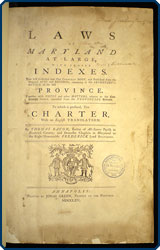
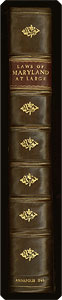
The MARYLAND Seal Makes Its Debut Maryland. Laws, statutes, etc. Laws of Maryland at large, with proper indexes. Now first collected into one compleat body, and published from the original acts and records, remaining in the secretary’s-office of the said province. Together with notes and other matters, relative to the Constitution thereof, extracted from the provincial records. To which is prefixed, the charter, with an English translation. By Thomas Bacon, Rector of All-Saints Parish in Frederick County, and Domestic Chaplain in Maryland to the Right Honourable Frederick Lord Baltimore. Annapolis: Printed by Jonas Green, printer to the province, MDCCLXV [1765]. Folio extra. [736] pp.
 unexcelled
by any other production of an American colonial press.
Additionally, it is commonly thought that this work marks the first appearance
of the Maryland seal, carved on a wood block by Thomas Sparrow, an employee
of the printer.
Click
the interior image for an enlargement.
unexcelled
by any other production of an American colonial press.
Additionally, it is commonly thought that this work marks the first appearance
of the Maryland seal, carved on a wood block by Thomas Sparrow, an employee
of the printer.
Click
the interior image for an enlargement.
Provenance: Signature on title-page of Bruce J. Worthington, dated 1794; of Ethan Allen, dated 1856; of John H. Alexander, Esq.; in the library of the Maryland Diocesan Library (deaccessioned).
• Evans 10049; Wroth, Maryland, 254; Sabin 45186. Recent full calf, old style, by Grace Bindings (signed “G.B.” on lower turn-in of inside back cover), with gilt tooling on covers and spine, raised bands on spine, red title-label. Title-page browned around the edges and with some loss of paper; leaf now backed as is the last (bookseller's advertisements). Maryland Diocesan library stamp (deaccessioned as above) on title-page. Dedication page with very old repair along inner area of blank verso. Old damp- and/or waterstaining to early and late leaves and a few other places; occasional stray spots or small stains. Complete with the errata/advertisement leaf. A handsome, impressive volume. (20605)

 King-Killing
is
King-Killing
is NOT
to Be Indulged
In
[Masson, Jean Papire]. Ad Franc. Hotomani Franco-galliam Antonii Matharelli...responsio. Lutetiæ: Ex off. Federici Morelli, 1575. 8vo. A–L8; 163, [1] pp., [6] ff.
NOT
to Be Indulged
In
[Masson, Jean Papire]. Ad Franc. Hotomani Franco-galliam Antonii Matharelli...responsio. Lutetiæ: Ex off. Federici Morelli, 1575. 8vo. A–L8; 163, [1] pp., [6] ff. 

Provenance: Charles Spencer, Third Earl of Sunderland, lot 6554 in the Sunderland Library sale (1882).
• Adams M866. 17th-century sprinkled calf, plain sides, round spine, raised bands, gilt spine extra. Leather worn. Old dust-stain on title-page. A library's blind pressure-stamps; properly deaccessioned with no additional stamps. Speckled edges. A very good copy.
Presentation
CopyFit
for a QueenMelgarejo
y Salafranca, José, Conde del Valle de San Juan.
Consideraciones sobre la iglesia en sus relaciones con la sociedad... Obra dedicada
a S.M. el Rey. Madrid: Zacarias Soler, 1851. 8vo (23 cm, 9"). [6], 316, [2] pp.;
1 plt.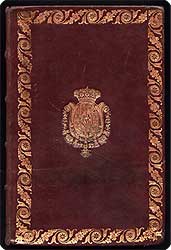
 • First edition of this uncommon defense of the Church and its involvement
with contemporary politics. The work is preceded by a portrait of the Count,
here depicted in his study, with cigarette in hand.
• First edition of this uncommon defense of the Church and its involvement
with contemporary politics. The work is preceded by a portrait of the Count,
here depicted in his study, with cigarette in hand.
 Binding:
Signed binding (with Bilbao’s ticket on front pastedown) of oxblood
morocco, front and back covers framed in a wide gilt roll surrounding gilt-stamped
coat of arms of Francesco de Assisi de Bourbon, Duc de Cadiz (consort to Isabella
II of Spain); spine with four raised bands, compartments gilt extra, with
author, title, and date gilt-stamped. Board edges and turn-ins with gilt rolls;
all page edges gilt; blue moiré endpapers.
Binding:
Signed binding (with Bilbao’s ticket on front pastedown) of oxblood
morocco, front and back covers framed in a wide gilt roll surrounding gilt-stamped
coat of arms of Francesco de Assisi de Bourbon, Duc de Cadiz (consort to Isabella
II of Spain); spine with four raised bands, compartments gilt extra, with
author, title, and date gilt-stamped. Board edges and turn-ins with gilt rolls;
all page edges gilt; blue moiré endpapers.
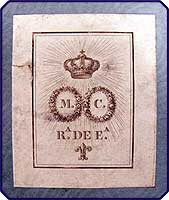
Provenance: Front pastedown with bookplate of Maria Christina, Queen of Spain.
• Palau 350495. Binding as above, showing light wear, spine slightly
faded; pastedowns with some offsetting, endpapers with spots of foxing. Rare
and attractive.

19th-Century Reader's Comment: “This book is full of folly and exag[g]erations” Melville, Herman. White-Jacket, or the world in a man-of-war. New York: Harper & Brothers; London: Richard Bentley, 1850. 12mo. 456 pp., [1 of 3] leaves of ads.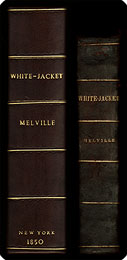
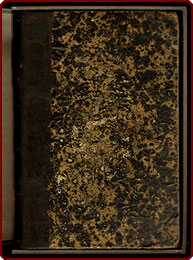
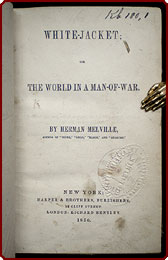
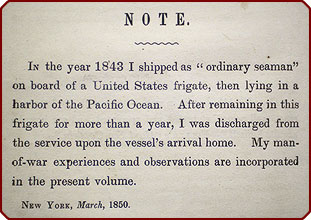
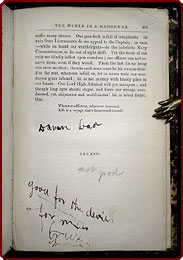 Click the images for enlargements.
 And, indeed, this account of a young man's experiences on the Neversink on a voyage around “The Horn” recounts the cruelty and hardship that Melville and all seaman experienced on naval vessels, but it also tells of camaraderie and good times.
Evidence of readership: Foremargins with finger oil staining. Notes in margins: p. 275, “this book is full of folly and exagerations” (sic); p. 345, “perfectly just”; p. 389, “what an improbable story — a regular U.S. Sailor wearing a rag[g]ed white jacket, a regular non-descript”; p. 403, “mis print”; lower area below final line of text: “damn bad,” “not good,” “good for the devil.”
Provenance: From the library of the German Society of Pennsylvania.
• BAL 13662; Wright, II, 1871. Slightly later quarter
sheep with marbled paper sides; binding shows wear, refurbished. Text with
staining and spotting as evidence of heavy reading and use; last several gatherings
with reinforcement at gutter. Various margins with short tears. Two leaves
misbound; lacks two leaves of advertisements. Ex–social club library:
call number on endpaper and at top of title-page, pressure- and rubber-stamp
on title-page, three pages with light rubber-stamp, no other library markings.
Now in a half-calf clamshell case with gilt spine. A
copy with a distinct, interesting, and perhaps further-explorable history!
(26827)

 Another
ofCortlandt
Bishop's
Mérimée,
Prosper. Colomba. Paris: L. Conquet, 1904. Small folio.
Another
ofCortlandt
Bishop's
Mérimée,
Prosper. Colomba. Paris: L. Conquet, 1904. Small folio.
• Bound by M. Lortic in red morocco, gilt extra with accents of black; original wrappers bound in; rubbing to joints at top and bottom. Wide turn-ins with gilt dentelles; marbled endpapers. All edges gilt.
The End Times, According to Muggleton Muggleton, Lodowick. A true interpretation of the eleventh chapter of the Revelation of St. John, and other texts in that book; as also many other places of Scripture. London: Pr. for the author, 1662. 4to (18.9 cm, 7.4"). [16], 172, [2 (blank)] pp.

 Click the images for enlargements.
 Provenance: Final blank leaf with inked inscriptions reading “Tho.s. Scupholme His Book 1740" and “Henery Collier His Book 1759.”
• ESTC R267; Wing (rev. ed.) M3050; Smith, Anti-Quakeriana, 305. Period-style calf, covers framed in blind double fillets, spine with gilt-ruled raised bands and gilt-stamped leather title-label. Pages age-toned and spotted; one leaf with tear from lower margin into text, sewn by hand some time ago. (26004)
 For
more MUGGLETONIANA, click here.
For
more MUGGLETONIANA, click here.
20 CHROMOSMurray, Hannah Lindley & Mary. The
toilet. Washington, DC: William Ballantine [Ballantyne], 1867. 8vo (21 cm, 8.25"). [4] pp.; 20 col. plts.


 Click the interior images for enlargements.
 Provenance: Inscription to Ellie Bond Robinson (from her cousin Elizabeth); elegant small booklabel, “Gardner.”
• Publisher’s textured cloth, framed in blind, front cover with gilt-stamped title; covers and corners showing very slight traces of wear. Front free endpaper with small booklabel and with inked gift inscription dated 1887. One flap (“Circumspection”) lacking, with all other flaps present and working. An attractive copy of an uncommon item.
ALLYou Ever Wanted to Know about the PSALMS Musculus, Wolfgang. In sacrosanctum Dauidis Psalterium commentarii, in quibus et reliqua Catholicae religionis nostre capita passim, non praetermissis orthodoxorum etiam Patrum sententiis, ita tractantur, ut Christianus lector nihil desiderare amplius possit. Basileae: [colophon: Per Ioannem Heruagium, 1551]. Folio (33 cm; 13"). [6] ff., 1702 (i.e., 1694 ) pp., [1 (blank)], [45] ff. (lacks final blank).


 Click the images for enlargements.
 The texts of the psalms are given in Latin, as is the commentary and explication. As one will surmise from the size of this work, the commentary and explications are much, much more extensive than the psalms themselves!
The text is printed in roman, single-column format, with phrases and passages in Greek and Hebrew in those typefaces. Each psalm begins with a four-line woodcut historiated initial; and the typographer's lay-out and execution are both workmanlike and handsome.
Provenance: 19th-century booklabel of collector W. Jackson.
• VD 16 ZV 1677. 19th-century vellum, later recased in that binding and hinges (inside) strengthened with cloth; soiled. Pin-hole type worming at front and rear of volume, in-text and touching but only rarely costing a letter, never impairing ability to read and understand; light waterstaining in some lower margins or across corners. A very few old marginal notes or corrections. (25943)
An
Edition that HasEscaped
the Bibliographers?
Nicolaus, de Plove (a.k.a. Nicolaus de Blony). TRactatus [sic] sacerdotalis d[e] sacrame[n]tis: de[que] diuinis officiis et eoru[m] administrato[n]ibus. [Strassburg: Johann Knobloch, 1502–8?]. Small 4to (19 cm; 7.5"). A8C–D4D8F–K4L–M8N–R4S8T6 (-T5); [97 (of 98)] ff. (without the “tabula”).


 Click the images for enlargements.
 The text is complete but it is clear that the next to the last leaf is missing: It would contain the “Tabula” and possibly the colophon. The final blank is present.
Nicolaus's text is printed in double-column format in gothic, black-letter type, with guide letters but the initials unaccomplished.
Evidence of readership: Marginalia throughout; a small area at the beginning of four lines on A6v with early reader's inking over of the lightly printed letters (in a near perfect approximation of the gothic type).
Provenance: Ownership signature of “G. Lunndro, Woodmansey, 1852”; bookplate of Madison University; later bookplate of Colgate University (i.e., Madison changed names in 1890); later transferred to Colgate Rochester Divinity School. Deaccessioned.
• Not in VD16; not in Adams. 19th-century plain boards. Ex-library with bookplates of two different institutions; pressure-stamp on title- and other leaves; five-digit acquisition number stamped in lower margin of first leaf of the prologue; residue of a charge pocket on rear pastedown and ink transfer to rear free endpaper. (26026)
Christian Philosophy from the “English Malebranche”
Norris, John. A treatise concerning Christian prudence: Or
the principles of practical wisdom, fitted to the use of human life, and design'd for the better regulation of it. London: Samuel Manship, 1710. 8vo (20 cm, 7.9"). [12], 399, [5] pp.
“English Malebranche”
Norris, John. A treatise concerning Christian prudence: Or
the principles of practical wisdom, fitted to the use of human life, and design'd for the better regulation of it. London: Samuel Manship, 1710. 8vo (20 cm, 7.9"). [12], 399, [5] pp.
 Click the interior image for an enlargement.
 Provenance: 18th-century inscription, “Master Griffith Boynton”; 20th-century bookplate of the John Donne scholar Charles Monroe Coffin.
• ESTC T76120. On Norris, see: Dictionary of National Biography. Contemporary speckled calf, framed and panelled (with plain calf) in blind with blind-tooled corner fleurons, rebacked, spine with recent gilt-stamped leather title-label; edges and corners showing minor rubbing, front cover with small faint area of staining from a now-absent paper label. Front pastedown with private collector's bookplate (institutionally rubber-stamped), as above; front free endpaper with inked inscription, as above; title-page institutionally rubber-stamped in lower margin. Two pencilled marginal annotations; scattered pencilled bracketing. Pages age-toned, with occasional light spotting. (20902)


 TO
Part VII TO
Part VII |