 16TH-CENTURY BOOKS
16TH-CENTURY BOOKS
16TH-CENTURY BOOKS
 German
 RENAISSANCE Caesar — Lushly Illustrated
 Caesar, Julius. Julius der erst römisch Keiser von seinem Leben und Krieg, erstmals uss dem Latein in Tütsch gebracht vnd mit andrer Ordnung der Capittel und uil zusetz nüw getruckt. [Strassburg: Durch Joannem Grüninger, vff sant Adolffs des heiligen Bischoffss, 1508]. Folio (31 cm; 11.5"). A6 Aa8 B6 C4 D–N6 O4 P–Z6 Zz6; [148] ff., illus.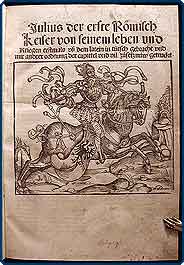
 All images of this book enlarge, via single-click.
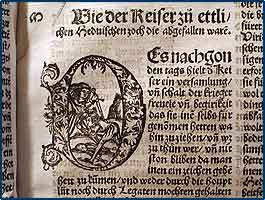
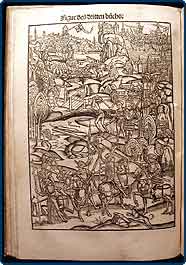
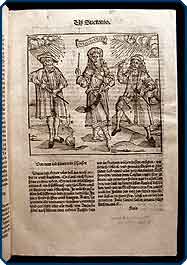
This handsome and  SCARCE book is famous for its woodcut illustrations: It has one quarter-page, four half-page, one three-quarter page, and
  eleven full-page woodcuts. These include battle scenes, the assassination, camp life, etc., all of the figures being dressed anachronistically in Renaissance garb.
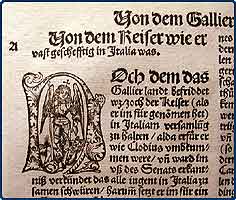 The text is printed in large gothic in double-column format.
 Of the first edition we find only two copies in the U.S. (Harvard and Stanford), and of the second we trace three (Brown, Duke, and Trinity College), all being incomplete except the Brown copy.
• Index Aurel. 128.654; Schmidt, Repertoire bibliographique Strasbourgeois, no. 91, p. 40–41; Schweiger, II, 51; not in Adams (who only lists much later editions in German). Recased in an 18th-century vellum-over-boards binding. Sophisticated copy in all likelihood, with several leaves apparently supplied from a different copy, those leaves being either slightly smaller than the others or more heavily sized. Occasional light waterstains in from a very few margins; two leaves with old scribbling in ink in margins; minor worming in lower margin of last six leaves.  A very nice copy of a very scarce book that is clearly difficult to find complete, incomplete, or sophisticated.
 Life & Letters — A German Neo-Latin Poet Camerarius, Joachim. Narratio de H. Eobano Hesso, comprehendens mentionem de compluribus illius aetatis doctis & eruditis uiris, composita à Ioachimo Camerario Pabebergensi. Epistolae Eobani Hessi ad Camerarium & alios quosdam, familiari in genere .... Norimbergae: Ioanne Montano & Ulrico Neubero, 1553. 8vo (16.3 cm, 6.4"). A–Z8a–b8 (O4 bound in after O5); [200] ff. [bound with] Hessus, Helius Eobanus. Libellus alter, epistolas complectens Eobani et aliorum quorundam doctissimorum virorum, necnon versus varii generis atque argumenti.... Lipsiae: Ex officina Papae, 1557. 8vo. A–K8 (-A8); [79] ff. (last leaf of preface/errata lacking). [and the same author’s]. [Tertius libellus epistolar. Eobani et aliorum.] [colophon:] Lipsiae: M. Ernesti Voegelini Constantiensis, 1561. 8vo. A–T8 (-A1, -T8 [final blank]); [150] ff. (title-page and final blank lacking).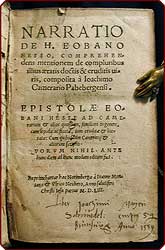
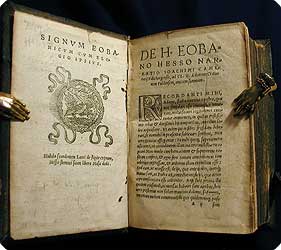 Click the images for enlargements.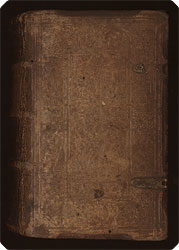
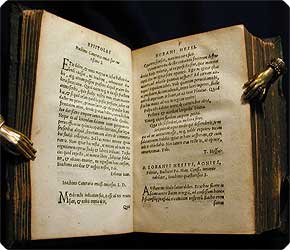
• Narratio: Adams C436; Brunet, II, 1009; VD16 C480 / VD16 C408. Libellus: Brunet, II, 1009; VD 16 C409; not in Adams. Tertius libellus: Brunet, II, 1009; VD16 C410. Binding as above, spine with later hand-inked paper label; binding much darkened and somewhat rubbed, one clasp intact and the other lacking. First title-page with ownership inscription dated 1559 inked in lower margin; Libellus alter lacking last leaf of preface (with errata on reverse) and Tertius libellus epistolar lacking title-page. Some corners dog-eared; two leaves with outer corners torn away, without loss to text. Early inked underlining and lining through of text, with a few marginalia, mostly in Narratio and occasionally in other two works. Last few leaves of final work with light waterstaining to lower outer corners.

 Canisius' Catechism of theYoungest Children Canisius, Petrus, Saint. Institutiones christianae pietatis. Seu parvus catechismus catholicorum. Coloniae : Apud Maternum Cholinum, 1571. 12mo (13.5 cm; 5.25"). [16] ff., 51, [1] pp., [36] ff.
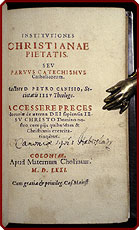
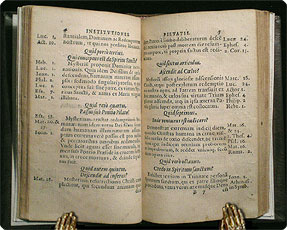
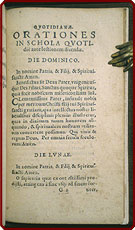 Click the interior images for enlargements.
 Offered here is an early printing of the version for the youngest students. The title-page and calendar are printed in red and black, and a few headlines in the early section are also in red.
Uncommon. OCLC locates only this now deaccessioned copy in the U.S., and one copy in Europe. Index Aureliensis fails to list this edition at all.
• Not in Index Aurel.; not in Adams. Recent ebony-brown calf old style: Round spine with raised bands, accented in gilt and with blind-tooled devices in compartments; single blind rules extending onto covers from each band to terminate in trefoils, and covers framed in blind double fillets. Author's name and date of printing in gilt on spine. Early underscoring and some minimal marginalia in red ink in a 16th-century hand; ownership note of same era on title-page. Some age-spotting and other light discoloration, not serious. For an early children's book, a very, very nice copy. (24855)

 Stolen
Letters!
Damage
Control! —
The Reformation
Capito, Wolfgang [a.k.a., Wolfgang Köpfel]. Der
nüwen zeytu[n]g vnd heymlichen wunderbarlichen offenbarung so D. Hans Fabri jungst vfftriben
vnd Wolffgang Capitons brieff gefälschet hat bericht vnd erklerung. Strassburg: No
publisher/printer, 1526. Small 4to. [32] ff.
Stolen
Letters!
Damage
Control! —
The Reformation
Capito, Wolfgang [a.k.a., Wolfgang Köpfel]. Der
nüwen zeytu[n]g vnd heymlichen wunderbarlichen offenbarung so D. Hans Fabri jungst vfftriben
vnd Wolffgang Capitons brieff gefälschet hat bericht vnd erklerung. Strassburg: No
publisher/printer, 1526. Small 4to. [32] ff.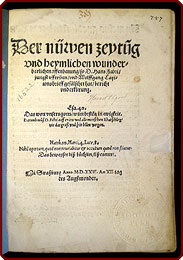
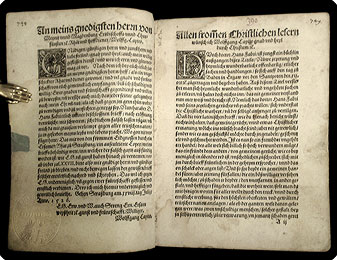
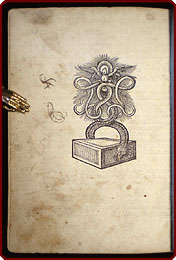 Click the images for enlargements.
 In his capacity as a leader of the early Reformation he was present at several important “conferences” (the second Zürich and that at Marburg). He coauthored, with Martin Bucer, the Confessio Tetrapolitana.
Capito's archenemy was a Dominican named Hans Faber (a.k.a. Johannes Faber), the vicar general of the bishop of Constance, who at every turn sought to undermine Capito and his relations with authorities and other Reformers, Zwingli in particular. Der nüwen zeytu[n]g is Capito's rebuttal of Faber's Newe Zeittung vnd heimliche wunderbarliche Offenbarung etlicher sache[n] vnd handlungen so sich vff dem tag der zw Baden, in which Faber published distorted versions of letters his agents had stolen that were addressed to Zwingli by Capito and relate to the disputation at Baden in 1526, which Zwingli had decided not to attend.
Schrodt and Vogelstein summarize: “Capito's defense in this tract suggests that he was not altogether comfortable with the language he had used, intended as it was for the eyes of a friend and spiritual comrade in arms. By presenting his original text passage by passage together with Faber's published German version of the same, Capito shows that it given the most offensive turn through the opponent's manner of translation.”
This proffers a large, interesting woodcut device on the verso of its last leaf and two small but nice woodcut initials in text.
Provenance: Ownership signature on title-page of Howard Osgood, noted late 19th- and early 20th-century collector and scholar; old circular pressure-stamp on same page of a seminary (properly released).
WorldCat finds no copies in North America and COPAC finds none in Great Britain.
• Panzer, II, 3051; Kuczynski 381; Index Aurel.; 131.648; VD16 C828; Schrodt & Vogelstein 28–29. In later plain wrappers; title-page torn with small loss of blank foremargin, repaired. Two different sequences of manuscript pagination, one in red, indicating the opusculum was bound at least twice in different sammelbands. Provenance indications as above, and a five-digit number in ink in the inner corner of the title-page; dust-soiling and old staining. (25953)
The Pope Lays It Down Here Catholic Church. Pope (1590–1591: Gregory XIV). Declaration de n.s. pere le pape Gregoire XIIII. Sur les lettres qui luy ont esté escrites par la noblesse qui suit le Navarrois. Paris: Robert Nivelle & Rolin Thierry, 1591. 8vo (15.9 cm, 6.25"). 14, [2] pp.
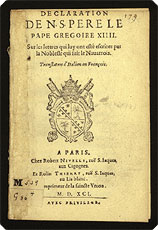 Click the image for an enlargement.
 This little pamphlet appears to be a scarce variant; OCLC finds no holdings, and the title is not listed by Lindsay & Neu.
• Not in Lindsay & Neu, French Political Pamphlets 1547–1648. Disbound. Title-page with paper shelving label, institutional pressure-stamp, and residue from previous nonce binding along inner margin; four other pages also pressure-stamped. Additional inked pagination in upper outer corners, in an early hand. (24463)


ImportantEarly Christian Hebrew Grammar Chevalier, Antoine-Rodolphe. Rudimenta Hebraicae linguae, accurata methodo & breuitate conscripta. Eor undem rudimentorum praxis, quae viuae vocis loco esse possit. Vitebergae: Iohan. Cratonem, [colophon: 1574]. 4to (20 cm, 7.9"). [16], 331, [1 (blank)] pp.
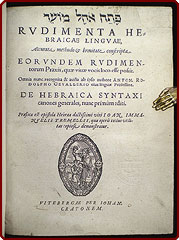
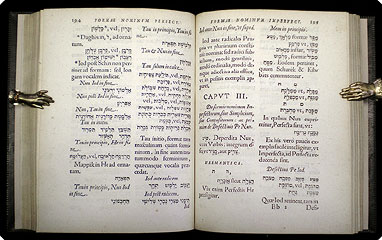 Click the images for enlargements.
 Uncommon: OCLC and NUC Pre-1956 locate only two U.S. holdings of this edition, one since deaccessioned.
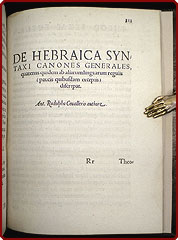
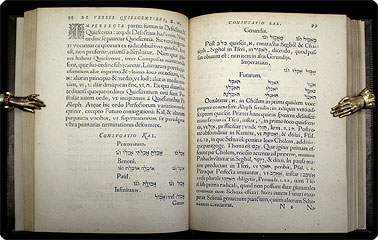
 A nice copy. (25649)
The Augsburg Confession — 51 Documents The First Much Annotated Chytraeus, David. Histoire de la confession d'Auxpourg, contenante les principauls traittez & ordonnances, faittes pour la religion, quand l'electeur Iehan, duc de Saxe auec les citez & autres princes protestants presenterent leur confession de foy (icy inserée) a l'Empereur Charles V. os estats generauls de l'empire, tenus a Auxpourg, 1530. Anvers: Chez Arnould Coninx, 1582. 4to (24.3 cm, 9.55"). [8], 835, [5] pp.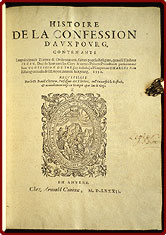
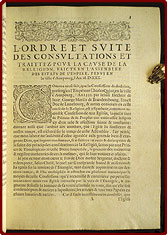
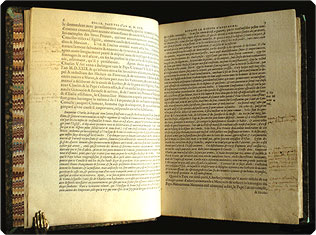 Click the interior images for enlargements.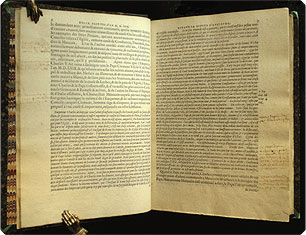
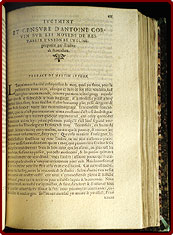
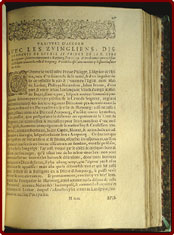
Rare. OCLC lists only four U.S. holdings and one deaccessioned copy (the present example).
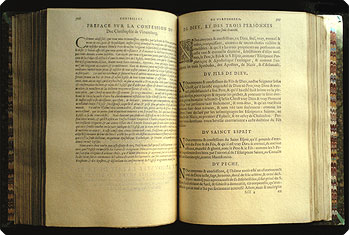
• Brunet 22420; Graesse, II, 154. Not in Adams. 19th-century quarter olive morocco with marbled paper–covered sides, spine with gilt-stamped author/title; edges and extremities rubbed. Top edge gilt. Front pastedown with bookplate as above; title-page and first text page each with early inked ownership inscription. Four leaves with small repaired tears from outer margins and three likewise from upper margins, not touching text in any case. Extensive early inked marginalia in first document, scattered examples elsewhere. (23536)
Conduct of Life duringthe Reformation Chytraeus, David. Regulae Vitae. Virtutum descriptiones methodecae, in Academia Rostochiana propositae, & recens recognitae. Vitebergae: Excudebat Iohannes Crato, 1557. Small 8vo (16 cm; 6.25"). [128] ff.
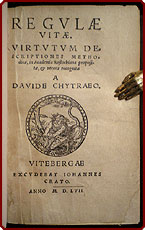
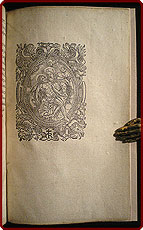 The final leaf with the beautiful Crato printer's device is present.
Chytraeus (1530–1600) was a German Lutheran theologian and historian and one of the authors of the Formula of Concord (1577), an authoritative Lutheran statement of faith. All of the first three editions of his Regulae Vitae (1555, 1556, 1557) are rare in U.S. libraries; only three copies of the 1555 are reported, two of the second, and one of the third, with a second copy of that last having been deaccessioned in 2006.
• VD16 C2736; Index Aurel. 136.817. Recent ebony-brown calf old style; round spine with raised bands accented in gilt and blind-tooled devices in compartments; single blind rules extending onto covers from each band to terminate in trefoils, and covers framed in blind double fillets and with a blind-tooled dentelle roll. Title, place of publication, and date in gilt on spine. Old repair to lower corner of title-page and that leaf reinforced at gutter; internally very good. (25096)
Peter Martyr MeetsSt. Clement of Alexandria Clement, of Alexandria, Saint. Clementis Alexandrini, viri longe doctissimi, qui Panteni quidem martyris fuit discipulus, praeceptor verò Origenis, omnia, quae quidem extant opera, à paucis iam annis inventa, [et] nunc denuò accuratiùs excusa Gentiano Herueto Aureliano interprete ... [with another, as below]. Basileae: Per Thomam Guarinum, 1566. Folio (33.5 cm; 13.125"). 364 pp., [8] ff. [also bound in] Vermigli, Pietro Martire. In selectissimam D. Pauli priorem ad Corinthios Epistolam. Tiguri: apud C. Froschouerum, 1567. Folio (33.5 cm; 13.125"). [6], 242, [17] ff. (lacks final blank). 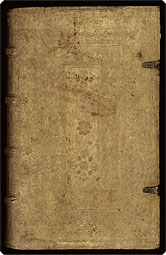
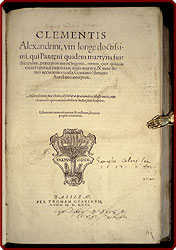
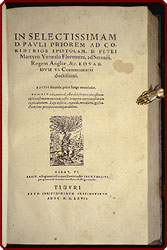
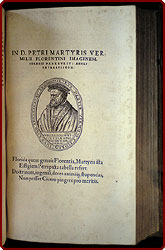 Click the images for enlargements.
 The second work is Peter Martyr's commentaries on Corinthians, here in the second edition. It has a full-page woodcut portrait of him on the recto of leaf aa6. The printer's woodcut device is on the title-page and there are numerous woodcut initials. The sidenotes are printed in italic while the text proper is in roman.
Peter Martyr (8 September 1499 – 12 November 1562), was an Italian theologian who began his religious life as an Augustinian friar, converted to the Protestant cause, was closely associated on the continent with Ochino, Bucer, and some prominent Lutherans, and, while in England where he held the Regius Chair of Divinity at Oxford, was an intimate of Thomas Cranmer and Bishop Jewel.
Both works are uncommon in these editions in the U.S.: We locate four copies of the first title and two of the Vermigli, but one copy of each title has been deaccessioned, meaning current holdings are three and one only.
Binding: Contemporary alum-tawed pig over wooden boards with bevelled edges and metal and leather clasps; one clasp perished. Leather tooled elaborately in blind using a variety of rolls and fillets, including one roll incorporating the date 1546, a medallion of David and his harp, and another medallion depicting John the Baptist with the words below the image, “Ecce Agnus Dei.”
• Clement: VD16 C4070; Index Aurel. 104.903; Adams C2106. Vermigli: VD16 B5054; Adams M788. Bound as above. Ex-library with bookplate on front pastedown, small blind pressure- (not perf-.) stamp on title-page and remnant of charge pocket at rear; six-digit number stamped in lower margin of one leaf. Early inked ownership indicia on title-page and old private ownership stamp on front free endpaper; a little old marginalia and underlining. A very little foxing and the odd spot only. Excellent copies of both works in a handsome contemporary binding. (24827)
ELIZABETH Must Have Loved HisThinking on Monarchy Crompton, Richard, ed. L'authoritie et iurisdiction des
courts de la maieste de la Roygne: nouelment collect & compose, per R. Crompton del milieu Temple esquire. Apprentice del ley. Londini: Caroli Yetsweirti, 1594. 4to. [4], 232 ff.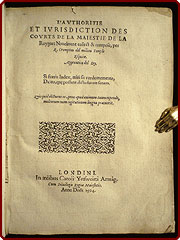
 Single-click any image where the hand appears on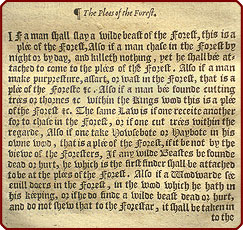
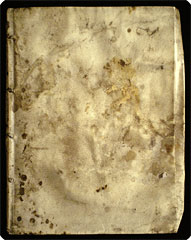
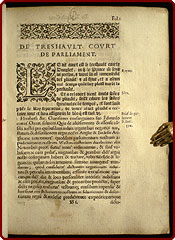
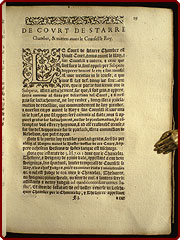
Written in Law French with some Latin, and with extended passages entirely in English in the section on “forrest” law; printed in black letter.
Provenance: Contemporary inked signatures to fly-leaf of Henry Wynn/Wine (Middle Temple?).
• ESTC S109077; STC (2nd ed.) 6050; Lowndes, I, 558. Contemporary limp vellum with remnants of ties. Pinhole or small worming throughout to top margins, touching a few letters in headings; light waterstaining to margins/corners of first/last leaves; one preliminary with just a very little bug-spotting. Paper flaws in margins of ff. 45, 164, and 172; last leaf a little tattered. Overall, very good. (21344)
Letters
of OBSCURE MEN —
Their Authors &
EVERYBODY ElseCrotus Rubeanus, Johannes, & Ulrich von Hutten. Duo volumina epistolarum obscurorum virorum, ad Dominum M. Ortuinum Gratium, Attico lepôre referta, denuò excusa, & à mendis repurgata. Francoforti ad Moenum: [Apud Ioannem Spies, impensis Sigismundi Feyerabenij], 1581. 8vo (16 cm, 6.25"). [179] ff. (lacking appendix: 16 ff.).

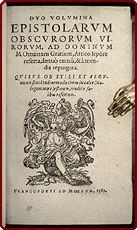
Click the images for enlargements. This example is lacking the appendix (entitled Conciliabvlvm theologistarvm adversvs Germaniae, & bonarum literarum studiosos), and thus is without the colophon providing printer and bookseller information. The title-page bears the printer's device of Feyerabend: Fame and her trumpets.
Uncommon: OCLC and NUC Pre-1956 locate only seven copies of this edition in U.S. libraries, one having been deaccessioned.
• VD16 E1729. This ed. not in Adams or Brunet. Period-style calf, covers framed in blind rolls, spine with gilt-stamped title/date and gilt- and blind-accented raised bands (blind tooling extended onto boards, terminating in decorative fleurons); spine compartments decorated in gilt and blind. Appendix (16 ff.) lacking; letters complete and the handsomely printed text all clean. (25643)

 TO Part
III .
. . TO Part
III .
. . |