
 16TH-CENTURY BOOKS
16TH-CENTURY BOOKS
16TH-CENTURY BOOKS
 This Author Covers a Lot Here
 Lindanus, Guilelmus Damasus. In hoc libello contenta: Tabulae grassantium passim haeresen anasceuasticae ... Quibus Subtexitur sectae Lutheranae trimembris epitome. Antuerpiae: Apud Joannem Withagium, 1562. Small 8vo. [46], 26 ff.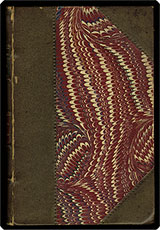
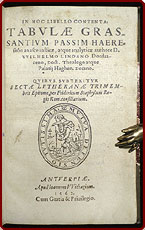
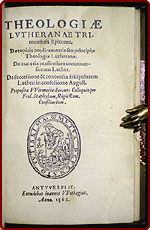
Rare in the U.S., withWorldCat locating only one copy in America (this at Notre Dame).
• Adams 728. 19th-century half-calf with marbled paper sides; leather (only) cracked at hinges, with volume holding quite sound. Library bookplate but no other markings. (19937)

 Cortés Malinche & Montezuma López de Gómara, Francisco. Historia, di Don Ferdinando Cortes, marchese della Valle, capitano varlorosissimo. In Venetia: per Giouanni Bonadio, 1564. 8vo. [8], 354 of 356 ff. (lacking fol. 1 and final blank).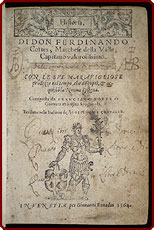
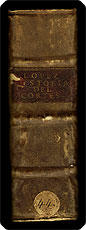
The Historia general de las Indias (first published in 1552) is divided into two parts which stand on their own although clearly written as two parts of a whole. Part I is a history of events concerning the discovery and conquests of the New World exclusive of those involving Cortés. Part II is entirely dedicated to the telling of Cortés's role in the conquest of Mexico and subsequent discoveries.
 Click the images for enlargements.
 In this Italian translation from the pen of Agostino di Cravaliz, López's “all-Cortés” volume stands as part III of the three-volume Historia, delle nuove Indie Occidentali, with parts I and II being translations of Cieza de Leon's Historia, over Cronica del gran regno del Peru and the previously mentioned part I of Gómara's Historia general de las Indias.
The text here is printed in italic type except the capitals, which are roman. The title-page is printed in roman and italic and has the woodcut printer's device.
• Alden & Landis 564/25; Sabin 27741; Medina, BHA, 159n; Wagner, Spanish Southwest, 2v. 18th-century vellum over paste boards, soiled and a bit rubbed; red leather spine label, with a chip, and an old circular paper shelf-label. Title-page dust-soiled, mounted; small, narrow, oblong portion of blank area of title-page excised and filled in at an early time. Lacks folio 1 and final blank. Top margins closely trimmed, sometimes costing the running heads and folio numbers. (25767)

Parasites in Apotheosis Lucianus, Samosatensis. [three lines in Greek characters transliterated as] Loukianou Peri Parasitou, etoi hoti techne he parasitike, [then in roman characters] Luciani parasitus, ubi artem ese parasiticam astruit. Parisiis: Ex officina Christiani Wecheli, 1536. Small 8vo. [20] ff.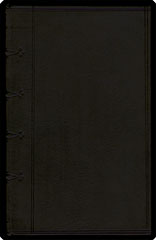
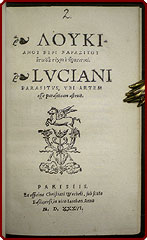
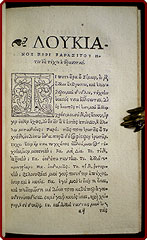 Click the interior images for enlargements.
 Text entirely in elegant Greek and with but one woodcut initial. The printer's device of a Pegasus is on the title-page.
Rare: We find no copy in WorldCat or COPAC. Moreau locates one copy in the Anglo world, at the Morgan Library.
• Moreau, V, 228. Full dark modern calf old style, absolutely plain without labels; spine with raised bands accented with blind rules extending onto covers to terminate in trefoils, and simple blind double fillets to covers. One old numeral inked to title-page; text unmarked with paper clean and even bright, throughout. (25728)

 King-Killing
is
King-Killing
is NOT
to Be Indulged
In
[Masson, Jean Papire]. Ad Franc. Hotomani
Franco-galliam Antonii Matharelli...responsio. Lutetiæ: Ex off. Federici
Morelli, 1575. 8vo. A–L8; 163, [1] pp., [6] ff.
NOT
to Be Indulged
In
[Masson, Jean Papire]. Ad Franc. Hotomani
Franco-galliam Antonii Matharelli...responsio. Lutetiæ: Ex off. Federici
Morelli, 1575. 8vo. A–L8; 163, [1] pp., [6] ff. 

Provenance: Charles Spencer, Third Earl of Sunderland, lot 6554 in the Sunderland Library sale (1882).
• Adams M866. 17th-century sprinkled calf, plain sides, round spine, raised bands, gilt spine extra. Leather worn. Old dust-stain on title-page. A library's blind pressure-stamps; properly deaccessioned with no additional stamps. Speckled edges. A very good copy.

Sole Aldine Edition Mela, Pomponius. Pomponivs Mela. Ivlivs Solinvs. Itinerarivm Antonini Avg. Vibivs Seqvester. P. Victor de regionibus urbis Romae. Dionysius Afer de situ orbis Prisciano interprete. [colophon: Venetiis: In aedibvs Aldi, et Andreae soceri mense, M.D. XVIII {1518}]. 8vo (16.5 cm; 6.5"). 233, [1] ff., without the final two leaves (one blank, one with Aldine device).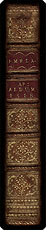
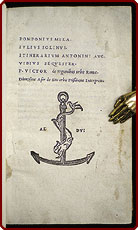
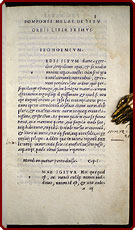
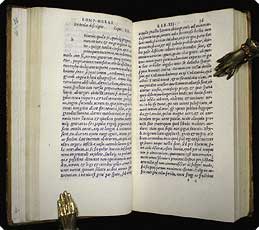 Click the images for enlargements.
 The sole Aldine edition of these works, it is also the editio princeps of Publius Victor, the second edition of Antoninus Augustus' Itinerarium, and the third edition of Dionysius in Latin.
As is to be expected, the text is in italic with spaces and guide letters provided for (unaccomplished) initials.
The register (leaf G2 recto) lists a gathering *4 that is not found here or in any known copy, so the reference would seem to be incorrect.
Binding: 18th-century English sprinkled tan calf, gilt spine extra and board edges gilt-tooled.
• Renouard, Alde, 83; Adams M1053; Schweiger, II, 607 (“seltene Ausg.”). Bound as above, small darkened spot near top of spine; joints starting to open but covers still nicely attached; without the final two leaves (one blank, one with Aldine device). Bookplate. Title-page holed at gutter, not nearing device; light waterstaining and a bit of dust-soiling to first and last leaves. Interior otherwise clean, even bright. (25876)

Dialectics Dissected Melanchthon, Philipp. Erotemata dialectices, continentia fere integram artem, ita scripta,ut iuventuti utiliter proponi possint. Lipsiae: [Iohannes Rhamba], 1562. Small 8vo (17 cm; 6.75"). [7] ff., 422 pp., [20] ff.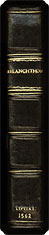
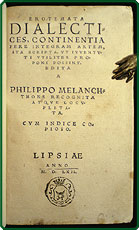
 Click the interior/detail images for enlargements.
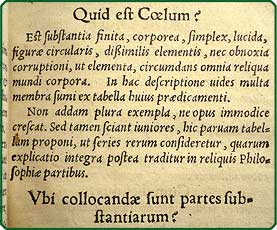
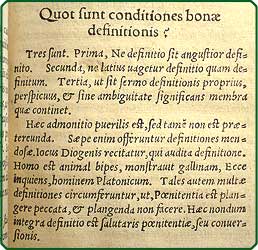
 Melanchthon here asks basic and important questions: Quid est dialectica? Quot sunt praedicabilia? Quid est genus? Quomodo differunt species item genera? Quid est deus? Quid est coelum? to mention only the first few.
• VD16 M3255. Full calf old style (signed G[race] B[indings] on lower inside corner of rear lower turn-in); tound spine with raised bands accented in gilt beading, author lettered directly on spine, fillets in blind extending onto covers from each band to terminate in trefoils with blind double fillets beyond. Light stain in lower inside area of many leaves; darker one, slimmer, at top; a little foxing, including to title-page, which has the tiniest of pin-type wormholes near its top edge. Private 18th- or 19th-century ownership stamps on two leaves. (24818)

 TO Part
VII .
. . TO Part
VII .
. . |