 LITERATURE
LITERATURE
LITERATURE
 Verse & Prose Inspired by Charity
  Independent
Order of Odd Fellows. The Odd-fellows'
offering, for 1850. Embellished with elegant engravings, and a highly-finished
presentation plate. Contributed chiefly by members of the order. New York: Edward
Walker, 1850 (© 1849). 8vo (22.3 cm, 8.75"). Col. frontis., frontis., add.
engr. t.-p., 298 pp.; 8 plts.
Independent
Order of Odd Fellows. The Odd-fellows'
offering, for 1850. Embellished with elegant engravings, and a highly-finished
presentation plate. Contributed chiefly by members of the order. New York: Edward
Walker, 1850 (© 1849). 8vo (22.3 cm, 8.75"). Col. frontis., frontis., add.
engr. t.-p., 298 pp.; 8 plts.


 Click the images for enlargements.
  illuminated
presentation plate, chromolithographed by Ackerman).
illuminated
presentation plate, chromolithographed by Ackerman).
Binding: Publisher's textured denim blue cloth, front cover with gilt-stamped vignette of Friendship, Love, and Truth personified within an architectural frame; back cover with Truth stamped in gilt within the same frame stamped in blind. All edges gilt.
• Faxon 608. Binding as above, front cover and spine lightened to an attractive dark robin's egg blue, gilt showing minor rubbing and oxidizing. Presentation leaf unused. Guard leaves foxed, pages and plates generally clean. (26749)
 “Our Ninth Annual
Casket” — Verse
& Prose
Inspired by Charity
Independent
Order of Odd Fellows. The Odd-fellows'
offering, for 1851. Embellished with elegant engravings, and a highly-finished
presentation plate. Contributed chiefly by members of the order, their wives
and sisters. New York: Edward Walker, 1851 (© 1850). 8vo (22.3 cm, 8.75").
Add. engr. t.-p., 204, [10 (adv.)] pp.; 10 plts.
“Our Ninth Annual
Casket” — Verse
& Prose
Inspired by Charity
Independent
Order of Odd Fellows. The Odd-fellows'
offering, for 1851. Embellished with elegant engravings, and a highly-finished
presentation plate. Contributed chiefly by members of the order, their wives
and sisters. New York: Edward Walker, 1851 (© 1850). 8vo (22.3 cm, 8.75").
Add. engr. t.-p., 204, [10 (adv.)] pp.; 10 plts.

 Click the images for enlargements.
  illuminated
presentation plate, chromolithographed by Ackerman). One plate,
“The Joyous Procession of the Law,” has an additional Hebrew title
carefully inked in by hand.
illuminated
presentation plate, chromolithographed by Ackerman). One plate,
“The Joyous Procession of the Law,” has an additional Hebrew title
carefully inked in by hand.
Provenance: The front free endpaper bears a neatly inked ownership inscription dated 1860 (J.C.W. Kempe) and an additional inked “sold to” inscription dated 1871 (Aden Mc Bowman); Bowman also signed another blank, and the presentation leaf is made out to Kempe as “P.G.J.C.W. Kempe.”
Binding: Publisher's deep blue/black diced sheep in imitation of morocco, covers with gilt-stamped vignette of Friendship, Love, and Truth personified within an architectural frame; spine gilt extra with column motif. All edges gilt.
• BAL 6877; Faxon 609. Binding as above, joints and extremities rubbed, spine gilt slightly dimmed. Inscriptions and presentation leaf as above. Poetry clippings, fabric swatch, and lock of hair laid in. Scattered staining, generally light, throughout; chromo very bright and nice. (27041)
 For
more AMERICAN GIFT BOOKS, click
here.
For FREEMASONRY, ODD
For
more AMERICAN GIFT BOOKS, click
here.
For FREEMASONRY, ODD
 “Cupid Befriend Me!” Ingraham, Joseph Holt. American lounger. Or, tales, sketches, and legends gathered in sundry journeyings by the author of “Lafitte,” &c. Philadelphia: Lea & Blanchard, 1839. 12mo. [10], 15-41, [5], 59-273 pp.
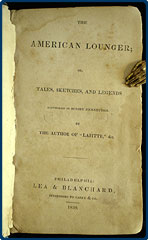 a story about General Washington entering a leaping contest and another involving the love affair between an illegitimate son of Charles I and a young maiden from a Native American tribe in Maine.
 WHITMAN
as
WHITMAN
as Herald
of Women's IndependenceIrwin, Mabel MacCoy. Whitman the poet-liberator of
woman. New York: Published by the author, 1905. 8vo (19 cm, 7.5"). Frontis., 77, [1] pp.
Herald
of Women's IndependenceIrwin, Mabel MacCoy. Whitman the poet-liberator of
woman. New York: Published by the author, 1905. 8vo (19 cm, 7.5"). Frontis., 77, [1] pp.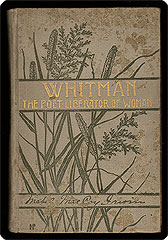
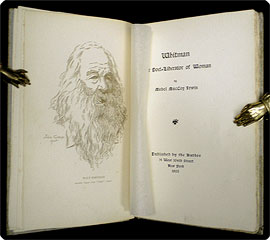 Click the images for enlargements.
 Binding:
Publisher's gray cloth, front cover with gilt-stamped title and green-stamped
grass vignette, spine with gilt-stamped title.  Binding signed “HP.” Top edge gilt.
• Binding as above, sunned and stained/spotted; front hinge (inside) cracked; frontispiece and title-page with small waterstain along inner margin. Pages mostly clean, with scattered light spotting. A copy with faults, but not faults to devastate its interest. (26629)
 A Human Rights
 Appeal/Exposé — American Indian Advocacy Jackson, Helen Fiske Hunt. A century of dishonor[.] A sketch of the United States government's dealings with some of the Indian tribes. By H. H. New York: Harper & Brothers, 1881. 12mo. x, 457, [1 (blank)] pp.; 6 pp. (ads).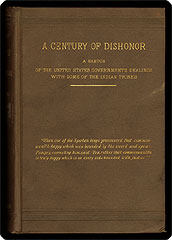
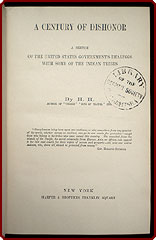 Click the images for enlargements.
 Jackson grew up in Massachusetts and was a close friend of Emily Dickinson. Her marriage in 1852 to a Captain Hunt ended tragically, for he and their two children were dead by 1865. For health reasons she moved to Colorado and in 1875 married a banker named William Jackson. She developed a keen interest in the plight of the American Indian and secured the extraordinary privilege of doing research in the Americana Department of the Astor Library in New York City during the morning hours before the doors officially opened.
She hoped this work would effect a reversal of government policy and herself purchased sufficient copies to send one to every member of both houses of Congress. She then turned to fiction as another avenue of attack: Her best-known novel, Ramona, was her attempt to produce for American Indians a work that would affect their lot as Uncle Tom's Cabin did the plight of black slaves.
 A landmark book.
• BAL 10444. Publisher's brown cloth, lettered in gold. Ex–social club library: 19th-century bookplate, call number on endpaper, rubber-stamp on title-page, no other markings. Two small areas of minor discoloration on spine where paper shelving labels removed. Overall a very nice copy. (26260)
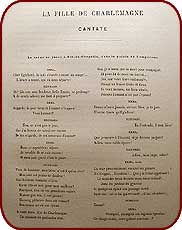
APearl of a Book of Its EraJacob, P.L. Les perles. Pièces d'écrin artistique et littéraire. Paris: Veuve Jules Renouard, 1867. Folio (35 cm, 13.75"). Add. engr. t.-p., [2], 81, [1] pp.; 22 plts.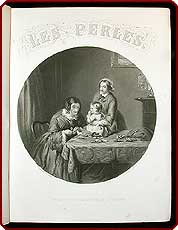
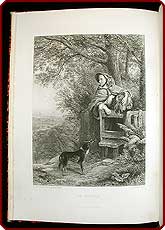
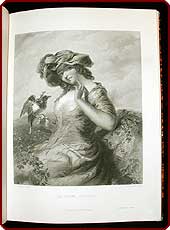 Click any image where the hand appears onundescribed in any major database. Edited and contributed to by the prolific French author Paul Lacroix, best known as “Bibliophile Jacob,” this lovely collection of short stories, poems, and meditations by Lacroix, Balzac, Émile Délerot, Charles Nodier, et al. is illustrated with22 large steel engravings done by J.C. Armytage, W. Greatbach, J.B. Allen, J.T. Willmore, F. Joubert, and others after designs by artists including Turner, Webster, etc.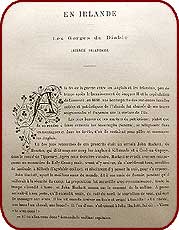
For
more BOOKS IN FRENCH, click here.
Incunable
“Golden Legend”
— The
Stories EVERYONE Knewin
1489Jacobus, de Voragine. Lombardica historia que a plerisq[ue] Aurea legenda sa[n]ctorum appellatur. [Arge[n]tine: {Printer of the 1483 Jordanus de Quedlinburg (Georg Husner)}, 1489]. Small folio (27 cm). [260 of 264] ff. 

 Click any image where the hand appears onpage
for page reprints. The imprint information is from the colophon
on H5r.
Click any image where the hand appears onpage
for page reprints. The imprint information is from the colophon
on H5r.
This is an uncommon edition in the U.S. though heavily held in Europe; Goff and ESTC locate only two U.S. copies — this being one of them, deaccessioned.


The text is printed in double-column format in gothic type.  In
this copy, virtually all of the initials are nicely accomplished in red or
blue.
In
this copy, virtually all of the initials are nicely accomplished in red or
blue.
• Copinger, II, 6452; ISTC ij00122000; Proctor 618; BMC, I, 138; Goff J122. 19th-century quarter German calf with black mottled paper sides. Various waterstaining throughout, with other stray stains; copy missing first two and final two leaves of text, and the leaves at front and back remargined (with some others repaired). Priced according to faults, not pleasures!
To
view our INCUNABLES, click here.
English Incunable Leaf — Crucifixion WoodcutJacobus de Voragine. Golden legend [single leaf]. [Westmynster: Wynkyn de Worde, 1498]. Small folio (27.5 cm; 10.5"). [1] f. .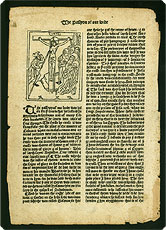
 Click the images for enlargements.
 The text is printed in double-column format in English gothic type. The printer, Wynkyn de Worde (a.k.a., Jan van Wynkyn) was England's first typographer and worked with William Caxton, England's first printer. In 1495, he took over Caxton's print shop, but only after a difficult three-year litigation following Caxton's death in 1491.
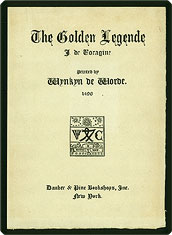
Provenance: Sold by Dauber & Pine (NY), the firm having dismembered an incomplete copy of the work and offered the individual leaves each with a letter-press leaf serving as ad hoc title-page.
English incunable leaves with woodcuts are increasingly difficult to obtain. That this Golden Legend leaf bears the image at the heart of its matter makes it a particularly desirable one.
• STC (rev. ed.) 24876; ESTC S103597; Duff 411; Copinger 6475; Goff J-151. Irregular in the margins and the recto of the leaf with old ink crossing out. The page with the woodcut in very good condition. (24601)
“On
a brilliant day in May, in the year 1868
. . .”
James,
Henry. The American. Boston: Houghton,
Mifflin & Co., 1882. 8vo. 473, [1] pp.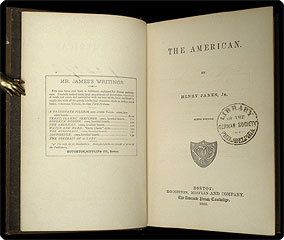
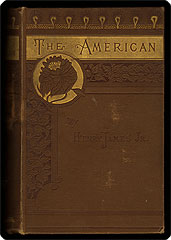 Click the images for enlargements.
 • Edel & Laurence, Bibliography of Henry James (3rd. ed.), A4 (for first ed.); Wright, III, 2909 (for first ed.). Publisher's brown cloth, front cover and spine stamped in gilt and maroon; a bit cocked, rubbed, spine with area of discoloration from now-absent label, and some light patches to cover cloth. Ex–social club library: call number on blank side of preliminary advertisement, rubber-stamp on title-page, no other markings. Pages age-toned, with faint staining in upper margins towards back of volume. (26559)
Bernard & Gordon & Angela James, Henry. Confidence. Boston: Houghton, Osgood & Co., 1880. 12mo (19.4 cm, 7.6"). [2], [5]–347, [1] pp.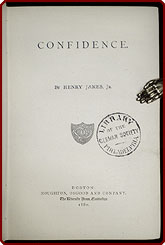
 We have, at the moment, an interesting number of such “first American editions.” Please, enquire!
• BAL 10549; Edel & Laurence, Bibliography of Henry James (3rd. ed.), A11b; Wright, III, 2913. Publisher's terra-cotta cloth, spine with gilt-stamped title; extremities rubbed and cloth with areas of discoloration. Ex–social club library: call number on endpaper, rubber-stamp on title-page, no other markings. Pages with scattered light stains, still a very nice copy. (26637)

1st
U.S. Edition — The
Europeans
James,
Henry. The Europeans. A sketch. Boston:
Houghton, Osgood & Co., 1879. 8vo (19.4 cm, 7.6"). [2], 281, [1] pp.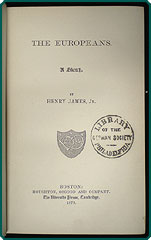
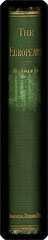
• BAL 10537; Edel & Laurence, Bibliography of Henry James (3rd. ed.), A7b. Publisher's green finely cross-ribbed cloth, covers framed in blind, spine with gilt-stamped title; corners and spine extremities rubbed, sides with small spots of discoloration, spine darkened with lighter, rubbed patch under title. Ex–social club library; 19th-century call-number inked to a front blank and rubber-stamp to title-page, no other markings. (26569)
 First American Edition
James, Henry. The Reverberator. London & New York:
Macmillan & Co., 1888. 8vo (18.1 cm, 7.1"). [4], 229, [1] pp.
First American Edition
James, Henry. The Reverberator. London & New York:
Macmillan & Co., 1888. 8vo (18.1 cm, 7.1"). [4], 229, [1] pp.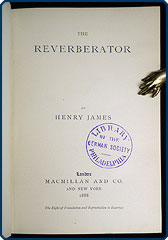
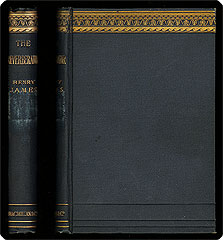
• BAL 10583; Edel & Laurence, Bibliography of Henry James (3rd. ed.), A31b. Not in Wright. Publisher's blue cloth, upper edge of front cover and spine with gilt-stamped decorative band, spine with gilt-stamped title; binding very slightly cocked, very minor rubbing, spine with square of light discoloration from a now-absent label. Ex–social club library: 19th-century call number on half-title, title-page rubber-stamped. No other markings. (26537)
We have, at the moment, an interesting number of
“InvestigatingOur Scottish Dialect”James V, King of Scotland; Callander, John, ed. Two ancient Scottish poems; The Gaberlunzie-man, and Christ's kirk on the green. Edinburgh: Pr. by J. Robertson, 1782. 8vo (21 cm, 8.25"). [2], 179 (i.e., 193), [1] pp. (1 prelim. f. lacking).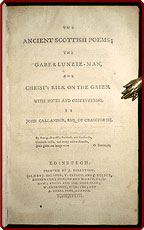
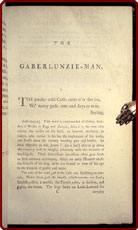 Click either image for an enlargement.
 ESTC notes that one institution reports a frontispiece, but most other listings cite a preliminary leaf (not present here) rather than a plate. No, this does NOT photograph well! — but it is very interesting in the hand, under the eye.
• ESTC T146717; Allibone 328. 19th-century half morocco and pebbled cloth–covered sides, spine with gilt-stamped title; rubbed and sides sunned. Front pastedown with private collector's bookplate. Lacking one preliminary leaf; title-page partially separated, with faint pencilled annotation beneath author's name. Occasional light spotting, confined to inner and outer margins; one early inked annotation in the addenda to the first poem. (24880)
 Hoe
Copy — BalladsBeautifully
BoundJamieson, Robert. Popular ballads and songs, from tradition, manuscripts, and scarce editions; with translations of similar pieces from the ancient Danish language, and a few originals by the editor. Edinburgh: Archibald Constable & Co. (pr. by J. Ballantyne & Co.), 1806. 8vo (22.2 cm, 8.75"). I: [6], ii, xix, [1], 352 pp. II: [4], iii, [1], 409, [5] pp.
Hoe
Copy — BalladsBeautifully
BoundJamieson, Robert. Popular ballads and songs, from tradition, manuscripts, and scarce editions; with translations of similar pieces from the ancient Danish language, and a few originals by the editor. Edinburgh: Archibald Constable & Co. (pr. by J. Ballantyne & Co.), 1806. 8vo (22.2 cm, 8.75"). I: [6], ii, xix, [1], 352 pp. II: [4], iii, [1], 409, [5] pp.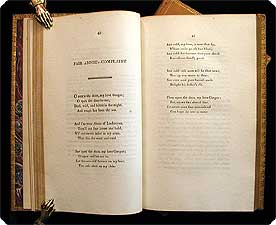
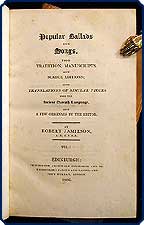 Single-click either image for an enlargement.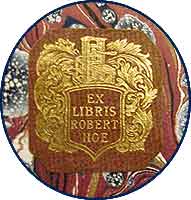
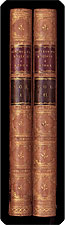 Provenance: Hoe copy, with morocco “Ex libris Robert Hoe” bookplates on both front
pastedowns.
Provenance: Hoe copy, with morocco “Ex libris Robert Hoe” bookplates on both front
pastedowns.
Binding: 19th-century gold calf with covers framed in double gilt fillets, turn-ins gilt-stamped, marbled endpapers. Spines gilt-tooled and with gilt-stamped title and volume labels. All page edges gilt.
• NSTC J236. Leather showing moderate acid-spotting, with some cracking over the spine (one label repaired). One leaf with short tear from bottom edge; pages with a very few scattered spots of foxing only. A very handsome set.
For
more Books with SPECIAL
SO SAD! Jemmy &
Nancy of Yarmouth; or the constant lovers: A tragical ballad.
Glasgow: Pr. for the booksellers, [ca. 1835?]. 12mo. 8 pp. 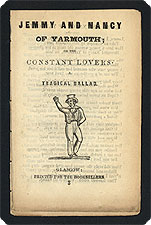
• This ed. not in NSTC. Removed from a nonce volume. Page edges slightly darkened, otherwise clean. (16757)
For
more CHAPBOOKS, click here. Or
for CARIBBEANA, click here.
Sin & Salvation — An Allegory Johnson, John. Mathematical question, propounded by the viceregent of the world; answered by the king of glory. Enigmatically represented, and demonstratively opened, John Johnson. London: George Keith, 1755. 8vo. [2], 106 pp.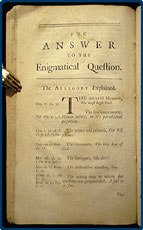
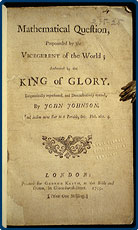 literary allegory of the danger of sin and the possibility of salvation. Includes an appendix, on pp. 48–106, titled “The Answer to the Enigmatical Question. The Allegory Explained.” John Johnson (1706–91) was “the founder of a sect called the Johnsonian Baptists. His followers were found for a long time at Wisbech in Cambridgeshire and elsewhere (see Dictionary of National Biography).”
Click the images for enlargements.
literary allegory of the danger of sin and the possibility of salvation. Includes an appendix, on pp. 48–106, titled “The Answer to the Enigmatical Question. The Allegory Explained.” John Johnson (1706–91) was “the founder of a sect called the Johnsonian Baptists. His followers were found for a long time at Wisbech in Cambridgeshire and elsewhere (see Dictionary of National Biography).”
Click the images for enlargements. Rare: A search of ESTC locates only one copy ONLY; OCLC adds one additional location. Both locations are in the U.S. (Yale and the NYPL), none in the U.K.
• ESTC N66391. Removed from a nonce volume; stitching holes present. Title-leaf repaired; shallow chipping/tearing to first three and final three leaves; one additional tear within text area of pp. 3/4 and 105/106 touching but not costing any text; reading fine throughout. First few leaves detaching. Ink annotations and underlining on p. 70, only. Ex-library, with pressure-stamp on title-page and inked accession number at base and inner margin of p. 3. (23667)
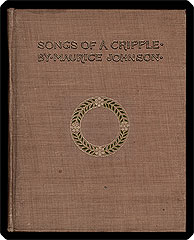
“My Legs A-Bein' Queer, They Never Let Me Walk” Johnson, Maurice. Songs of a cripple. New York: Grafton Press, © 1909. 12mo (15.5 cm, 6.1"). Frontis., xi, [1], 103, [1] pp.; 5 plts.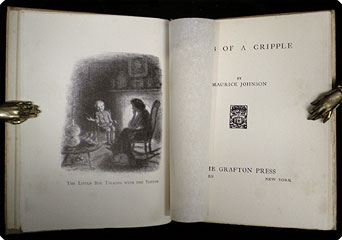
 Click the images for enlargements.
 Signed by the author: With tipped-in typed sheet bearing inspirational message, signed in pencil. Also tipped in is a photograph of the author inan early motorized wheelchair.
• Publisher's tan cloth, front cover with gilt-stamped title and gilt and green laurel wreath, spine with gilt-stamped title and a little sunned; touches of rubbing and some pages with light to moderate spotting. A nice copy. (26621)
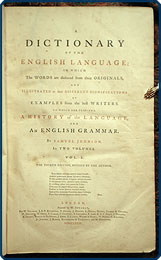
Last Edition with HIS Revisions Strong & Handsome Johnson, Samuel. A dictionary of the English language: in which the words are deduced from their originals, and illustrated in their different significations by examples from the best writers. To which are prefixed, A history of the language, and An English grammar. . . . In two volumes. London: Pr. by W. Strahan, for
W. Strahan, J. & F. Rivington, T. Davies, J. Hinton, L. Davis, et al., 1773. Folio (45.2 cm, 17.75"). 2 vols. I: [553] ff. II: [478] ff.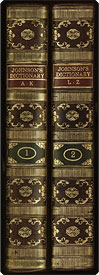
 Click the images for enlargements.
 Robert Keating O'Neill, in his English-Language Dictionaries,1604–1900, notes that 1,250 copies of this edition were printed and that it, “unlike its two predecessors, was much revised and is considered generally to be the best edition.”
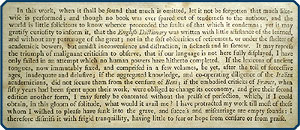 BE
SURE to click THIS image!
BE
SURE to click THIS image! • ESTC T117232; Brunet, III, 553; O’Neill J-52; Vancil 123; Printing and the Mind of Man 201 (for the first edition). 18th century treed calf, with minor surface cracks and chips and small areas rubbed; strongly and splendidly rebacked with speckled calf, spines gilt extra in bars and compartments; new leather spine labels bearing volume numbers and the emblazoned notes, “Johnson's Dictionary. A–K” and Johnson's Dictionary. L–Z.” Old gilt-tooling around covers and on turn-ins; nice old marbled endpapers. Title-pages printed in red and black. Occasional foxing; old waterstaining, generally quite light and inoffensive, in margins of early and later leaves. Paper flaw on B1 costing 4 letters of the footnotes; hole in blank area of outer margin of B1–B4. A few page edges chipped and ragged, with significant portion of paper lost from outer margins of two leaves, without costing any text; several leaves with a fold-in or dog-ear, paper quite strong at folds. Good text in a handsome and sturdy binding. (23890)
For more SETS, click here.This
is a PRB&M “FEATURED BOOK” —
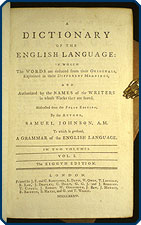
Elegant Two-Volume Abridgement — With the GrammarJohnson,
Samuel. A dictionary of the English language: In which the words are deduced from their originals, explained in their different meanings, and authorized by the names of the writers in whose works they are found. Abstracted
from the folio edition ... the eighth edition. London: Pr. for J.F. & C. Rivington, et al., 1786. 8vo (21.8 cm, 8.6"). 2 vols. I: [289] ff. II: [266] ff.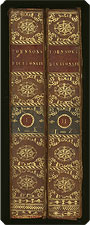
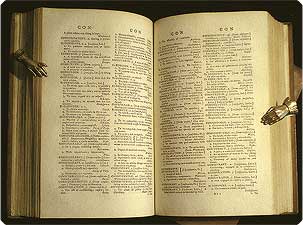 Single-click any image where the hand appears on
• ESTC T83956; Brunet, III, 553; O’Neill J-65; Vancil 123; Printing and the Mind of Man 201 (for the first edition). Contemporary speckled calf, spines gilt extra with gilt-stamped leather title and volume labels; all joints strengthened and bindings otherwise showing only light wear overall. Front pastedowns with bookseller’s stamp; title-pages with upper margins excised. An attractively bound abridgment of Johnson’s magnum opus.
For more SETS, click here. For
DICTIONARIES/GRAMMARS, ETC., click
here.
One
Eminently
Perusable“ORIENTAL”
GrammarJones,
William. A grammar of the Persian language...fifth edition, revised.
With an index. London: J. Murray & S. Highley (pr. by S. Rousseau),
1801. Folio (25.8 cm, 10.12"). [4], xx, 147, [1 (blank)], [38 (index)] pp.; 1
plt.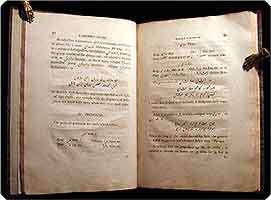 Click the image above for an enlargement.
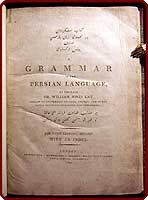 tantalizing
lyrical snippets involving jasmine, wine, nightingales, and fair maidens.
The Grammar was first printed in 1771, marking one highlight of a long
and distinguished career in Arabic and Asiatic scholarship, during the course
of which Sir William became the first English scholar to master Sanskrit.
tantalizing
lyrical snippets involving jasmine, wine, nightingales, and fair maidens.
The Grammar was first printed in 1771, marking one highlight of a long
and distinguished career in Arabic and Asiatic scholarship, during the course
of which Sir William became the first English scholar to master Sanskrit.
• NSTC J1084 (describing 6th and 7th editions only). On Jones, see: The Dictionary of National Biography, XXX, 174–77. 20th-century half morocco with marbled paper–covered sides, spine with gilt-stamped decorative motifs; binding is clean and all but unworn. Pages foxed, though not nastily so,with occasional pencil and ink marks of emphasis; one leaf with small repair to outer margin.
For
more PERSIANA, click here. For
DICTIONARIES/GRAMMARS, ETC., click
here.

Classically
CORRECT . . .
Jonson,
Benjamin. Catiline his
conspiracy. A tragedy.... pp. 237–264.
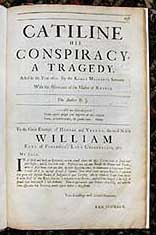
• Wing J1006; Greg, I, 296 (h). Narrow green cloth spine; black leather label with gilt rule and stamping on front cover. Slight foxing, and pinhole worming through top corner of outer margins; a small hole on p. 241/242 affects text just barely, and there is a clean two-inch tear on p. 245.

Spanish Statecraft — First English Appearance Juan de Santa María, fray. Christian policie: Or, the Christian common-wealth. London: Pr. by Thomas Harper for Richard Collins, 1632. 4to (22 cm, 8.6"). [18 of 19 (lacks blank {only})], 481, [1] pp.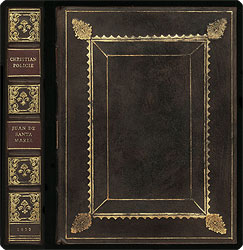
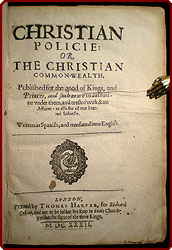
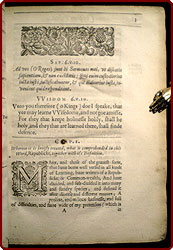 Click the images for enlargements. scholar and poet James Mabbe, known for his translations of Cervantes and other works of Spanish literature and theology.
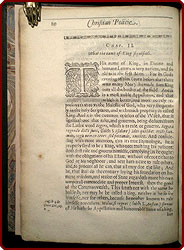
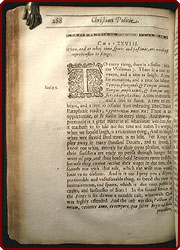
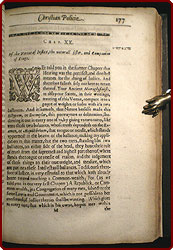
Uncommon: ESTC, OCLC, and NUC Pre-1956 find only 9 U.S. holdings.
• ESTC S107911; STC (2nd ed.) 14831. Period-style calf framed and panelled in gilt fillets with gilt-stamped corner fleurons; spine gilt extra with gilt-stamped leather title and author labels. Lacks initial blank leaf, as is the case with virtually all copies. Two leaves with tattered outer edges, one leaf with small hole affecting a few letters; pages with some moderate offsetting, a few browned. (25084)
In Latin, Printed at The HagueJuvenalis, Decimus Junius, & Aulus Persius Flaccus. D. Iun. Iuvenalis et Auli Persii Flacci Satyrae. Hagae Comitum: Apud Arnoldum Leers, 1683. 12mo (14 cm, 5.5"). 189, [1 (blank)] pp.
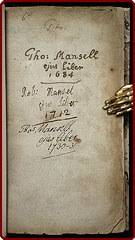
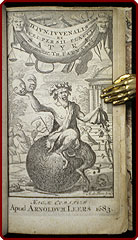
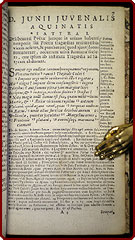 Click the images for enlargements. apparently the first printing at The Hague of any Latin Classic(s) in their original Latin.
Juvenal was a Roman poet of the early second century A.D. His Satires are a standard of the genre, eloquent, humorous, and rhetorically polished, but revealing a very bitter man. Persius (a.d. 34–62), was a gentler soul than Juvenal, and his poems are more Stoic sermons than satires, preaching a moral life during one of Rome's more corrupt periods and doing so, most remarkably, without a hint of self-righteousness. The two Satyrae are often published together, in contrast and comparison.
This is the first printing at the Hague of this edition with Farnaby's notes, originally printed at London in 1612 and then reprinted in Amsterdam in 1630. The emblematic engraved title-page here was done by A. de Blois; the separate title-page for Persius bears the printer's device.
Provenance: Front fly-leaf with three generations of early, dated, inked ownership inscriptions: Thomas Mansell, first Baron Mansel (1684); Robert Mansel (sic, 1712); and Thomas Mansell (1730–31).
• Brunet, III, 631; Graesse, III, 520; Morgan, Bibliography of Persius, 298; Schweiger, I, 511. Recent marbled paper–covered boards, spine with gilt-stamped leather title-label. Front fly-leaf darkened and engraved title a littlevery little tattered at edges, the first with inscriptions “stacked” as above and the second with old repair. Pages gently age-toned and generally clean, with all edges red. (25952)
An Unusual Edition fromthe Widow VandenhoeckJuvenalis, Decimus Junius; & Aulus Persius Flaccus. D. Iunii Iuvenalis et Auli Persii Satyrae ad fidem optimorum librorum accurate recensitae. Gottingae: Viduae Abr. Vandenhoeck, 1769. 12mo (13.9 cm, 5.5"). [2], 178 pp.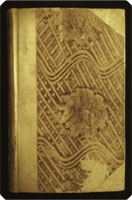
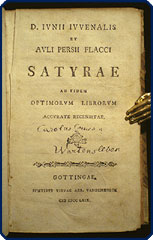
• Schweiger, II, 513; this ed. not in Brunet. Contemporary half vellum over paste paper covers, spine with early inked title; sides and edges lightly scuffed, spine with vellum darkened and chipped. Front pastedown with inked ownership inscription dated 1775, lined through; front free endpaper with 19th-century (?) inked inscription; title-page with early inked inscription reading “Carolus Comes a Wartensleben.” Back free endpaper excised. Title-page torn along inner margin and with short tear from outer edge, just touching one letter. One leaf with small ink blots and several leaves with small nicks to outer edges; scattered light foxing. A few small early inked annotations.
The Mégha Dúta — The Cloud MessengerKalidasa. The Mégha Dúta; or cloud messenger; a poem, in the Sanscrit language. Calcutta printed and London reprinted: Black, Parry, & Co., 1814. 8vo (20.4 cm, 8"). [4], 2, [ix]–175, [1 (blank)] pp.
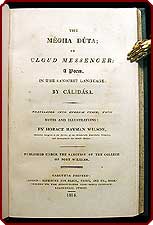
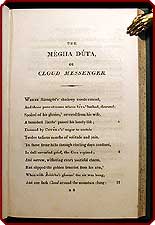 Click either righthand image for an enlargement.
 A scarce book: Via OCLC, RLIN, and NUC Pre-1956 we trace only six copies in U.S. institutions!
• NSTC K23. Recent neat green cloth, spine with gilt-stamped leather title-label. Some pages with very faint foxing. A decidedly nice copy.
For
our INDIA gathering, click here.
A Lonely Lass Was Kate Dalrymple, Kate Dalrymple, and the flowers of the forest. Glasgow: Pr. for the booksellers, [ca. 1830?]. 12mo. 8 pp. 
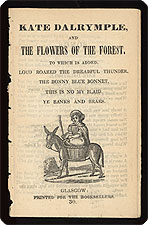
• This ed. not in NSTC. Removed from a nonce volume. Pages age-toned, else clean. (16762)
Keach
onTropes
of the Bible
Keach, Benjamin. Tropologia: A key, to open Scripture metaphors, in four books ... together with Types of the Old Testament, by the Rev. Mr. Benjamin Keach. London: Pr. by J.W. Pasham for William Otridge, 1779. Folio (32.7 cm, 12.9"). [8], xxiv, 224, 225*–40*, 225–980, [12 (index)] pp.
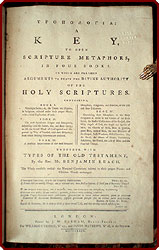
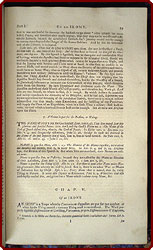
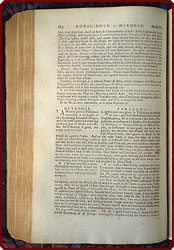 Click the interior images for enlargements.
 The Tropologia was first printed in 1681, and went through several editions; Lowndes and Allibone both identify this present one as the best of the old issues. Allibone notes how rare it had become by mid-19th-century, and also cites De Coetlogn, who called the work “A most valuable treasure of human composition: a book without which no Christian Minister's Library can be complete.”
• ESTC T194778; Lowndes 1254; Allibone 1008. Contemporary treed sheep, spine with gilt-stamped leather title-label and old paper shelving label; covers scuffed and abraded, minor cracks to spine leather, front joints starting from the weight of the substantial volume. Front free endpaper with early inked presentation inscription: “Presented to the N.Y. Bap. Ed. Socty. by Lewis Leonard, Poughkeepsie.” One leaf with closed tear to center, no loss of text. Pages gently age-toned, with occasional light foxing. (24895)
Not
ThatOther
Netley AbbeyKeate, George. Netley Abbey. An elegy...the second edition, corrected and enlarged. London: J. Dodsley, 1769. 4to ( 26.4 cm, 10.4"). 31, [1 (blank)] pp. (lacking the half-title).
• ESTC T75210. Marbled paper–covered boards, front cover with printed paper label. Half-title lacking. Upper margin of title-page showing small abrasions and traces of affixed paper; title-page and several others stamped by a now-defunct institution.
A
Novel of
the“Peculiar
Institution”
Kirke, Edmund [pseud. of James R. Gilmore]. Among
the pines: Or, South in secession-time. New York: J.R. Gilmore & Charles T. Evans, 1862. 8vo.
310 pp.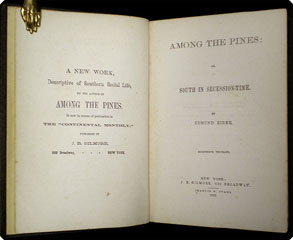
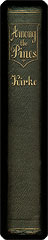 Click
the images for enlargements.
Click
the images for enlargements.
• Wright, II, 1003. Publisher's dark green textured cloth, spine with gilt-stamped title; corners and spine extremities rubbed, spine slightly sunned, sides with spots of lighter discoloration. Front free endpaper with pencilled and inked inscription (partly) dated 1862. Light to moderate foxing throughout. (25992)
One
Year's Worth ofWell-Spent
Half Hours
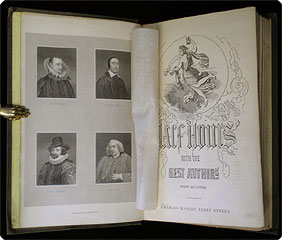
Knight, Charles. Half-hours with the best authors.
[London: Charles Knight, 1847–48]. 8vo (22.8 cm, 9"). 4 vols. in 2. I: Frontis., engr. t.-p., [2],
312 pp., frontis., engr. t.-p., [2], 312 pp. II: Frontis., engr. t.-p., [iii]–iv, 312 pp., frontis., engr. t.-p., [iii]–iv, 316 pp.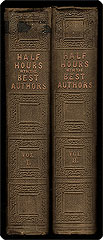
 Click
the images for enlargements.
52
weekly issues meant to be consumed in half-hour portions, with
each weekly number containing seven half-hours. (Indices and quarterly title-pages
are bound in here.)
Click
the images for enlargements.
52
weekly issues meant to be consumed in half-hour portions, with
each weekly number containing seven half-hours. (Indices and quarterly title-pages
are bound in here.)
Knight, who was devoted to books and to literature from the time he was a small child, was a much-admired printer and publisher, as well as an author, reformer, and would-be educator: Many of his publishing endeavors were aimed at improving and enlightening the working class.
• NSTC 2K7731. On Knight, see: Oxford Dictionary of National Biography online. On binding cloth, see: Krupp, Bookcloth, style Wav3. Publisher's textured brown cloth, covers blind-stamped with muse motif and title, spines with gilt-stamped title and blind-stamped decorations; lightly worn overall with some fading, vol. II spine head with traces of a strip of cloth tape. Ex–social club library: 19th-century bookplate, call number on endpaper, pressure-stamp on title-page, no other markings. Paper slightly embrittled (more so in second volume), with a few short edge tears. Externally ordinary; internally worthwhile. (26860)
The ESSAYS that Made Lamb's Reputation — 1st U.S. Edition Lamb, Charles. Elia. Essays which have appeared under that signature in the London Magazine. Philadelphia: Carey, Lea, & Carey (pr. by Mifflin & Parry, and J.R.A. Skerrett), 1828. 12mo (I: 18.4 cm, 7.25", II: 16.8cm, 6.6"). 2 vols. I: 292 pp. II: 230 pp. (both vols. without ads.).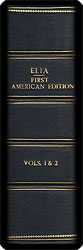
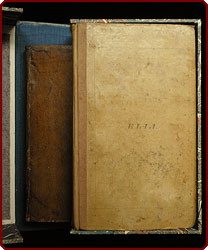
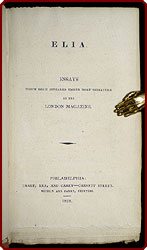
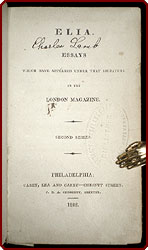 Click the images for enlargements. true
first edition of the unofficial second series, of Lamb's pseudonymously
published essays for the London Magazine. These eloquently written pieces
mingle humor and pathos as they describe the experiences of the author and his
acquaintances while attending boarding school, playing whist, listening to music,
visiting Quaker meetings, etc. Food is a recurring topic (“A Dissertation
upon Roast Pig”); there are two essays on Valentine's Day (one in each
volume), and several on plays and actors.
Click the images for enlargements. true
first edition of the unofficial second series, of Lamb's pseudonymously
published essays for the London Magazine. These eloquently written pieces
mingle humor and pathos as they describe the experiences of the author and his
acquaintances while attending boarding school, playing whist, listening to music,
visiting Quaker meetings, etc. Food is a recurring topic (“A Dissertation
upon Roast Pig”); there are two essays on Valentine's Day (one in each
volume), and several on plays and actors.
The first series made its first appearance in book form in London, 1823. The authorized second series was not published until 1833, under the title The Last Essays of Elia; the pieces selected for the unauthorized American second series offered here are different from those contained in that volume, and mistakenly include three essays written by other hands.
• Shoemaker 33813 & 33814; NCBEL, III, 1225; NSTC 2L2346. Vol. I: Uncut copy. Publisher's quarter once-red cloth and paper sides, covers printed with “Elia” within a simple frame, spine with printed paper label; binding rubbed and lightly soiled, spine sunned to yellow. Repaired tear to one leaf, touching text without loss; remarkably clean and sound. Vol. II: Contemporary speckled sheep, spine with gilt-stamped leather title-label; rubbed, and head of spine chipped with old refurbishing. Ex–social club library: 19th-century bookplate and call number ticket on front pastedown, front free endpaper with inked numerals, title-page pressure-stamped. Author's name inked on title-page; front free endpaper and title-page reinforced at fore-edge (the latter from the back). Both volumes age-toned, with intermittent spots of staining; advertisements absent. The set now housed in a quarter blue morocco and blue cloth–covered clamshell case with marbled paper–covered sides and gilt-stamped spine. (26434)
STRIKINGLY Illustrated La Motte-Fouque, F. de la. Undine. New York: The Limited Editions Club, 1930. 4to. vii, [1], 141, [5] pp.; illus.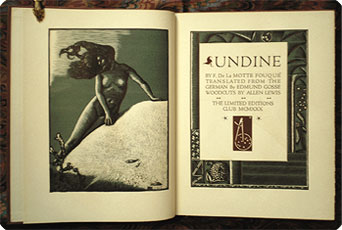
• Limited Editions Club, Bibliography of the Fine Books Published by the Limited Editions Club, 10. Binding as above; a clean, fresh copy showing next to no wear, in a rubbed slipcase with the spine reinforced some time ago with tape. (11241)

Dante Meets Beatrice, Washington Meets FranklinLandor, Walter Savage. Imaginary conversations selected & introduced by R.H. Boothroyd. [Verona]: Pr. for the members of the Limited Editions Club,
1936. 4to (26.3 cm, 10.4"). xi, [2], 303, [3] pp.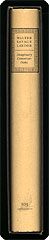
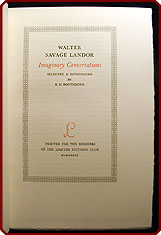
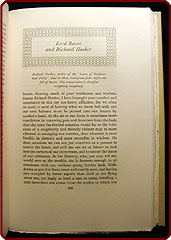
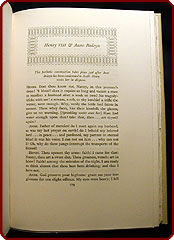
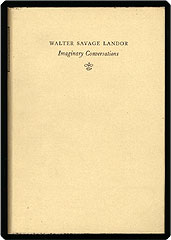
Binding: Full natural linen stamped in brown, spine with gilt-stamped cloth label.
• Bibliography of the fine books published by the Limited Editions Club 1929–1985, 76. Binding as above, in original printed paper dustwrapper and plain very dark brown paper–covered slipcase, slipcase a touch rubbed over extremities. Binding clean and fresh, dustwrapper with tiny nicks to upper edge and with very faint discoloration around numeral printed at foot. Back pastedown with small bookseller’s ticket. Many signatures unopened. A very nice copy.
For
more LIMITED EDITIONS CLUB books, click
here. For
more “GIFTABLES” — mostly $150
“Oriental” Romance for CT SubscribersLanghorne, John. Solyman and Almena: an Oriental tale. East Windsor, Conn.: Pr. by Luther Pratt, 1799. 12mo. 168 pp.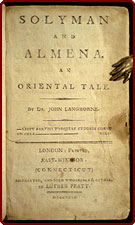
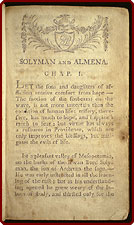
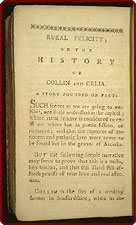
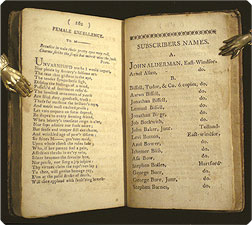 Click the images above for enlargements.
 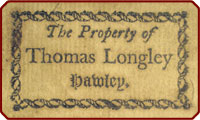 Provenance: Bookplate of Thomas Longley (Hawley).
We find seven copies reported in libraries, ALL between Worcester/Providence and Washington, D.C.
• Evans 35710; Trumbull, Connecticut, 2313; ESTC W3365. Old calf with remnants of black leather spine label; leather with one gouge to back cover and a bit abraded overall. Tear and chip to front free endpaper; title-page with tiny edge tears. Small wormhole at base of initial three leaves, not touching print. Some leaves extruded with shallow tattering. Bookplate as above on front free endpaper. Offsetting from leather of cover and a brown blot or stain at outer margin of title- and following page; same offsetting to last leaves; some general staining and an ink "x-mark" in margin of one other page. This seems to have been read with enthusiasm! (20994)
He Had a Dream Langland, William. The vision and creed of Piers Ploughman. London: Reeves & Turner, 1883. 12mo. 2 vols. I: Frontis., xl, [2], 272 pp. II: [4], [273]–621 pp.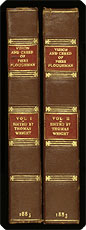
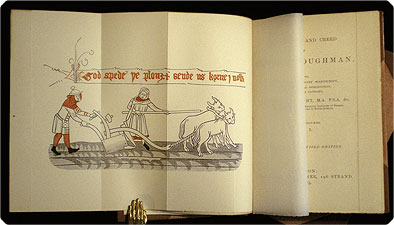 Click the interior images for enlargements.
 • Later 19th-century half toffee-brown calf over salmon cloth boards; gilt-lettered red leather spine-labels (title, volume, editor); gilt-accented raised bands, date in gilt at base. Slight rubbing to joints and extremities, one label with a streak of discoloration, vol. II with small chip at head of spine and lower corners rubbed. Pages toned. One leaf with edge nicks. Lower outer portion of pp. 211/212 chipped, with loss of outermost letters of bottom four lines and detached piece laid in; aforesaid pages also creased down the middle, brittle, and all but separated in two (still, present). Top edge gilt, others deckle. A pleasing and attractive binding; a volume internally clean. (21256)
For more SETS, click here.
Studying Hawthorne, withCommentary from Melville Lathrop, George Parsons. A study of Hawthorne. Boston: James R. Osgood & Co., 1876. 12mo. 350 pp., [1 (ads)] f.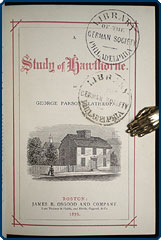
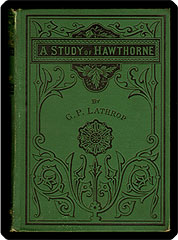 Click the images for enlargements.
 Binding: Publisher's green cloth elaborately stamped and decorated in black on front cover and in black and gold on spine. Rear cover modestly embossed in blind. All edges red.
• Bound as above. Ex–social club library: call number on front fly-leaf, two rubber-stamps on title-page, no other markings. A clean, bright copy. (26367)

GOTHIC“MONK”Lewis,
M[atthew] G[regory]. Tales of wonder...the second
edition. London: Pr. by W. Bulmer & Co. for J. Bell, 1801. 8vo (18 cm,
7.1"). [4], 251 (pp. 138–39 numbered 134–35), [1 (adv.)] pp.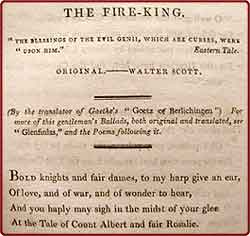
This author enjoyed great success among feminine (and young) audiences with his gothic tales of horror and woe, most notably with his one novel, The Monk, a youthful production that earned him his nickname. Shelley was especially fond of Lewis’s work, although Byron mocked the author’s “gibb’ring spectres” and “infernal brain” in the poem “English Bards and Scotch Reviewers.”
• NCBEL, III, 743 (first ed.). Later 19th-century half sheep in imitation of morocco over marbled paper sides, worn and abraded; leather chipping over head of spine, front and back covers pressure-stamped by a now-defunct institution, spine with paper shelving label. Title-page and several others stamped; many pages, not unexpectedly, show light to moderate spots of foxing, and there is some staining.
A Moral Tale? The Life and death of fair Rosamond, concubine to King Henry III. To which is added The Lass o' Gowrie. Stirling [Scotland]: Printed for the Bookseller, [18--]. 12mo. 8 pp. 
This Stirling printing is rare. There is also a Glasgow printing of which OCLC locates only 6 copies worldwide.
• Original self wrappers (unbound, removed). The bottom corner of the second leaf is lightly chipped and the pages are somewhat darkened. Good. (17552)
(LISTS). . . .
|
We've
created a new series of book lists for you! Most of the
usually budget-priced books in these simple, unillustrated, EXTENSIVE
catalogues are not offered via any of the databases (e.g., ABE, Biblio,
ILAB); they are mostly not described here at our independent website
either. It's
“find 'em in these lists or come find 'em on our shelves”!
|
 |
Click: The LIST of LISTS
A
17th-Century English
Superhero
& ADVENTURERAMERICA
& PatagoniaLloyd, David, attrib. author. The wonderful, surprizing and uncommon voyages and adventures of Captain Jones, to Patagonia. London: Pr. for John Lever, 1766. Narrow 4to (21.1 cm; 8.5"). Engr. title-page, 74 pp., [1] f. (ads).
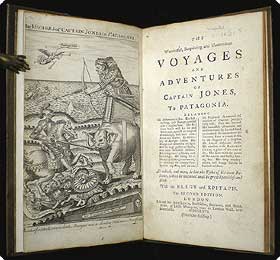 Click the images for enlargements.
 Outrageous
in extremis, this has as its proximate target Captain John Smith, who is satirized
while references to Florida and America fly left and right, including, for example
on p. 5, a poem “engraven on a Pillar of Gold, in the famous City of Chiapa”
that purports to be in Maya! — this with, “by the assistance of
Mr. Gage,” a translation helpfully given below it.
Outrageous
in extremis, this has as its proximate target Captain John Smith, who is satirized
while references to Florida and America fly left and right, including, for example
on p. 5, a poem “engraven on a Pillar of Gold, in the famous City of Chiapa”
that purports to be in Maya! — this with, “by the assistance of
Mr. Gage,” a translation helpfully given below it.
The title-page better than a cataloguer summarizes this work: “Relating his adventures to sea. His first landing, and strange combat with a mighty bear. His furious battle with his six and thirty men, against an army of eleven kings, with their overthrow and deaths. His relieving of Kemper Castle. His strange and admirable sea fight with six huge galleys of Spain, and nine thousand soldiers. His being taken prisoner, and hard usage. His being set at liberty by the king's command, in exchange for twenty-four Spanish captains, and return for England. A comical description of Captain Jones's ruby nose. Part the second. His incredible adventures and atchievements [sic] by sea and land, particularly his miraculous deliverance from a wreck at sea, by the support of a dolphin. His several desperate duels. His combat with Bahader Cham, a giant of the race of Og. His loves with the queen of No-Land, and basely leaving her. His deep employments, and happy success in business of state. All which, and more, is but the tythe of his own relation, which he continued until he grew speechless and died. With his elegy and epitaph.”
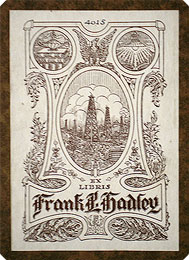
Provenance: 20th-century bookplate of Frank L. Hadley
Searches of WorldCat and ESTC locate only four copies in U.S. institutions.
• Sabin 41685; ESTC T116640. 20th-century half tan calf with tan linen sides. Booksellers' catalogue entry pasted to the front free endpaper. Engraved title-page closely trimmed at left edge, costing a sliver of the image. (25940)
Not All Humor“Wears” Real Well . . . Lochore, Robert. Margaret and the minister, a true tale. Glasgow: Pr. for the booksellers, [1840?]. 12mo. 8 pp. 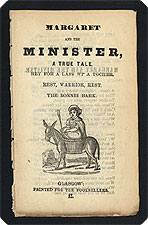
• NSTC 2M14137. Removed from a nonce volume. Pages clean. (16756)
A Beautiful Edition — A Copy with a Fore-Edge Painting Longfellow, Henry Wadsworth. The poetical works of Henry Wadsworth Longfellow. London & Edinburgh: Gall & Inglis, [1865]. 8vo (18.6 cm, 7.4"). xx, 700 pp.; 6 plts.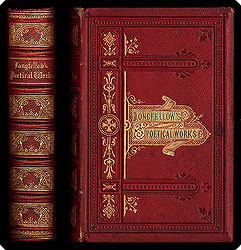
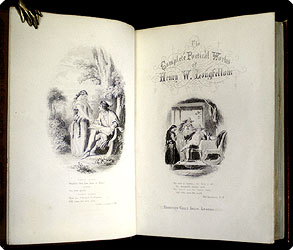 Click the images for enlargements.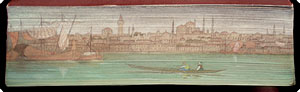
• Binding as above, minor traces of shelf wear, covers with unobtrusive small spots of discoloration, spine very slightly sunned. A few spots of light foxing. A lovely volume. (25947)

In PRAISE of theVirgin of Guadalupe Lopez de Abiles, Joseph [a.k.a., José López de Aviles]. Veridicum ad modum anagramma, epigramma obsequiosum, unaque cum acrostichide virgilio centunculus rigorosus in laudem purissimae immaculataeque conceptionis sanctissimae virginis dei-genitricis Mariae.... Mexici: ex typographia vidue Bernardi Calderon, 1669. Folio (30 cm; 11.75"). [17of 19] ff., lacking half-title and plate.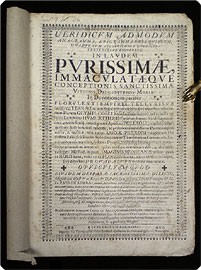
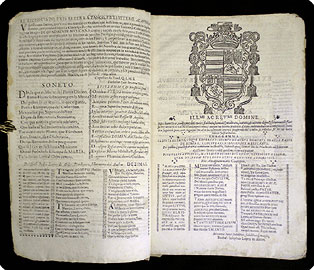 Click the images for enlargements.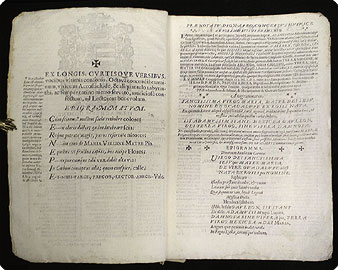
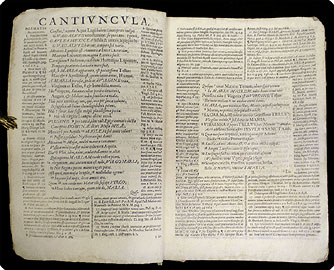
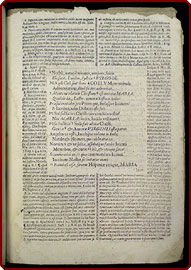
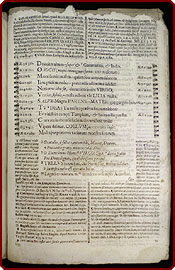
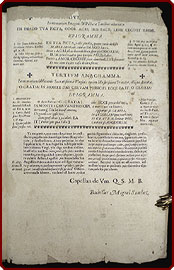
This
ambitiously designed production is from the press of one of Mexico's famous
17th-century woman printers, the Widow Calderón.
The work ends with a short essay addressed to López de Abiles by Lic. Miguel Sánchez and with anagrams by him as well. Sánchez was the author of Imagen de la Virgen Maria madre de dios de Guadalupe, milagrosamente aparecida en la ciudad de Mexico that had appeared in 1648. As a researcher with considerable knowledge of the Virgin of Guadalupe, he praises López de Abiles in no uncertain terms.
For some unfathomable reason Medina lists this under the extensive half-title — Poeticum viridarium in honorem, laudationem, et obsequium purae admodum ... Mariae: eiusdem dominae miraculosae Mexiceae imaginis de Guadalupe.... — and the cataloguer at the University of Arizona has blindly followed Medina down that road so that the WorldCat record is not findable via the real title.
Rarity: WorldCat locates only one copy worldwide but we know of two others. No additional copies were located via COPAC, Catálogo Colectivo del Patrimonio Bibliográfico, Metabase, or the OPACs of the Spanish National Library, the Mexican National Library, and the British Library.
• Medina, Mexico, 1016; Andrade 582; Grajales & Burrus, Bibliografia guadalupana, 82. In later wrappers, a little tattered at the spine. Lacks the half-title and the plate. Top margins of last 10 leaves rodent-gnawed with loss of paper but not of text, although a few letters are touched and the headline words “Segundum Anagramma” lost to that animal. Some light staining, front and rear. In all, a good if damaged copy of an important rarity. (26413)
Sacred
Hebrew Poetry
Lowth, Robert. De sacra poesi hebraeorum. Oxonii: E
typographeo Clarendoniano, 1775. 8vo (22.5 cm; 8.875"). [4] ff., 515, [1 (blank)] pp., [6] ff.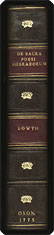
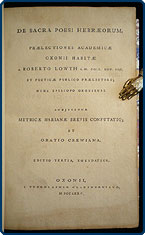
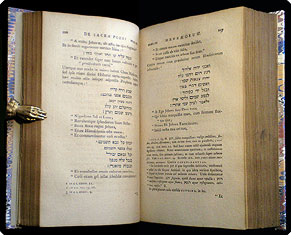 Click the interior images for enlargements.
 • ESTC T113648. Recent quarter calf, old style; raised bands, gilt ruling above and below the bands as accents, gilt center devices in spine compartments. Deep red spine labels lettered in gilt; marbled paper sides, with dark wedge of soil crossing bottom 3/4-inch of front cover’s paper and line of same soil also to turn-ins of back cover. Faint off-setting to top and bottom margins of early leaves from old binding; medium-light waterstains in margins of index (i.e., last 6 leaves), and the odd spot or bit of soil elsewhere. Generally, a very nice clean book. (25318)
EarlyENGLISH
TranslationLucanus,
Marcus Annaeus [Lucan]. Lvcans Pharsalia: Or the civill warres of Rome,
betweene Pompey the great, and Ivlivs Cæsar. The whole tenne bookes, Englished
by Thomas May...the second edition, corrected, and the annotations inlarged by
the author. London: Thomas Iones (pr. by Aug. Mathews), 1631. 8vo (14.5 cm,
5.75"). π1a8A–S8T2; engr.
frontis., [146] ff. [with] May, Thomas. A continvation of the subiect of Lucan’s historicall poem
till the death of Ivlivs Cæser the 2d edition corrected and amended. London:
James Boler, 1633. 8vo. A–K8(-K8); [79 of 80] ff.
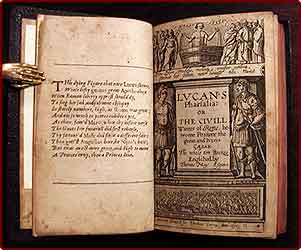
The editio princeps of the Pharsalia was printed in Rome by Sweynheym and Pannartz in 1469; Christopher Marlowe published the first English translation of any part of the Pharsalia, his rendition of the first book, in 1600, with a 1614 effort by Sir Arthur Gorges being the only other such to precede May’s standard-setting 1626 English version of books one through three.
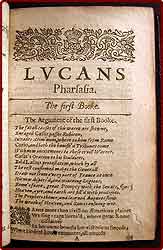 In the present volume, this great epic poem in May’s translation is
accompanied by its translator’s English rendition of his own sequel,
originally written in Latin verse. This Continuation advances the
action through Cleopatra’s seduction of Caesar (May depicts the Egyptian
queen with “snowie necke” and “golden tresses”), the
death of Cato, and various additional battles before arriving at Caesar’s
death. At the time, May’s work was thought highly enough of that Charles
I allowed the Continuation’s dedication to bear his name.
In the present volume, this great epic poem in May’s translation is
accompanied by its translator’s English rendition of his own sequel,
originally written in Latin verse. This Continuation advances the
action through Cleopatra’s seduction of Caesar (May depicts the Egyptian
queen with “snowie necke” and “golden tresses”), the
death of Cato, and various additional battles before arriving at Caesar’s
death. At the time, May’s work was thought highly enough of that Charles
I allowed the Continuation’s dedication to bear his name.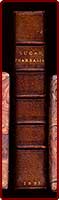
• Pharsalia: STC 16888; Schweiger, II, 567; ESTC
S108868. Continuation: STC 17712; ESTC S108892. 20th-century
black morocco in imitation of early, severe style, with raised bands from
which blind-tooling extends onto covers; spine with gilt-stamped title and
date, and turn-ins elaborately tooled in blind. Moderately worn, spine faded
not unattractively, and leather rubbed over joints. Front pastedown with bookplate,
inked date of 1986; front free endpaper with inked gift inscription dated
1944. T1-2 trimmed differently and possibly surviving from another copy;
A3 of the continuation also possibly supplied. Occasional instances of very
minor staining; mostly clean. Pleasant
on shelf and in hand.
AGAIN Lucan English’dLucanus, Marcus. Lucan’s Pharsalia: Or the civill warres of Rome, betweene Pompey the great, and Iulius Caesar. London: Pr. by A.M. for Will. Sheares, 1635. 8vo (14.7 cm, 5.8"). π1a8A–S8T2; [310] pp. [with] May, Thomas. A continuation of the subiect of Lucan’s historicall poem till the death of Iulius Caeser. London: James Boler, 1633. 8vo. 2A–2K8; [160] pp.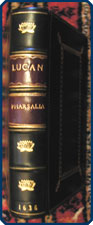
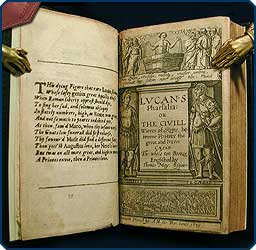
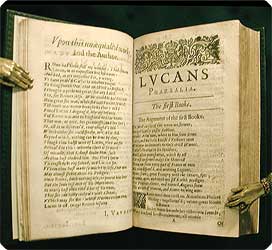 Click the interior images for enlargements.
 • ESTC S108867; STC (2nd ed.) 16889. Continuation: ESTC S108892; STC (2nd ed.) 17712. Both: Lowndes, III, 1408. Period-style calf by Grace (signed “GB” on lower back turn-in), framed and panelled in gilt rolls, spine with gilt-stamped leather title and author labels and gilt-stamped decorations in compartments. Outer and lower edges of the engraved title-page of second work shaved, touching design. Light waterstaining to upper portions of approx. 25 ff. of Continuation; small area of worming to lower inner margins of a few leaves, touching the occasional catchword but not main text.
“A Valuable Edition” —
per DibdinLucanus, Marcus Annaeus. Pharsalia, cum commentario Petri Burmanni. Leidae: Apud Conradum Wishoff, Danielem Goetval, & Georg. Jacob. Wishoff, 1740. 4to (25 cm, 9.75"). [52], 735, [1 (blank)], [160 (index)] pp.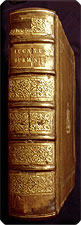
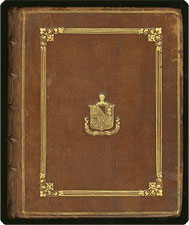
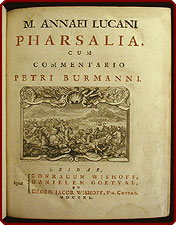
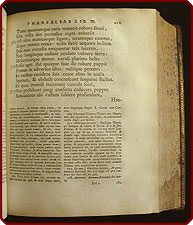 Click the interior images for enlargements.
 Binding / Provenance: Contemporary calf, framed in gilt triple fillets and panelled in gilt quadruple fillets with gilt-stamped corner fleurons and gilt-stamped central coat of arms of the Wilder family, with the motto “Virtuti moenia cedant.”
• Schweiger, II, 565; Dibdin, II, 186–87. Binding as above, rebacked making use of most of the original spine, spine with gilt-stamped compartments and gilt-stamped leather title-label; edges worn and rubbed, portions of original spine leather cracked and chipped. Front pastedown with small abraded area; front fly-leaf with inked inscriptions dated 1834 and 1938. Some leaves with faint waterstaining in upper margins and lower outer corners. Attractive.
For
(even!) more LUCAN, click here.
Parasites in Apotheosis Lucianus, Samosatensis. [three lines in Greek characters transliterated as] Loukianou Peri Parasitou, etoi hoti techne he parasitike, [then in roman characters] Luciani parasitus, ubi artem ese parasiticam astruit. Parisiis: Ex officina Christiani Wecheli, 1536. Small 8vo. [20] ff.
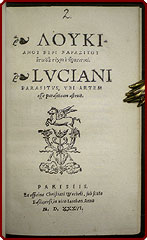
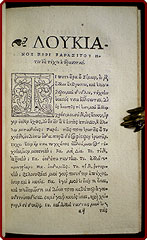 Click the interior images for enlargements.
 Text entirely in elegant Greek and with but one woodcut initial. The printer's device of a Pegasus is on the title-page.
Rare: We find no copy in WorldCat or COPAC. Moreau locates one copy in the Anglo world, at the Morgan Library.
• Moreau, V, 228. Full dark modern calf old style, absolutely plain without labels; spine with raised bands accented with blind rules extending onto covers to terminate in trefoils, and simple blind double fillets to covers. One old numeral inked to title-page; text unmarked with paper clean and even bright, throughout. (25728)
The Devil AsmodeusLytton, Edward Bulwer Lytton, Baron. Asmodeus at large. Philadelphia: Carey, Lea & Blanchard, 1833. 12mo. [4 (adv.)], iv, [13]-227, [25 (adv.)] pp. 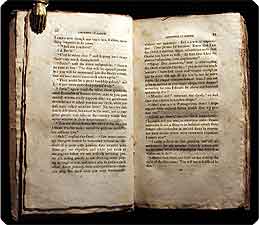 Single-click
the image for an enlargement.
Single-click
the image for an enlargement.
• Plain quarter cloth and paper-covered sides, worn and water-stained, corners bumped. Front free endpaper with pencilled inscription. Page edges untrimmed; pages with foxing ranging from mild to severe. This copy with the full complement of advertising pages. (5813)
 TO Part V
|