 TRANSLATIONS
A-B • Bibles • C-D • E-H
I-L • M • N-Sg • Sh-Z
TRANSLATIONS
 Uncommon & Carefully Printed
  Society of Jesus. Constitutiones Societatis Iesu. Cum earum declarationibus. Romae: In Collegio Romano eiusdem Societatis, 1615. 8vo. 309, [71] pp.


 Click the interior images for enlargements.
 The contents include “Primvm ac generale examen iis omnibvs, qvi in Societatem Iesv admitti petent, proponendum”; “Constitvtiones cum declarationibus”; “Formvla votorvm simplicivm, quae professi emittunt post professionem, iuxta constitutiones; extracta ex prima Congregatione generali, & recognita à tertia”; “Index in examen, & constitutiones”; each of those sections starts with a decorative capital. An extensive index is provided.
Much attention was paid overall to the attractive typography of this work, which was printed at the Jesuits' Roman college. A four-element woodcut architectural title-page border, woodcut initials and tailpieces, and carefully laid-out columns of roman and italic text adorn the volume. The text of the Constitutiones is printed in roman type and the “declarationibus” that supplements them is printed in italic, sometimes surrounding the text, other times in a column to the right or left.
Scarce: Only three U.S. institutions report holdings.
• DeBacker-Sommervogel, V, 78; Graesse, II, 255. Recent calf, covers ruled in blind in period style: blind rules above and below each band extending onto the covers forming a V with a trefoil at the end of each V; each band with fine gilt rule. Title-page with inked Jesuit ownership inscription dated 1625. Light foxing throughout; waterstaining to lower and outer portions of some early leaves. All edges stained red. A handsome production in a good copy. (23547)

“A Glorious Period of the Past” Sor, Charlotte de. Napoleon and his times. Philadelphia: E.L. Carey & A. Hart, 1838. 12mo (19.2 cm, 7.5"). 2 vols. I: viii, [13]–253, [1 (blank)] pp. II: viii, [13]–230 pp.
 Click
the images for enlargements.
Click
the images for enlargements.
Binding: Publisher's
ribbon-embossed green geometric-patterned cloth of Krupp's style Gt2; original
printed paper labels. Do
please click to enhance the image of this handsome American binding cloth—
it's hard to show, but worth trying to see!
Do
please click to enhance the image of this handsome American binding cloth—
it's hard to show, but worth trying to see!
• American Imprints 49627. On the binding, see: Krupp,
Bookcloth in England & America, 1823–1850, Gt2. Bindings
as above, cocked; edges, extremities, labels rubbed, chipped, spotted —
far from fresh, but also far from devastated. Ex–social club library:
bookplate on each front pastedown, call numbers in a 19th-century hand (lined
through) on pastedown and front free endpaper, title-pages and a few others
rubber-stamped. No other institutional markings. Front hinge (inside) of vol.
I starting, text block pulling away from spine, first few leaves starting
to separate. Front fly-leaf with pencilled numeral and  pencilled
doodle/sketch of a chubby child; occasional faint pencilled
annotations. A few scattered spots of staining, pages mostly clean. (26294)
pencilled
doodle/sketch of a chubby child; occasional faint pencilled
annotations. A few scattered spots of staining, pages mostly clean. (26294)

 A
A Swede
in South Africa
— Scottish
Edition
Sparrman, Anders. A voyage to the Cape of Good Hope, towards the Antarctic polar circle, and round the world: But chiefly into the country of the Hottentots and Caffres, from the year 1772, to 1776...translated from the Swedish original. Perth: Pr. by R. Morison, Jr. for R. Morison & Son, G. Mudie, & J. Lackington, 1789. 12mo (19 cm, 7.5"). I: Map, frontis., xx, 264 pp.; 2 plts. II: vi, 260 (i.e., 258) pp., [1] f.; 7 plts.
Swede
in South Africa
— Scottish
Edition
Sparrman, Anders. A voyage to the Cape of Good Hope, towards the Antarctic polar circle, and round the world: But chiefly into the country of the Hottentots and Caffres, from the year 1772, to 1776...translated from the Swedish original. Perth: Pr. by R. Morison, Jr. for R. Morison & Son, G. Mudie, & J. Lackington, 1789. 12mo (19 cm, 7.5"). I: Map, frontis., xx, 264 pp.; 2 plts. II: vi, 260 (i.e., 258) pp., [1] f.; 7 plts.

 Click the images for enlargements. An
appendix of examples of Hottentot and Caffre language is also supplied.
Click the images for enlargements. An
appendix of examples of Hottentot and Caffre language is also supplied.


 The
engraved plates include illustrations of a rhinoceros, a hippopotamus, dwarf
mice, and Hottentot weaponry, as well as an oversized folding landscape and
a map of the territory covered by the author.
The
engraved plates include illustrations of a rhinoceros, a hippopotamus, dwarf
mice, and Hottentot weaponry, as well as an oversized folding landscape and
a map of the territory covered by the author.
• ESTC T131019. Recently rebound in quarter calf over marbled paper
sides, spines with gilt-stamped title labels. Title-page and two others of
vol. I stamped by a now-defunct institution; one page with outer margin reinforced.
Small hole to map. Title-page of vol. II with topmost left portion of title
repaired and replaced in facsimile; title-page and five others stamped. Pagination
skips in vol. II from 136 to 139. A few minor spots of foxing to plates; one
plate with short edge tear carefully repaired.

Wharton as TranslatorSudermann, Hermann; Edith Wharton, trans. The joy of living (Es Lebe das Leben) a play in five acts. New York: Charles Scribner’s Sons, 1902. 8vo (19 cm, 7.7"). vii, [1], 185, [1 (blank)] pp.

• Garrison A7.1.a. Publisher’s olive paper–covered boards, front cover and spine stamped in gold; lacking the now seldom-seen dustwrapper, spine very slightly darkened, extremities showing touches of wear. Top edge gilt. Front free endpaper with inked ownership inscription dated 1903. Pages clean. A good-looking copy.


Jerusalem Delivered & IllustratedTasso, Torquato. Godfrey of Bulloigne, or, Jerusalem delivered ... translated by Edward Fairfax. London & New York: George Routledge & Co., 1858. 8vo (16.5 cm, 6.5"). Frontis., xlviii, 445, [1] pp.; 7 plts.

 Click the interior image for an enlargement.
 • Contemporary half calf over marbled paper–covered sides, gilt spine extra; sides and edges of paper showing light scuffing, spine leather a bit darkened; attractive. Marbled endpapers; all edges marbled to match endpapers and sides of covers. Front pastedown with small paper adhesions. One signature separated. An attractive edition, a pretty copy.
Anglican Moral Theology from “the Shakespeare of Divines” Taylor, Jeremy. Ductor dubitantium, or the rule of conscience in all her generall measures; serving as a great instrument for the determination of cases of conscience. London: Pr. by James Flesher for Richard Royston, 1660. Folio (32 cm, 12.6"). 2 vols. I: Add. engr. t.-p., [6], xl, 559, [1] pp.; 1 plt. II: [2], 558, [2] pp.


 Click the interior images for enlargements.
 The portrait of the author was engraved by Pierre Lombard, while the added engraved title-page is unsigned. Each of the four books here (in two volumes) has a separate title-page; the main title-pages are printed in black and ruled in red. The text is in English, Greek, and Latin. A printed addenda slip is affixed to the final text page of vol. II, above the catalogue of books sold by Richard Royston. Leaf L6 in vol. II is a cancel (and separated).
Provenance: Vol. I added title-page recto with inked ownership inscription dated 1781 (“T. Moore”); vol. II front fly-leaf with inked ownership inscription dated 1696 (“Guilel. Rayner”) and another (of “T. Moore's”) dated 1781.
• ESTC R20123; Wing (rev.) T324; Allibone 2348. On Taylor, see: Oxford Dictionary of National Biography online. Recent quarter calf and marbled paper–covered sides, leather edges tooled in blind, spine with gilt-stamped title and volume labels and gilt-stamped decorations between raised bands. Ownership inscriptions as above. First few leaves of vol. I (including regular and added title-pages) with tiny spots of worming; slightly larger sections of same to inner margins of some subsequent leaves; a number of pages in both volumes with scattered spots of worming, touching letters but not affecting sense. Light waterstaining to outer margins of some leaves. One leaf in vol. II separated. Significant and attractive. (24889)
English/Latin Edition — Roman Comedy Terentius, Publius. Terence in English. Fabulae comici facetissimi et elegantissimi poetae Terentii omnes anglicae factae & hac noua forma editae. Londini: Iohannes Legatt celeberrimae Academiae Cantabrigiensis typographi, 1614. Small 4to (8.5", 21 cm). [4] ff., 332, 335–428 pp. (mispaginated, but complete).

 Click the interior images for enlargements.


 French Perspective onTheir Own Victory(Textbook Military Science). The journal of the Battle of Fontenoy: As it was drawn up, and published by order of His Most Christian Majesty. Translated from the French. London: M. Cooper, 1745. Folio (30.6 cm, 12"). 8 pp.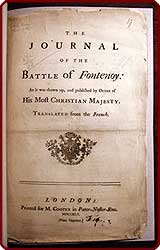
This work is rare: A search of ESTC, NUC Pre-1946, RLIN, and OCLC revealed
onlyone
copy.
• ESTC T13180. In recent marbled wrappers. Uncut copy: some soiling and deckle edges with some chipping with loss of part of a letter in one place. Paper lightly age-toned. Rubber-stamps from a now-defunct library, including one on title-page.

Kotopitta & Lamb's Feet Soup Tselementes, Nicholas. Greek cookery. New York: D.C. Divry, Inc., 1967. 8vo. 239, [1] pp.
• Publisher's red cloth, spine with title stamped in black, in dust wrapper; binding slightly cocked and dust jacket sunned at fore- and top-edges, with nick to front outer edge. Pages clean. Very good condition. (22496)
Turgenev
— Love!
Turgenev, Ivan. The torrents of spring. Westport, Conn.: The Limited Editions Club, 1976. Tall 8vo. xiii, [3], 186, [3 (2 blank)] pp.; 8 plts.


Binding: Publisher's green calf, done by the Tapley-Rutter Company, with marbled paper–covered sides, spine gilt extra, in original slipcase.
• Limited Editions Club, Bibliography of the Fine Books Published by The Limited Editions Club, 1929–1985, 502. Fine, in a near fine slipcase (paper cracked along a small portion of one edge, and carefully laid back down). (21808)

 Learning about Domestic AnimalsUlliac-Trémadeure, Sophie. Jane Brush and her cow: A story for children, illustrative of natural history. New York: M.W. Dodd, 1841. 12mo (15.4 cm, 6"). Frontis., 8, [2], [13]–133, [1] pp.
 telling in the development of their characters as it is in the case of humans.
Click the images for enlargements.
telling in the development of their characters as it is in the case of humans.
Click the images for enlargements. • Not in American Imprints. Binding: Krupp, Bookcloth in England and America, 1823--50, p. 40. Publisher's brown fine-ribbed cloth of Krupp's style Rib2, covers blind-stamped with foliate and arabesque designs, front cover with gilt-stamped title; spine sunned, edges and extremities worn, sides with spots of light discoloration. Foxed moderately (not worse) throughout; front fly-leaf with pencilled gift inscription dated 1845. (26633)
Italian Travels Englished,
1825Villemarest, Charles Maxime Catherinet de. The hermit in Italy, or observations on the manners and customs of Italy .... London: Geo. B. Whittaker, 1825. 12mo (19.9 cm, 7.9"). 3 vols. I: vii, [1], 267, [1 (blank)] pp. II: [4], 281, [1 (blank)] pp. III: [4], 295, [1 (blank)] pp.

 Click the interior images for enlargements.
 Many sources, including OCLC, attribute this work to de Jouy himself, but the Monthly Review of May, 1825 admits that the “similarity of title, of decorum, of form, and of manner,” as well as the title-page’s claim that this is a continuation of de Jouy’s work, all misled their reviewer and a number of others into that incorrect and much-perpetuated citation. The travelogue has more recently been attributed to Louet de Chaumont, among others, while Barbier and Quérard suggest that it may have been compiled by de Villemarest from de Chaumont’s notes and manuscripts.
• NSTC 2H18614. Publisher’s plain paper-covered boards, sometime rebacked with speckled paper and old printed paper labels laid on, the set now in a recent case with sides covered in blue cloth and speckled paper; extremities rubbed, covers with spots of discoloration, retained spine labels chipped and darkened. Front pastedowns each with institutional bookplate (no other markings). Hinges (inside) reinforced some time ago. Vol. II with one signature separated. Pages untrimmed and clean save for scattered small spots of foxing. A strong, agreeable set.
 For more SETS, click here.
FIRST English Translation of the Apostolic FathersWake, William, ed. & trans. The genuine epistles of the Apostolical Fathers S. Barnabas, S. Clement, S. Ignatius, S. Polycarp. The shepherd of Hermas, and the martyrdoms of St. Ignatius and St. Polycarp, written by those who were present at their sufferings. London: Ric. Sare, 1693. 8vo (18 cm, 7"). [6], 196, [6], 9–168, [173]–547, [9 (index)] pp. 

 Click the interior images for enlargements.
 • Wing (rev.) G523A; ESTC R10042; Allibone 2534. Contemporary speckled calf, framed and panelled in blind with blind-tooled corner fleurons, rebacked some time ago with speckled calf preserving original gilt-stamped leather spine label and rebacking extending into lower portion of front cover; corners rubbed, spine label cracked. Free endpapers lacking. Front pastedown with inked presentation inscription to a seminary and two small adhesions from a now-absent bookplate; title-page with early inked owner's name in upper margin. Pagination skips 169 through 172, with text and signature collation uninterrupted. Very minor small area of waterstaining to lower inner margins of about half of the volume, pages otherwise clean. (20831)
Magnum Opus of the CHRONICLER Dubbed“the CAMDEN of IRELAND” Ware, James. The antiquities and history of Ireland. London: Awnsham & John Churchill and Jonathan Robinson, 1704–05. Folio (31.7 cm, 12.4"). [18], 172 (i.e., 178), [14], 76 (i.e., 80), 164, 64, 175–196, [4], 70, 44, 55 (i.e., 57), [1], 28, [4], 42 (i.e., 46), [4], 59, [1] pp. (pagination erratic); 4 plts., 1 map.


 Click the interior images for enlargements.


 A sound, enjoyable copy. (25438)
 Lappish Devotionals — Rare, by Our Tracing Wexels, Wilhelm Andreas. Rokkus-ja oappo-girje. Samas jårggaluvvum. Kristianiast: Kr. Gröndahl lut prenttijuvvum, 1840. [1] f., 209, [1 blank] pp.
 Click the interior image for an enlargement.
 NUC Pre-1956 locates only one copy; RLIN adds no others.
• Quarter recent leather over marbled boards; spine with gilt-stamped title label and five raised bands, two inscribed lines above and below each gilt band. Edges stained green. A handsome copy. (24884)
Revelation Scholarship Willoughby, Harold Rideout; & Ernest Cadman Colwell, eds. The Elizabeth Day McCormick Apocalypse. Chicago: University of Chicago Press, [1940]. 8vo. Vol. I: Frontis., xxxviii, 602 pp.; 72 plts. Vol. II: Frontis., xiii, [1], 171, [3] pp.; 5 plts.  Click the image for an enlargement.
 • Publisher's blue cloth, spines with gilt-stamped titles; lacking dust jackets and front free endpaper of vol. I with affixed publisher's blurb clipped from same; spines with inked call numbers. Neat institutional rubber-stamps on front pastedowns, first text pages, and lower and outer page edges of closed books (not title-pages). Pages clean. (20791)
Men
of Cajamarca —
TWOEYEWITNESS
Accounts of Events
Xerez, Francisco de. Libro primo de la Conqvista del Perv & prouincia del Cuzco de le Indie occidentali. [colophon: Vinegia {i.e., Venice}: Stampato per Stephano da Sabio, 1535]. 4to. [62] ff.


 Click the interior images for enlargements. true
entertainment cast in the tradition of the romance of chivalry;
not surprisingly, it was a blockbuster.
Click the interior images for enlargements. true
entertainment cast in the tradition of the romance of chivalry;
not surprisingly, it was a blockbuster.


Appended to Xerez's account (fols. [43v] to [55r]) is a translation of Miguel de Estete's account of Pizarro's army's journey from Cajamarca to Pachacamac and then to Jauja. Estete too was present at Cajamarca and is said to have been the first Spaniard to lay hands on Atahuallpa.

 A very good copy.
(25785)
A very good copy.
(25785)
Peruvian
Conquest Illustrated Zárate, Agustín de. Histoire de la decouverte et de laconquete du Perou. Traduite de l'Espagnol...par S.D.C. Paris: La compagnie des libraires, 1716. 8vo (17 cm, 6.75"). 2 vols. I: Frontis., [40], 360 pp.; 13 (2 fold.) plts., 1 fold. map. II: [8], 479, [1 (blank)] pp.

 Click the interior images for enlargements.


• Sabin 106261; Palau 379641. Contemporary mottled sheep and calf as above, corners and edges worn, all joints cracking, both volumes with minor worming to front covers and pinholes to spines; vol. I with loss of leather over spine head (half of top compartment). Pencilled check marks scattered throughout; front free endpaper and recto of last text page of vol. II with annotations.
For
more of ANDEAN INTEREST, click here. For
more ILLUSTRATED BOOKS, click here. This set also appears in the HISPANIC

PLACE AN ORDER | E-MAIL US | GO (BACK) TO TOPIC/INTEREST TABLE | PRB&M HOME
All material © 2010
The Philadelphia Rare Books & Manuscripts
Company