
 TRANSLATIONS
A-B • Bibles • C-D • E-H
I-L • M • N-Sg • Sh-Z
TRANSLATIONS
 German
 RENAISSANCE Caesar — Lushly Illustrated
 Caesar, Julius. Julius der erst römisch Keiser von seinem Leben und Krieg, erstmals uss dem Latein in Tütsch gebracht vnd mit andrer Ordnung der Capittel und uil zusetz nüw getruckt. [Strassburg: Durch Joannem Grüninger, vff sant Adolffs des heiligen Bischoffss, 1508]. Folio (31 cm; 11.5"). A6 Aa8 B6 C4 D–N6 O4 P–Z6 Zz6; [148] ff., illus.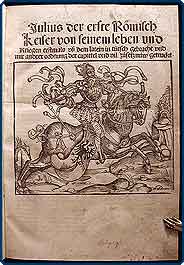
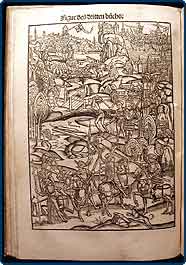
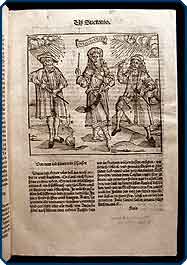
 All images of this book enlarge, via single-click.
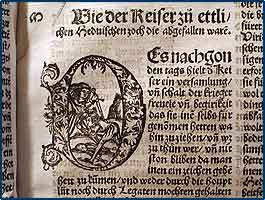
This handsome and SCARCE book is famous for its woodcut illustrations: It has one quarter-page, four half-page, one three-quarter page, and  eleven full-page woodcuts. These include battle scenes, the assassination, camp life, etc., all of the figures being dressed anachronistically in Renaissance garb.
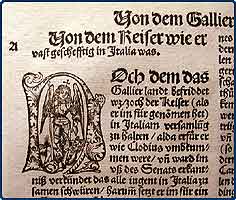 The text is printed in large gothic in double-column format.
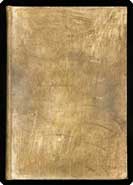
 Of the first edition we find only two copies in the U.S. (Harvard and Stanford), and of the second we trace three (Brown, Duke, and Trinity College), all being incomplete except the Brown copy.
• Index Aurel. 128.654; Schmidt, Repertoire bibliographique Strasbourgeois, no. 91, p. 40–41; Schweiger, II, 51; not in Adams (who only lists much later editions in German). Recased in an 18th-century vellum-over-boards binding. Sophisticated copy in all likelihood, with several leaves apparently supplied from a different copy, those leaves being either slightly smaller than the others or more heavily sized. Occasional light waterstains in from a very few margins; two leaves with old scribbling in ink in margins; minor worming in lower margin of last six leaves.  A very nice copy of a very scarce book that is clearly difficult to find complete, incomplete, or sophisticated.
 For more 16TH-CENTURY BOOKS, click here. For more GREEK & LATIN CLASSICS, click here. For more ILLUSTRATED BOOKS, click here. Or for more BOOKS IN GERMAN, click here.

 English Camões in Green Morocco Camões, Luís de. Poems, from the Portuguese of Luis de Camoens. London: J. Carpenter (pr. by C. Whittingham), 1805. 8vo. Frontis., [4], 160 pp.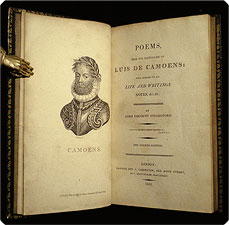
 Click the interior image for an enlargement.
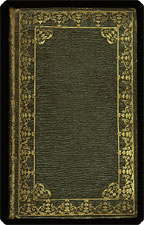
 Binding: Contemporary dark green straight-grain morocco, spine with gilt-stamped rules, rolls, and devices. Covers framed with a delicately curly gilt-rolled border; the center panels, within, accented by gilt-stamped corner fleurons. A bit of additional filigree in blind appears both within the rules of the gilt border and within the border on each center panel, to nice subtle effect. Gilt inner dentelles. All edges gilt.
• NSTC C355. Binding as above, leather rubbed at edges and joints, spine a bit dimmed. Front pastedown with armorial bookplate of John Allan Powell; front fly-leaf with inked inscription dated 1922. A few spots of foxing, pages otherwise clean.  A pretty and very English production for this Portuguese poet. A charming volume. (23077)


A FAMED but UNLUCRATIVEPolyglot Dictionary Castell, Edmund. Lexicon heptaglotton, Hebraicum, Chaldaicum, Syriacum, Samaritanum, Æthiopicum, Arabicum, conjunctim; et Persicum, separatim. London: Thomas Roycroft, 1669. Folio (44.9 cm, 17.6). 2 vols. in I. Frontis., [8] pp., 44 columns (43 & 44 repeated in numbering), [2] pp., 573 columns (402, 403, 421 & 422 repeated in numbering; 340, 341, 399, & 400 skipped), [1] p., 4008 columns (376–78 & 391–93 incorrectly numbered; 484–86, 538, 1936–38, 3220–25, 3773–78, & 3950–51 repeated in numbering; 487–89, 535, & 3226–3231 skipped).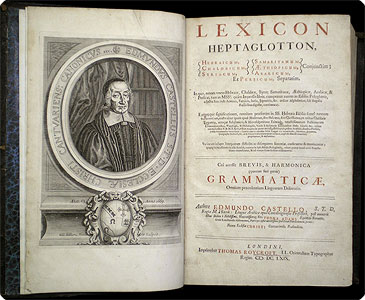
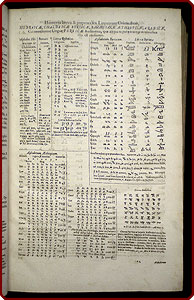
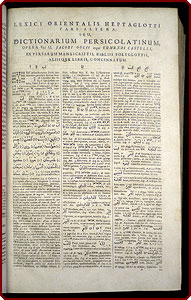 Click the images for enlargements.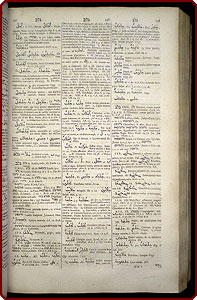
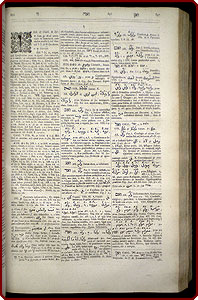
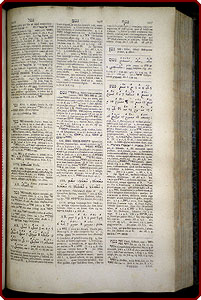
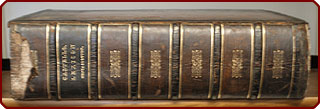
• ESTC R16460; Wing (rev. ed.) C1225; Vancil 46; Lowndes 386; Dibdin, I, 31–35. On Castell, see: Oxford Dictionary of National Biography online. 18th-century speckled calf, covers bordered with a darker calf band blind-rolled and then framed with single gilt fillet; spine with gilt-stamped leather title-label, darker-leather raised bands gilt-stamped/blind-tooled, and compartments gilt- and blind-tooled enclosing gilt-stamped floral decorations. Binding rubbed, with leather significantly lost in top compartment and and lost also at foot. All edges marbled. Front fly-leaf with inked ownership inscription as above dated 1837; title-page with old institutional pressure-stamp. Frontispiece with outer margin reinforced some time ago. One leaf slightly oversized and creased, intermittent soiling in many upper margins, one leaf with text affected but not obscured, small sections with light waterstaining to outer or upper margins; over all, a book both impressive and pleasant. Columns erratically numbered, text complete. (25792)
The Armenian Rite Englished & IllustratedCatholic Church. Armenian Rite. The Armenian liturgy translated into English. Venice: Pr. at the Armenian Monastery of St. Lazarus, 1862. 8vo (22 cm, 8.6"). 70, [2 (blank)] pp.; 8 plts.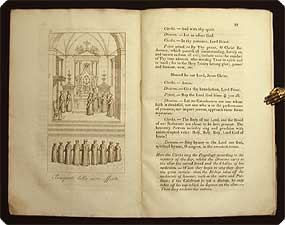
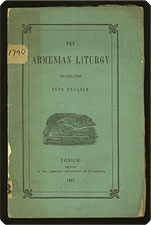
• Publisher’s printed paper wrappers, detached and darkened, front wrapper with tear from inner margin, paper split and chipped along spine, front wrapper with paper shelving label. Title-page with institutional stamp (no other markings). A few plates with very light spots of foxing. Very interesting!


The Pope Lays It Down Here Catholic Church. Pope (1590–1591: Gregory XIV). Declaration de n.s. pere le pape Gregoire XIIII. Sur les lettres qui luy ont esté escrites par la noblesse qui suit le Navarrois. Paris: Robert Nivelle & Rolin Thierry, 1591. 8vo (15.9 cm, 6.25"). 14, [2] pp.
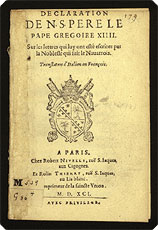 Click the image for an enlargement.
 This little pamphlet appears to be a scarce variant; OCLC finds no holdings, and the title is not listed by Lindsay & Neu.
• Not in Lindsay & Neu, French Political Pamphlets 1547–1648. Disbound. Title-page with paper shelving label, institutional pressure-stamp, and residue from previous nonce binding along inner margin; four other pages also pressure-stamped. Additional inked pagination in upper outer corners, in an early hand. (24463)

Fly Me to the Moon — On a Magic Horse!
Cervantes Saavedra, Miguel de. The second part of the history of the valorous and witty knight-errant, Don Quixote of the Mancha. Written in Spanish by Michael Cervantes...now translated into English. London: Pr. [by Eliot’s Court Press] for Edward Blount, 1620. 4to. [8] ff., 276, 279–504 pp. (without engr. t.-p., final blank; pp. 503–04 in pen and ink “facsimile”).
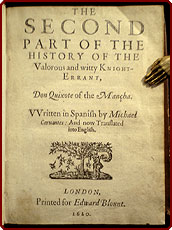
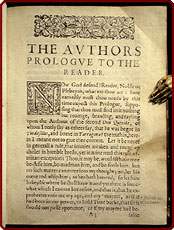 Click the interior images for enlargements.
 Shelton's part I was reissued in 1620 in a new edition as a logical companion to this part II; the original Spanish editions had also been issued separately over a period of time, part I in 1605 and part II in 1615.
 It is extremely noteworthy that this translation was entered into the Stationer’s Register on 5 December 1615, although not printed until five years later. That is, it was entered the same year that part II appeared in Spanish!
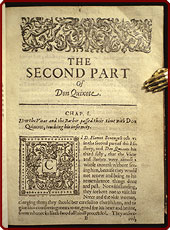
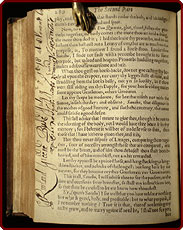
The printer’s name is taken from the STC, and as in all other reported copies, B4 is a cancel.
Provenance: On p. 280, “Rowland Greene . . . July y.e 8 1678.”
A sophisticated copy: Pp. 403 to end supplied from a different copy, and one leaf in facsimile.
• ESTC S107642; STC (rev. ed.) 4917; Pforzheimer 140; Rius, I, 607; Palau 52462 . Later 17th-century English calf (ca. 1670?), each board with center panel formed by a blind-tooled double fillet and having blind-stamped corner devices inside and outside; spine tooled in gilt, somewhat dulled/flaked, and with small circular paper shelfmark label (private) at bottom. See above about sophistication: Without the engraved title-page and final blank, last 50 leaves from another copy, and final leaf of text supplied in neat 18th-century pen and ink block lettering. Closely trimmed affecting running heads and some sidenotes (these with some loss of letters); marginalia, not substantive, sometimes lined or scribbled through. Overall age-toning and some soiling; supplied section at end with tattering in some margins. Far from an ideal copy but an interesting one, priced with faults most in mind. (23815)
What to Wear, the Duty of Schoole-Masters, Divorce Sentences, & More Church of England. Constitutions and canons. 1603. English. Constitutions and canons ecclesiasticall treated upon by the Bishop of London, president of the convocation for the province of Canterbury, and the rest of the bishops and clergy of the said province: And agreed upon with
the Kings Majesties licence in their synod begun at London, anno Dom. 1603, and in the year of the reign of our soveraigne Lord James, by the grace of God, King of England, France, and Ireland the first, and of Scotland the 37. And now published for the due observation of them, by His Majesties authority under the Great Seal of England. London: Pr. by John Norton, for Joyce Norton, and Richard Whitaker, 1633. Small 4to. [60] ff.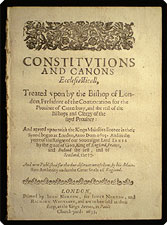
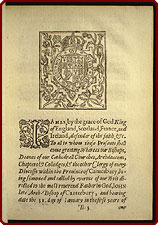
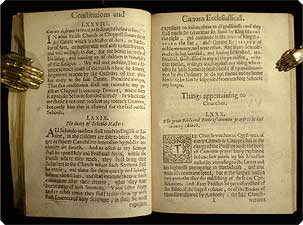 Click the images for enlargements.
 The Constitutions and Canons Ecclesiastical was an assemblage of rulings given equal force with the canon law, although the rulings themselves were not based on canon law.
• STC (rev. ed.) 10076; ESTC S101555. Removed from a nonce volume. A very nice, clean copy with an array of marginal markings — Xs, asterisks, “vid.,” and the odd hand-with-pointing-finger. (21226)
The Augsburg Confession — 51 DocumentsThe First Much Annotated Chytraeus, David. Histoire de la confession d'Auxpourg, contenante les principauls traittez & ordonnances, faittes pour la religion, quand l'electeur Iehan, duc de Saxe auec les citez & autres princes protestants presenterent leur confession de foy (icy inserée) a l'Empereur Charles V. os estats generauls de l'empire, tenus a Auxpourg, 1530. Anvers: Chez Arnould Coninx, 1582. 4to (24.3 cm, 9.55"). [8], 835, [5] pp.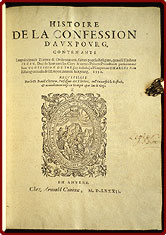
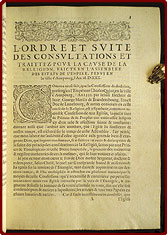
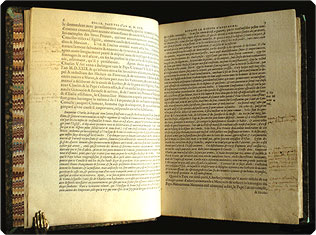 Click the interior images for enlargements.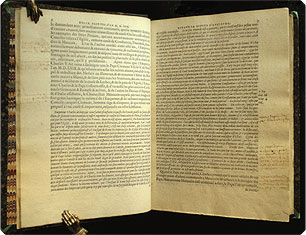
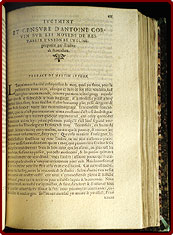
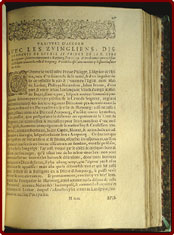
Rare. OCLC lists only four U.S. holdings and one deaccessioned copy (the present example).
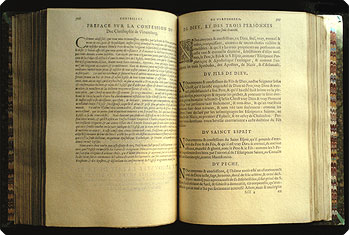
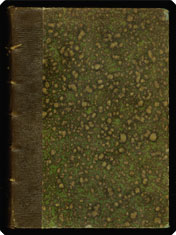
• Brunet 22420; Graesse, II, 154. Not in Adams. 19th-century quarter olive morocco with marbled paper–covered sides, spine with gilt-stamped author/title; edges and extremities rubbed. Top edge gilt. Front pastedown with bookplate as above; title-page and first text page each with early inked ownership inscription. Four leaves with small repaired tears from outer margins and three likewise from upper margins, not touching text in any case. Extensive early inked marginalia in first document, scattered examples elsewhere. (23536)
Huguenot
Horrors —Translated
forEnglish
Readers,
1686[Claude,
Jean]. [Account of the persecutions and oppressions of the Protestants
in France. London: J. Norris, 1686]. 4to (19.5 cm, 7.6"). A–G4
(-A1); 56 pp. (lacking title-page).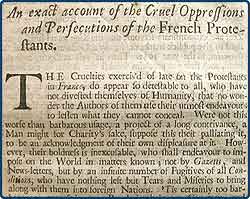
• Wing (rev.) C4589. Removed sometime from a nonce volume and now contained in a cloth-covered clamshell case with gilt-stamped leather spine label. Lacks the title-page; otherwise complete, with small loss of paper (not nearing text) at inner lower corners and one leaf with “chip” (only) of lower outer corner torn away (this perhaps in fact a paper flaw, and, again, far from type). One page with early monogram inked in upper outer corner; last page with neat stamp marking institutional deaccession (ex-Folger Shakespeare Library).
For more 17TH-CENTURY BOOKS, click
here. For
more RELIGION, click here. For
more CATHOLICA, click here.
For
more BOOKS IN FRENCH, click here.
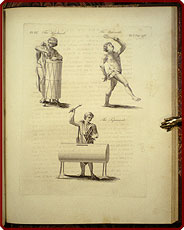
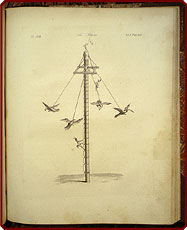
Illustrated IndigenousCustoms & Dress FIRST Edition in ENGLISH Clavigero, Francesco Saverio. The history of Mexico. Collected from Spanish and Mexican historians, from manuscripts, and ancient paintings of the Indians ... translated from the original Italian, by Charles Cullen. London: Pr. for G.G.J. and J. Robinson, 1787. 4to (28.5 cm, 11.2"). 2 vols. I: [2], xxxii, [4], 440, (441–44), 441–76 pp. (pagination skips v/vi, with text complete); 1 fold. map, 25 plts., 1 table. II: [4], 463, [1 (blank)] pp.; 1 fold. map, 1 plt.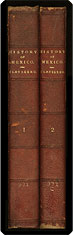
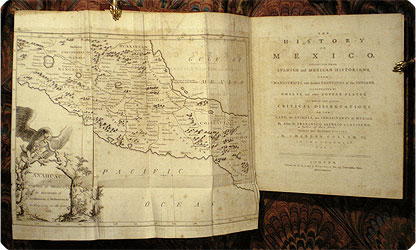 Click the interior images for enlargements.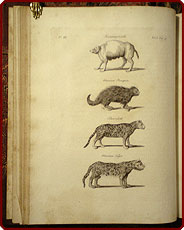
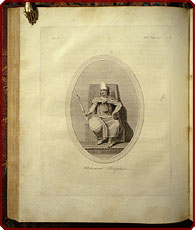
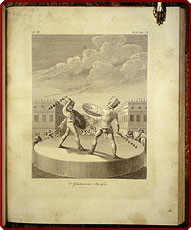
Thetwo oversized, folding maps were engraved by T. Conder; a genealogical chart in vol. I shows the descent of the Mexican kings from the 13th century, while numerous engraved plates depict Mexican artifacts, costumes, activities, flora and fauna, architecture, etc.
 For more SETS, click here.
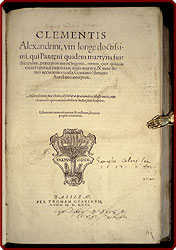
Peter Martyr MeetsSt. Clement of Alexandria Clement, of Alexandria, Saint. Clementis Alexandrini, viri longe doctissimi, qui Panteni quidem martyris fuit discipulus, praeceptor verò Origenis, omnia, quae quidem extant opera, à paucis iam annis inventa, [et] nunc denuò accuratiùs excusa Gentiano Herueto Aureliano interprete ... [with another, as below]. Basileae: Per Thomam Guarinum, 1566. Folio (33.5 cm; 13.125"). 364 pp., [8] ff. [also bound in] Vermigli, Pietro Martire. In selectissimam D. Pauli priorem ad Corinthios Epistolam. Tiguri: apud C. Froschouerum, 1567. Folio (33.5 cm; 13.125"). [6], 242, [17] ff. (lacks final blank). 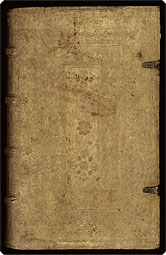
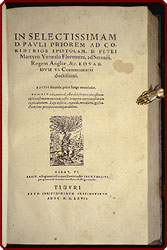
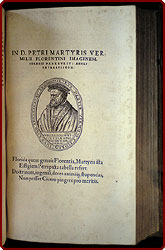 Click the images for enlargements.
 The second work is Peter Martyr's commentaries on Corinthians, here in the second edition. It has a full-page woodcut  portrait of him on the recto of leaf aa6. The printer's woodcut device is on the title-page and there are numerous woodcut initials. The sidenotes are printed in italic while the text proper is in roman.
Peter Martyr (8 September 1499 – 12 November 1562), was an Italian theologian who began his religious life as an Augustinian friar, converted to the Protestant cause, was closely associated on the continent with Ochino, Bucer, and some prominent Lutherans, and, while in England where he held the Regius Chair of Divinity at Oxford, was an intimate of Thomas Cranmer and Bishop Jewel.
Both works are uncommon in these editions in the U.S.: We locate four copies of the first title and two of the Vermigli, but one copy of each title has been deaccessioned, meaning current holdings are three and one only.
Binding: Contemporary alum-tawed pig over wooden boards with bevelled edges and metal and leather clasps; one clasp perished. Leather tooled elaborately in blind using a variety of rolls and fillets, including one roll incorporating the date 1546, a medallion of David and his harp, and another medallion depicting John the Baptist with the words below the image, “Ecce Agnus Dei.”
• Clement: VD16 C4070; Index Aurel. 104.903; Adams C2106. Vermigli: VD16 B5054; Adams M788. Bound as above. Ex-library with bookplate on front pastedown, small blind pressure- (not perf-.) stamp on title-page and remnant of charge pocket at rear; six-digit number stamped in lower margin of one leaf. Early inked ownership indicia on title-page and old private ownership stamp on front free endpaper; a little old marginalia and underlining. A very little foxing and the odd spot only. Excellent copies of both works in a handsome contemporary binding. (24827)
 L'essence du Tao — Systèmes Nya'ya et Vais'echi'ka Colebrooke, Henry Thomas, & Guillaume Pauthier. Essais sur la philosophie des Hindous, par T.-M. Colebrooke ... Traduits de l'Anglais et augmentés de textes Sanskrits et de notes nombreuses. Par G. Pauthier. Paris: Firmin Didot, 1833. 8vo. vii, [1], 20, 115 pp.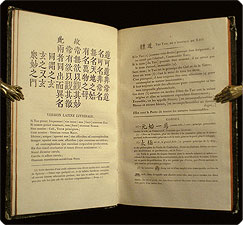
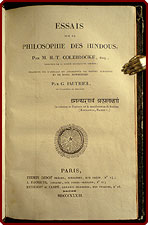 Click the images for enlargements.
 • 19th-century German boards, with black mottled paper, spine with inked paper title label; edges and small areas of covers rubbed and abraded, boards exposed on corners, spine chipped at head. All edges stained red. Ex-library with 19th-century bookplate on front pastedown, call number in black on spine and in pencil on verso of title-page, paper shelf label (with call number blacked out) on lower left corner of front cover, and four-digit number in ink on p. [iii]. No stamps and, withal, Very Good. (19255)
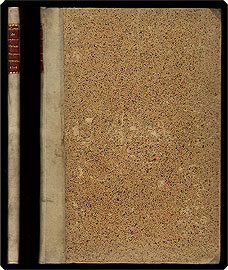
Cortés' Second Letter: The Conquest of Mexico Cortés, Hernando, & Peter Martyr. Praeclara Ferndinandi Cortesii De Nova Maris Oceani Hyspania Narratio. [colophon: Impressa in Nurimberga: per Fridericum Peypus], 1524. Folio (30.3 cm; 11.875" ). [4], 49, 12 leaves.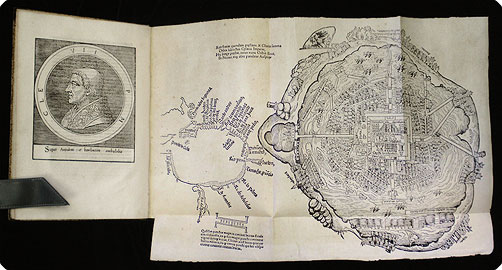 Click the images for enlargements. Cortés was the first conqueror since Julius Caesar to write a description of his conquests.
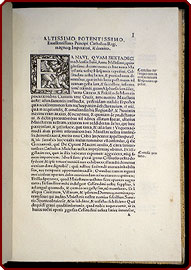
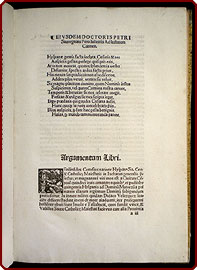
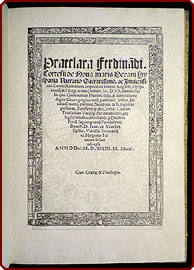 It is here that Cortés provides a definitive name for the country, calling it “New Spain of the Ocean Sea.” This letter is also important for making reference to Cortés's “lost” first letter, supposedly composed at Vera Cruz on 10 July 1520. Whether that letter was actually lost or was suppressed by the Council of the Indies is unknown, though there is little doubt it once existed.
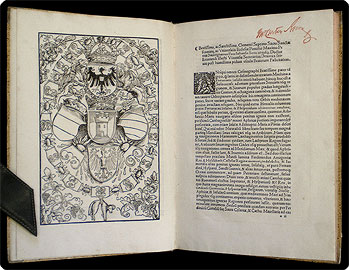
 It is the text of this “second” letter, THE FIRST SURVIVING ONE, that was the first major announcement to the world of the discovery of major civilizations in the New World — and, as such, is a work of surpassing importance.
This copy bears the full-page woodcut portrait of Pope Clement VII on the verso of the fourth preliminary leaf, which is not found with all copies. Additionally, the title-page bears an interesting 14-piece composite woodcut border and the verso of that page has a stunning full-page woodcut of the coat of arms of Charles V, the Holy Roman emperor, to whom the letter is addressed. The coat of arms is surrounded by the collar of the Order of the Golden Fleece. The text is printed in roman with side- and shouldernotes; the lay-out is elegant and there is one large, handsome woodcut initial.
As usual, the letter is here bound with Peter Martyr's De Rebus, et insulis noviter repertis, which provides an account of the recently discovered islands of the West Indies and their inhabitants. It is often considered a substitute for the lost Cortés letter.
One of the most important early descriptions of Mexico and of the first encounter of the West with the Aztec civilization, this is a work of bedrock importance to the New World. No complete copy has appeared for sale since 1985.
• Alden & Landis, European Americana, 524/5; Sabin 16947; Harrisse, BAV, 125. Sanz 933–34; Medina, BHA, 70; Church 53; Burden 5; JCB, German Americana, 524/4; Streeter Sale 190. 18th-century half vellum and sprinkled paper over boards, gilt red leather label. Map supplied in expert facsimile; blank leaf H8 lacking. Bookplate of John Carter Brown (Library) on front pastedown, with deaccession stamp. Occasional very minor soiling in the text, else very good — a copy clean and even crisp. (26808)
 Cortes's Stirring Lettersin French Cortés, Hernán. Correspondance de Fernand Cortès avec l'empereur Charles Quint sur la conquête du Mexique. Francfort: J.J. Kesler, 1779. 8vo. xvi, 471 pp.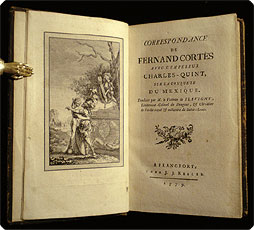
 Click the interior image for an enlargement.
 • Sabin 16953. Contemporary treed calf, front joint (outside) starting at top to open. A good+ copy — in fact, a rather nice one. (20510)
FIRST Edition In English Cortés, Hernán. The despatches of Hernando Cortés,the conqueror of Mexico, addressed to the emperor Charles V, written during the conquest, and containing a narrative of its events. New York: Wiley & Putnam, 1843. 12mo. xii, 431 pp.; ill.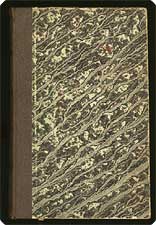
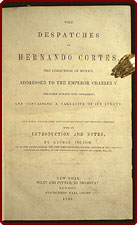
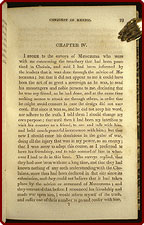
• Sabin 16964. Publisher's quarter cloth over marbled paper boards, lightly abraded; light foxing to interior. Private bookplate. Good+ copy. (20502)
Syriac & English — Greek & LatinCureton, William. Spicilegium syriacum: Containing remains of Bardesan, Meliton, Ambrose and Mara bar Serapion. London: Rivingtons, 1855. 8vo (26.2 cm,
10.3"). [4], iii, [1], xv, [1], 102, [54] pp.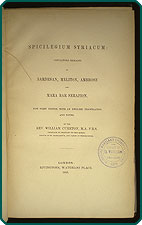
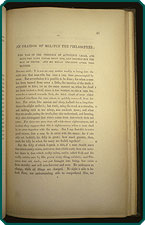
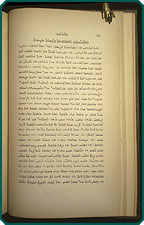 Single-click any image for an enlargement.
• NSTC 2C47117. Publisher’s cloth, covers blind-stamped, spine embossed and with gilt-stamped title; front cover detached, cloth chipped at spine extremities and rubbed at edges. Front pastedown with institutional bookplate, front free endpaper and title-page rubber-stamped, front free endpaper with inked ownership inscription dated 1870. Early inked marginalia to one page.
Christian ConsolationsSpiritually Endorsed Defoe, Daniel; Charles Drelincourt. [The Christian’s defence against the fears of death. With seasonable directions how to prepare ourselves to die well. Written originally in French ... Translated into English, by Marius D’Assigny] A true relation ofthe apparition of one Mrs. Veal ... the eighteenth edition. [London: Pr. for R. Ware, W. Innys & J. Richardson, W. & D. Baker, et al., 1756]. 8vo (20.3 cm, 8"). [2], xi/xii, 12, 502 pp. (lacking frontis., main t.-p., 3 ff. preface, & final f.).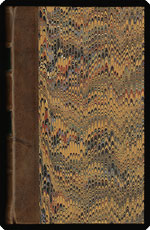
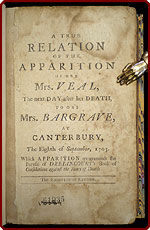
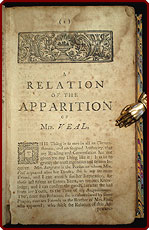 Click the interior images for enlargements.
 This example particularly showcases the “True Relation,” as the separate title-page for that item is the first leaf present here; the title-page and preface for the Defence are absent.
• ESTC T189434; Lowndes 616–17; Allibone 490. Recent quarter mottled calf and marbled paper–covered sides, leather edges blind-tooled, spine with gilt-stamped leather labels, gilt-dotted raised bands, and gilt-stamped decorations in compartments. First three pages institutionally pressure-stamped, lower (closed) edges rubber-stamped; title-page with inked and rubber-stamped numerals in lower margin. Frontispiece, main title-page, preface to Christian's Defence, and final leaf lacking (the last interrupting the text of a brief account of Drelincourt's life). Title-page stained with inner margin reinforced and tear repaired some time ago. Pages browned, foxed, and stained, first and last few with edges tattered; some corners dog-eared. Two leaves torn, without loss of text; one leaf with outer margin chipped, affecting four words without loss of sense. A book often “read to death” . . . (25807)
The Lives of PlantsDigby, Kenelm. Discovrs svr la vegetation des plantes, fait par le Cheualier Digby, le 23. Ianuier 1660, en presence de Messieurs de l’Academie Royale d’Angleterre.... Paris: Chez la veuve Moet, 1667. 12mo (15. 6 cm, 6.2"). ã8A–G6H4 (-H4, blank); [16], 89, [1 (blank)] pp.

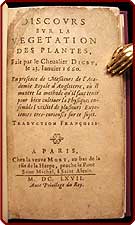
Rare. Searches via OCLC, RLIN, and NUC locate only five copies worldwide: Two in the U.S. (both at same university!) and three in France.
• Duveen D494. Recent calf with covers framed in single gilt fillets, spine with gilt-stamped title label and gilt-ruled raised bands. Leaves with some dustsoiling and dampstaining; now heavily sized, many with margins repaired and a few with stray pencil marks. Lacks final blank leaf (only). In fact, a rather nice copy of a very uncommon item.
For more 17TH-CENTURY BOOKS, click here. For more BOOKS IN FRENCH, click here. For a little more SCIENCE, click here. For NATURAL HISTORY, click here.

Rare Variant — “WE”
Binding
Detail — Sunderland Copy Diodorus Siculus. Diodorus Siculus. [Operum lib. vi. priores, Latine Poggio interprete.] [Paris]: [pr. by Jean Marchant for] Jean Petit, [ca. 1507]. 4to. a–v8.4x6y4; 123, [6] ff. [bound with] Justinus, Marcus Junianus. Justini historia ex Trogo Pompeio quattor & triginta epithomatis collecta; acc. Lucius Florus et Sextus Rufus. [Paris]: De Marnef, [ca. 1507]. 4to. A8B4C6a–y8.4z6&4; [18], 140 ff.


While one copy of Diodorus bound with Petit’s Justinus was found at Harvard, no record of the apparently extremely scarce de Marnef variant could be located.
Provenance: Charles Spencer, Third Earl of Sunderland, lot 3934 in the Sunderland Library sale (1882).
• Diodorus: Moreau 1508:64; not in Schweiger. Justinus: not in Moreau, not in Schweiger. On Diodorus, see: Oxford Companion to Classical Literature, 146. 17th-century English calf, panelled, with gilt fleurons and elaborate front and back gilt floral center motifs, each worked with a minute WE. (You need a magnifying glass, but this is THERE.) Overall, showing wear with
some leather chipped from spine, covers abraded, and joints starting. Pages mostly clean, with slight staining to inner margins from binding supports. Gilt cover lozenges still bright and the whole safe to be worked with.
For more 16TH-CENTURY BOOKS, click here. For more GREEK & LATIN CLASSICS, click here. For more Books with SPECIAL PROVENANCE, click here. For more ATTRACTIVE, FINE, &
Agitating
Against Parliament —
But Not Against
the King?Dublin
(Ireland). The great charter of the liberties of the city
of Dublin, transcribed and translated into English; with explanatory notes. Addressed
to his Majesty, and presented to his Lords Justices of Ireland. Dublin: James
Esdall, 1749. 8vo (19.8 cm, 7.75"). [2], vi, xliv, 31, [1 (blank)], 3–36,
[2 (1 blank)] pp. (pp. iii/iv of the dedication bound in between iv & v of
the preface).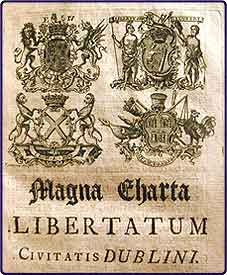
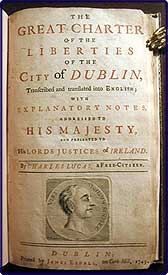
The work bears two imposing engraved headpieces done by P. Simms, and is handsomely printed in roman, italic, and fraktur, with the title-pages for the English and Latin sections in red and black.
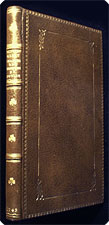
• ESTC T200365. Full brown morocco old style, covers framed in
gilt rolling and panelled in single gilt fillet with inset corner fleurons;
spine with gilt-stamped title, raised bands decorated with dotted gilt rules,
and gilt-stamped shamrock devices in compartments. Title-page and one other
lightly stamped by a now-defunct institution; Latin title-page trimmed closely
with loss of three characters; the leaves with the beautiful headpieces (and
in fact all others) just as they should be. Some cockling and mild
browning, pages otherwise clean. A nice copy of this evocative expression of Irish
patriotic feeling.
For more of IRISH interest, click
here. For
ENGLISH POLITICS, click here.
For ENGLISH LAW, click
here.
Earnest & Illustrated
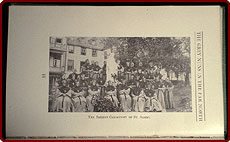
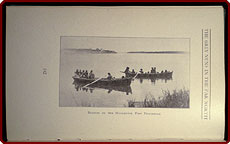
Duchaussois, Pierre. The Grey Nuns in the far north. Toronto: McClelland & Stewart, (copyright 1919). 8vo. [4], 287, [1] pp.; illus.
 Click the images for enlargements.
 This is illustrated with a good many half-tones.
• Publisher's green cloth, front cover and spine with black-stamped title; spine sunned and with inked call number, spine head chipped, corners slightly rubbed. Front pastedown with institutional bookplate, front free endpaper faintly rubber-stamped. (24822)

 TO
Part IV . . . TO
Part IV . . . |