
 TRANSLATIONS
A-B • Bibles • C-D • E-H
I-L • M • N-Sg • Sh-Z
TRANSLATIONS
 H.
Estienne's Final
H.
Estienne's Final FOLIO
Text
FOLIO
Text Greek, Latin, & Impressive
 Isocrates. [two
lines in Greek, then] Isocratis Orationes et epistolae cvm Latina interpretatione
Hier. VVolfij, ab ipso postremùm regognita. Henr. Steph. in Isocratem
Diatribæ VII: quarum van obseruationes Harpocrationis in eundem examinat.
Gorgiae et Aristidis quædam, eiusdem cum Isocraticis argumenti. Guil. Cantero
interprete. [Geneva]: Excudebat Henricus Stephanus, 1593. Folio. [fleuron]4*6**4a–z6aa–mm6nn4;
Aa–Ll6; A–C6D4; a
–d
4a.4b.6 (-b.6, blank); [14] ff., 427, [1 (blank)],
131, [1 (blank)], xxxiiii pp., [1 (blank)], [4] ff., 31, [1 (blank)] pp., [9]
ff. (without the final blank).
Isocrates. [two
lines in Greek, then] Isocratis Orationes et epistolae cvm Latina interpretatione
Hier. VVolfij, ab ipso postremùm regognita. Henr. Steph. in Isocratem
Diatribæ VII: quarum van obseruationes Harpocrationis in eundem examinat.
Gorgiae et Aristidis quædam, eiusdem cum Isocraticis argumenti. Guil. Cantero
interprete. [Geneva]: Excudebat Henricus Stephanus, 1593. Folio. [fleuron]4*6**4a–z6aa–mm6nn4;
Aa–Ll6; A–C6D4; a
–d
4a.4b.6 (-b.6, blank); [14] ff., 427, [1 (blank)],
131, [1 (blank)], xxxiiii pp., [1 (blank)], [4] ff., 31, [1 (blank)] pp., [9]
ff. (without the final blank).
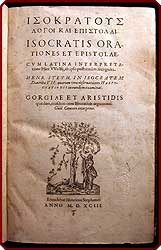

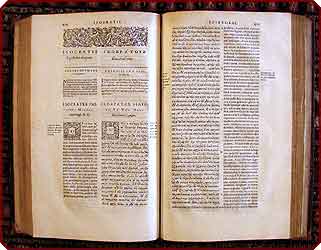
The texts of the orations and "letters" of the great Athenian orator (436–338 B.C.) are printed in double-column format, with the Greek presented in exquisite Greek type in the inner columns and the Latin translation in roman type in the outer ones. A version of the famous Estienne printer's device graces the title-page.
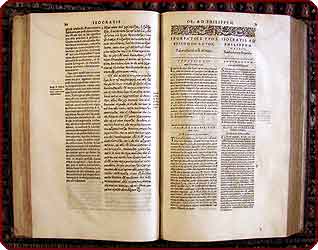
 Single-click either double-page image for an enlargement.
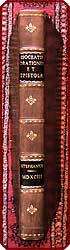
• Adams O219; Renouard (2nd ed.), Annales de l'imprimerie des Estienne, 155.1; Schreiber, Estienne, 225; Schweiger, Handbuch der classischen Bibliographie, I:181; Dibdin (4th ed.), An Introduction to . . . Greek and Latin Classics, II:126. 18th-century plain calf, recently rebacked; round spine, raised bands accented with gilt ruling. Gilt-tooled center devices in spine compartments. Two gilt-lettered spine labels. Title-page dust-soiled; a library's blind pressure-stamps; properly deaccessioned with no additional stamps.  A covetable exemplar.
 For
a few more ESTIENNES, click here.
For
a few more ESTIENNES, click here.

 The
“Laws of the Sea”
at a Time When
England Was!
The
“Laws of the Sea”
at a Time When
England Was! the
Law on the Seas
Jacobsen, Friedrich Johann. Laws of the sea, with reference to maritime commerce during peace and war. Baltimore: Edward J. Coale, (J. Robinson, printer), 1818. 8vo (22 cm; 8.75"). xxxv, [1], 636 pp.
the
Law on the Seas
Jacobsen, Friedrich Johann. Laws of the sea, with reference to maritime commerce during peace and war. Baltimore: Edward J. Coale, (J. Robinson, printer), 1818. 8vo (22 cm; 8.75"). xxxv, [1], 636 pp.
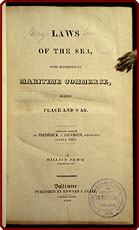
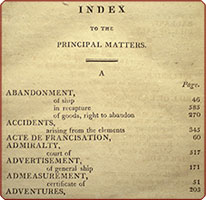
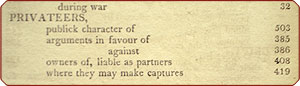
Published at a critical period in America's commercial history, this work presents the then prevailing international law on such matters as shipwreck, salvage, abandonment, blockages, embargoes, delivery, demurrage, and neutrality, to mention just a few topics.

 Hoe Copy — Ballads
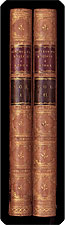
 Beautifully BoundJamieson, Robert. Popular ballads and songs, from tradition, manuscripts, and scarce editions; with translations of similar pieces from the ancient Danish language, and a few originals by the editor. Edinburgh: Archibald Constable & Co. (pr. by J. Ballantyne & Co.), 1806. 8vo (22.2 cm, 8.75"). I: [6], ii, xix, [1], 352 pp. II: [4], iii, [1], 409, [5] pp.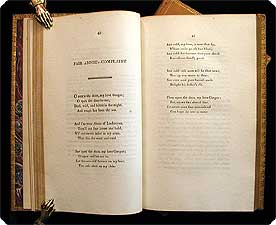
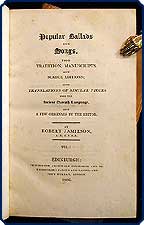 Single-click either image for an enlargement.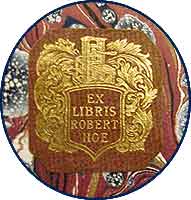
 Provenance: Hoe copy, with morocco “Ex libris Robert Hoe” bookplates on both front
pastedowns.
Provenance: Hoe copy, with morocco “Ex libris Robert Hoe” bookplates on both front
pastedowns.
Binding: 19th-century gold calf with covers framed in double gilt fillets, turn-ins gilt-stamped, marbled endpapers. Spines gilt-tooled and with gilt-stamped title and volume labels. All page edges gilt.
• NSTC J236. Leather showing moderate acid-spotting, with some cracking over the spine (one label repaired). One leaf with short tear from bottom edge; pages with a very few scattered spots of foxing only.  A very handsome set.
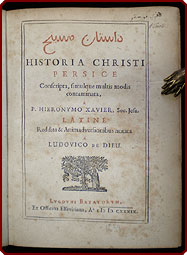
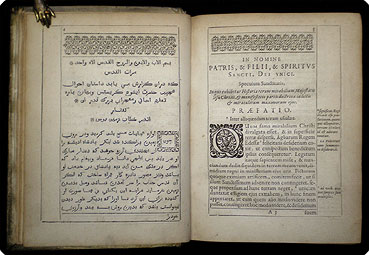
TWO Notable Orientalists — Elzevir Edition Javier, Jerónimo. [two words in Persian, then] Historia Christi Persice conscripta, simulque multis modis contaminata. Lugduni Batavorum: Ex Officina Elseviriana, 1639. 4to (20.6 cm, 8.1"). [24], 636, [4 (index)] pp. [with, as issued, the same author's] [three words in Persian, then] Historia S. Petri Persice conscripta, simulque multis modis contaminata. Latine reddita, & brevibus animadversionibus notata ... Lugduni Batavorum: Ex Officina Elseviriana, 1639. [8], 144 pp. 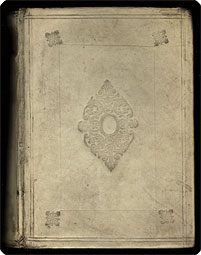
 Click the images for enlargements.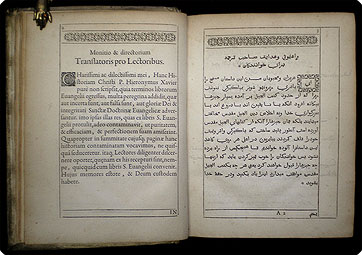
• Willems 490; Copinger 5255; Palau 376807–8; DeBacker-Sommervogel, VIII, 1339. Contemporary vellum, covers framed in blind with blind-tooled central medallion, spine with early hand-inked title; vellum lightly soiled overall, upper outer front corner bumped, splits in spine vellum repaired with Japanese paper and minor (expert) repair to joints. Upper outer corner of title-page with early inked ownership inscription in both Persian and English, possibly by orientalist Henry Pitts Forster (1766–1815); title-page with shadows of other annotations. Pages age-toned, with upper portions darkened; scattered light spotting towards back of volume. Eleven leaves with small spots of worming, affecting a few letters without loss of sense; light to moderate waterstaining to portions of leaves towards back of volume. Last leaf with small tear without loss. One page with pencilled annotations. (25957)

 Methodist Missionary & Chippewa Chief's HYMNS
 Chippewa
& English Jones, Peter, tr. Collection of hymns for the use of native Christians of the Chipeway tongue. [added title-age in Chippewa:] Nahkahmoonun kanahnahkahmoowaudt ekewh ahneshenahpaigk anahmeahchik. Kahahnekahnootahpeungkin owh Kahkewaquonnaby. New York: Printed at the conference office by J. Collord, 1829. 12mo (13.2 cm; 5.125"). [1] f., pp. [1–2], 3, then 37, 37, 38–92 pp.
Chippewa
& English Jones, Peter, tr. Collection of hymns for the use of native Christians of the Chipeway tongue. [added title-age in Chippewa:] Nahkahmoonun kanahnahkahmoowaudt ekewh ahneshenahpaigk anahmeahchik. Kahahnekahnootahpeungkin owh Kahkewaquonnaby. New York: Printed at the conference office by J. Collord, 1829. 12mo (13.2 cm; 5.125"). [1] f., pp. [1–2], 3, then 37, 37, 38–92 pp.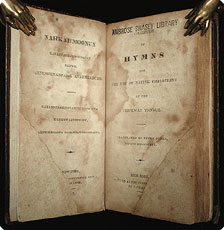
 Click the images for enlargements.
 Peter Jones (1802–56) was a mixed-blood Missisauga chief and a Methodist missionary at New Credit, Ontario.
• Pilling, Proof-sheets, 2024; Pilling, Algonquian, 266; Shoemaker 39161. Not in Sabin; not in Newberry Library, Ayer Indians; not in Boston Athenaeum, Schoolcraft Collection. Contemporary brown calf, modest triple-rule border on covers in blind; rebacked and spine blind-tooled with ruled compartments containing blind-stamped devices. Lower outer corners of both title-pages torn away and paper repairs made, with partial loss of imprint information on each page; old library rubber-stamp to top of English one. Staining, sometimes heavy; chipping of page edges; pp. 39/40 with large semicircular tear with loss of text. Far from a perfect copy, but copies are extremely uncommon in commerce these days. (25853)
Antiquities
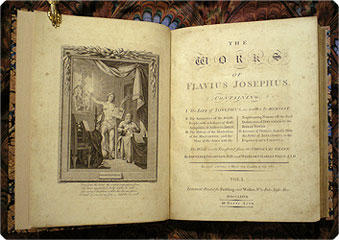
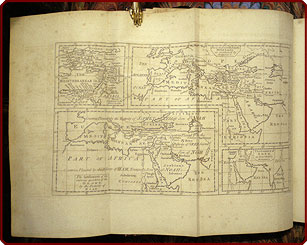
of the Jews ILLUSTRATEDJosephus, Flavius. The works of Flavius Josephus. Containing, I. The life of Josephus, as written by himself. II. The antiquities of the Jewish people; with a defense of those antiquities, in answer to Apion. III. The history of the martyrdom of the Maccabees; and the wars of the Jews with the neighbouring nations till the final destruction of Jerusalem by the Roman power. IV. Account of Philo's ambassy from the Jews of Alexandria, to the Emperor Caius Caligula. London: Pr. for Fielding & Walker by Henri Lion, 1777–78. 4to (27.2 cm, 10.75"). 2 vols. I: Frontis., 719, [1] pp. (lacking list of subscribers); 44 (1 fold.) plts., 7 maps (1 fold.). II: Frontis., [2], 644, [28 (index)] pp.; 16 (of 17) plts.
 Click the interior images for enlargements.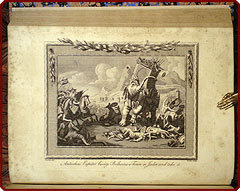
The two volumes are illustrated with a total of69 copper-engraved plates (out of 70 called for), including a number of maps, all engraved by several different hands after the work of various artists.
• CBEL, II, 1492; ESTC T112662; Lowndes 1236; Schweiger, I, 179. Period-style quarter mottled calf with marbled paper–covered sides, leather edges blind-tooled, spines with gilt-stamped leather title-labels and gilt-stamped compartment decorations. Front fly-leaf of vol. II with 19th-century inked gift inscription. Vol. I lacking list of subscribers; vol. II lacking one plate (“The Death of Caius Caesar”). Light to moderate spotting and staining throughout; some offsetting to and around plates. One leaf torn from outer edge, narrowly missing text. A sound, handsome set fine for working or playing with. (24538)

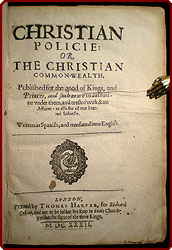
Spanish Statecraft — First English Appearance Juan
de Santa María, fray. Christian
policie: Or, the Christian common-wealth. London: Pr. by Thomas Harper for Richard
Collins, 1632. 4to (22 cm, 8.6"). [18 of 19 (lacks blank {only})], 481, [1]
pp.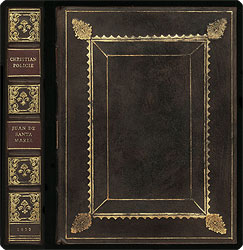
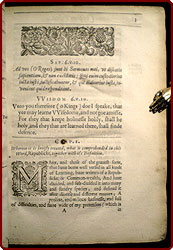 Click the images for enlargements. scholar and poet James Mabbe, known for his translations of Cervantes and other works of Spanish literature and theology.
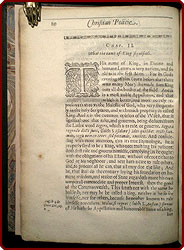
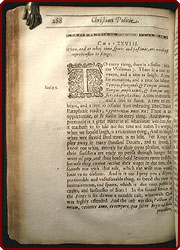
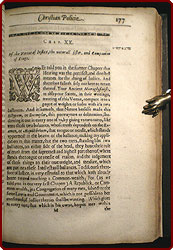
Uncommon: ESTC, OCLC, and NUC Pre-1956 find only 9 U.S. holdings.
• ESTC S107911; STC (2nd ed.) 14831. Period-style calf framed and panelled in gilt fillets with gilt-stamped corner fleurons; spine gilt extra with gilt-stamped leather title and author labels. Lacks initial blank leaf, as is the case with virtually all copies. Two leaves with tattered outer edges, one leaf with small hole affecting a few letters; pages with some moderate offsetting, a few browned. (25084)
 The Mégha Dúta — The Cloud MessengerKalidasa. The Mégha Dúta; or cloud messenger; a poem, in the Sanscrit language. Calcutta printed and London reprinted: Black, Parry, & Co., 1814. 8vo (20.4 cm, 8"). [4], 2, [ix]–175, [1 (blank)] pp.
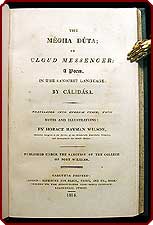
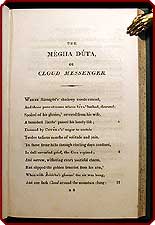 Click either righthand image for an enlargement.
 A scarce book: Via OCLC, RLIN, and NUC Pre-1956 we trace only six copies in U.S. institutions!
• NSTC K23. Recent neat green cloth, spine with gilt-stamped leather title-label. Some pages with very faint foxing. A decidedly nice copy.
FromRomulus Augustulus to Louis PhilippeKoch, Christopher William. History of the revolutions in Europe.... Middletown [Ct.]: Edwin Hunt, 1833. 2 vols. in 1. 12mo (19.5 cm, 7.625"). I: 280 (i.e., 276) pp.; 4 plts. II: 393, [1 (blank)] pp., [1 (blank)] f.; 8 plts. 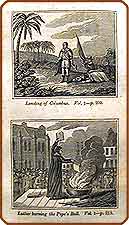
 24 wood-engraved illustrations on 12 plates, some of which are signed “JWB” and one of which is signed “B.”
• Contemporary publisher’s mottled sheep; spine gilt extra. Fine abrasions or chipping to leather, especially to head and foot of spine. Offsetting from turn-ins; lightly foxed throughout. A closed tear without loss in pp. 327–28. All edges marbled.
For more POST-1820 AMERICANA, click here. For more ILLUSTRATED BOOKS, click here. For a little more CONNECTICUTiana, click here.
Rabbi Kohn'sSamaritan Thesis Kohn, Samuel. De Pentateucho Samaritano ejusque cum versionibus antiquis nexu. Dissertatio inauguralis quam amplissimi philosophorum ordinis auctoritate in alma litterarum universitate Viadrina ... die VII. mensis Aprilis MDCCCLXV. Lipsiae: G. Kreysing, 1865. 8vo (22.7 cm, 8.9"). [6], 68, [4] pp.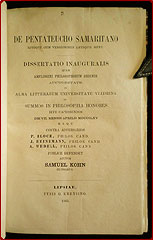
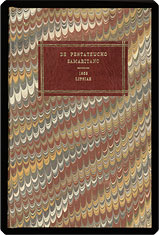 Click the interior image for an enlargement.
• Recent marbled paper–covered boards, front cover with gilt-stamped red leather title-label (a little darkened). Three leaves with offsetting from now-absent laid-in item. Some upper corners bumped; one leaf with repairs to inner margin, touching but not obscuring text. Endpapers and some edges with a little soiling; generally, quite clean. (25365)
First French Koran — Pirated Edition Koran. L'Alcoran de Mahomet. Traduit d'Arabe en François, par le Sieur du Ryer, Sieur de la Garde Malezair. A la Haye: Adrian Moetjens, 1683. 12mo (13.7 cm, 5.4"). Frontis., [10], 486, [4] pp.
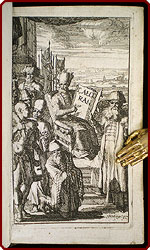
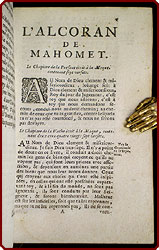 Click the images for enlargements.
 This edition opens with a copper-engraved added title-page signed by J. Padebrugge; the main title-page bears the Elzevir sphere mark. Willems notes that it is “une copie exacte et ligne pour ligne de celle [the Elzevir edition] de 1672, dont en effect Moetjens s'était rendu adjudicataire, mais c'est positivement une réimpression.” It is, in effect, aline-for-line piracy, and a handsome one faithful to its original's good qualities.
Uncommon: OCLC and NUC Pre-1956 locate only eight U.S. holdings.
Provenance: Front pastedown with bookplate of collector Robert J. Hayhurst.
• Brunet, III, 1309; Willems 1472. Contemporary vellum, spine with early inked title; vellum remarkably clean. Original blue silk place marker present and intact. Front free endpaper with upper outer corner excised, mostly removing an early inked ownership inscription; title-page with early inked inscriptions lined through; back free endpaper with recent pencilled purchase record. One leaf with short tear from outer margin, just touching text without loss. Pages clean. A nice book. (25561)
STRIKINGLY Illustrated La Motte-Fouque, F. de la. Undine. New York: The Limited Editions Club, 1930. 4to. vii, [1], 141, [5] pp.; illus.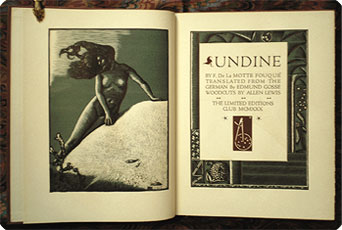
• Limited Editions Club, Bibliography of the Fine Books Published by the Limited Editions Club, 10. Binding as above; a clean, fresh copy showing next to no wear, in a rubbed slipcase with the spine reinforced some time ago with tape. (11241)

 “CORRECT”
Plutarch — Wrangham's
Edition
Langhorne, John & William. Plutarch's lives, translated from the original Greek; with notes critical and historical, and a life of Plutarch.... A new edition, in six volumes, with corrections and additions by the Rev. Francis Wrangham. London: Pr. by Thomas Davison, 1809 (vol. III pr. by Wood & Innes; vols. IV, V pr. by W. Flint). 8vo (21.8 cm, 8.6"). I: Frontis., [8], xcvi, 465, [1] pp. II: [4], 659, [1] pp. III: [4], 563, [1 (blank)] pp. IV: 648 pp. V: [4], 518 pp. VI: [4], 443, [1 (blank)], [4] pp.
“CORRECT”
Plutarch — Wrangham's
Edition
Langhorne, John & William. Plutarch's lives, translated from the original Greek; with notes critical and historical, and a life of Plutarch.... A new edition, in six volumes, with corrections and additions by the Rev. Francis Wrangham. London: Pr. by Thomas Davison, 1809 (vol. III pr. by Wood & Innes; vols. IV, V pr. by W. Flint). 8vo (21.8 cm, 8.6"). I: Frontis., [8], xcvi, 465, [1] pp. II: [4], 659, [1] pp. III: [4], 563, [1 (blank)] pp. IV: 648 pp. V: [4], 518 pp. VI: [4], 443, [1 (blank)], [4] pp.
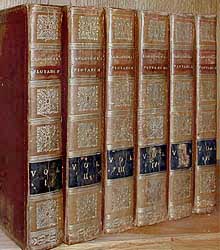
correct
than North's spirited translation from the French of Amyot, or the unequal production
known as Dryden's version, and though written more than 120 years ago, it still
holds the field" (this in 1892). First printed in 1770, the work was later edited
by Francis Wrangham, a classical scholar and passionate collector of books;
it appears here in the first printing of Wrangham's edition.
• On John and William Langhorne, see: Dictionary of National Biography, XXXII, 101–02. Contemporary calf, covers framed Histoire des personnes with gilt roll and blind-stamped feather-and-scroll roll, spines gilt extra with gilt-stamped titles and leather volume labels. Covers and edges showing moderate wear, some joints starting; spines with slight cracking, wear to title compartments and volume labels. With bookplates of two 20th-century collectors to front pastedowns, catalogue clipping affixed to front free endpaper of vol. I. Varying degrees of offsetting with some leaves lightly spotted. A dignified set.
For
more GREEK & LATIN CLASSICS, click here.
The First CompleteTao in the WestLao-tzu. Lao Tseu tao te king. Le livre de la voie et de la vertu...traduit en français, et publié avec le texte chinois et un commentaire perpétuel par Stanislas Julien. Paris: L'Imprimerie Royale, 1842. Small 8vo (22 cm; 8.5"). [3] ff., xlv, [1 (blank)], 303, [1 (errata)] pp. 
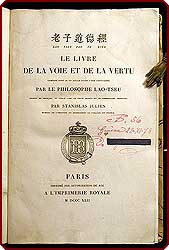
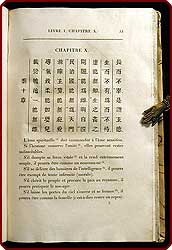 Click either of the two images above right, for enlargement.
Uncommon: Of institutional copies, we only locate five in the U.S.
• Cordier, Bibliotheca Sinica, 723. 19th-century quarter brown morocco with marbled paper sides. Joints just starting at top and bottom, with a bit of a “bite” taken at bottom of front one. Blank portion of half-title excised and replaced with later paper. Evidence of sometime water exposure, with some crinkling/cockling and faint outline of stain to upper outer page quadrants. Gift inscription on title-page partially blacked out. Overall a good copy of a scarce book.
For more BOOKS IN FRENCH, click here. For CHINA, click here. For more RELIGION, click here. Or for LITERATURE, click here.
Cortés Malinche & Montezuma López de Gómara, Francisco. Historia, di Don Ferdinando Cortes, marchese della Valle, capitano varlorosissimo. In Venetia: per Giouanni Bonadio, 1564. 8vo. [8], 354 of 356 ff. (lacking fol. 1 and final blank).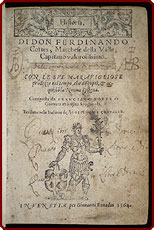
The Historia general de las Indias (first published in 1552) is divided into two parts which stand on their own although clearly written as two parts of a whole. Part I is a history of events concerning the discovery and conquests of the New World exclusive of those involving Cortés. Part II is entirely dedicated to the telling of Cortés's role in the conquest of Mexico and subsequent discoveries.
Click the images for enlargements. In this Italian translation from the pen of Agostino di Cravaliz, López's “all-Cortés” volume stands as part III of the three-volume Historia, delle nuove Indie Occidentali, with parts I and II being translations of Cieza de Leon's Historia, over Cronica del gran regno del Peru and the previously mentioned part I of Gómara's Historia general de las Indias.
The text here is printed in italic type except the capitals, which are roman. The title-page is printed in roman and italic and has the woodcut printer's device.
• Alden & Landis 564/25; Sabin 27741; Medina, BHA, 159n; Wagner, Spanish Southwest, 2v. 18th-century vellum over paste boards, soiled and a bit rubbed; red leather spine label, with a chip, and an old circular paper shelf-label. Title-page dust-soiled, mounted; small, narrow, oblong portion of blank area of title-page excised and filled in at an early time. Lacks folio 1 and final blank. Top margins closely trimmed, sometimes costing the running heads and folio numbers. (25767)
 An EarlyENGLISH TranslationLucanus,
Marcus Annaeus [Lucan]. Lvcans Pharsalia: Or the civill warres of Rome,
betweene Pompey the great, and Ivlivs Cæsar. The whole tenne bookes, Englished
by Thomas May...the second edition, corrected, and the annotations inlarged by
the author. London: Thomas Iones (pr. by Aug. Mathews), 1631. 8vo (14.5 cm,
5.75"). π1a8A–S8T2; engr.
frontis., [146] ff. [with] May, Thomas. A continvation of the subiect of Lucan’s historicall poem
till the death of Ivlivs Cæser the 2d edition corrected and amended. London:
James Boler, 1633. 8vo. A–K8(-K8); [79 of 80] ff.
An EarlyENGLISH TranslationLucanus,
Marcus Annaeus [Lucan]. Lvcans Pharsalia: Or the civill warres of Rome,
betweene Pompey the great, and Ivlivs Cæsar. The whole tenne bookes, Englished
by Thomas May...the second edition, corrected, and the annotations inlarged by
the author. London: Thomas Iones (pr. by Aug. Mathews), 1631. 8vo (14.5 cm,
5.75"). π1a8A–S8T2; engr.
frontis., [146] ff. [with] May, Thomas. A continvation of the subiect of Lucan’s historicall poem
till the death of Ivlivs Cæser the 2d edition corrected and amended. London:
James Boler, 1633. 8vo. A–K8(-K8); [79 of 80] ff.
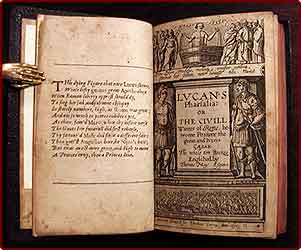
The editio princeps of the Pharsalia was printed in Rome by Sweynheym and Pannartz in 1469; Christopher Marlowe published the first English translation of any part of the Pharsalia, his rendition of the first book, in 1600, with a 1614 effort by Sir Arthur Gorges being the only other such to precede May’s standard-setting 1626 English version of books one through three.
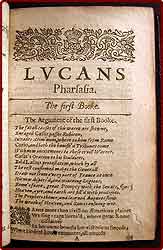 In the present volume, this great epic poem in May’s translation is
accompanied by its translator’s English rendition of his own sequel,
originally written in Latin verse. This Continuation advances the
action through Cleopatra’s seduction of Caesar (May depicts the Egyptian
queen with “snowie necke” and “golden tresses”), the
death of Cato, and various additional battles before arriving at Caesar’s
death. At the time, May’s work was thought highly enough of that Charles
I allowed the Continuation’s dedication to bear his name.
In the present volume, this great epic poem in May’s translation is
accompanied by its translator’s English rendition of his own sequel,
originally written in Latin verse. This Continuation advances the
action through Cleopatra’s seduction of Caesar (May depicts the Egyptian
queen with “snowie necke” and “golden tresses”), the
death of Cato, and various additional battles before arriving at Caesar’s
death. At the time, May’s work was thought highly enough of that Charles
I allowed the Continuation’s dedication to bear his name.
• Pharsalia: STC 16888; Schweiger, II, 567; ESTC
S108868. Continuation: STC 17712; ESTC S108892. 20th-century
black morocco in imitation of early, severe style, with raised bands from
which blind-tooling extends onto covers; spine with gilt-stamped title and
date, and turn-ins elaborately tooled in blind. Moderately worn, spine faded
not unattractively, and leather rubbed over joints. Front pastedown with bookplate,
inked date of 1986; front free endpaper with inked gift inscription dated
1944. T1-2 trimmed differently and possibly surviving from another copy;
A3 of the continuation also possibly supplied. Occasional instances of very
minor staining; mostly clean. Pleasant
on shelf and in hand.
For
more 17TH-CENTURY BOOKS, click here. For more of MILITARY/NAVAL interest, click here. For more GREEK & LATIN CLASSICS, click here. For more
ENGLISH LITERATURE, click here.For
more LUCAN, click
here.A
PRB&M “FEATURED BOOK” —
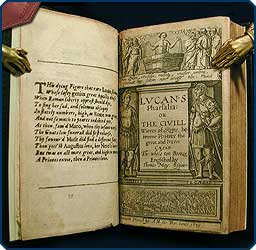
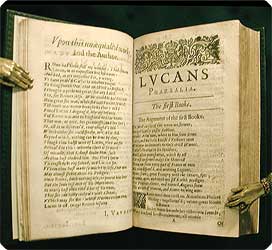
AGAIN Lucan English’dLucanus, Marcus. Lucan’s Pharsalia: Or the civill warres of Rome, betweene Pompey the great, and Iulius Caesar. London: Pr. by A.M. for Will. Sheares, 1635. 8vo (14.7 cm, 5.8"). π1a8A–S8T2; [310] pp. [with] May, Thomas. A continuation of the subiect of Lucan’s historicall poem till the death of Iulius Caeser. London: James Boler, 1633. 8vo. 2A–2K8; [160] pp.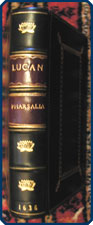
 Click the interior images for enlargements.
 • ESTC S108867; STC (2nd ed.) 16889. Continuation: ESTC S108892; STC (2nd ed.) 17712. Both: Lowndes, III, 1408. Period-style calf by Grace (signed “GB” on lower back turn-in), framed and panelled in gilt rolls, spine with gilt-stamped leather title and author labels and gilt-stamped decorations in compartments. Outer and lower edges of the engraved title-page of second work shaved, touching design. Light waterstaining to upper portions of approx. 25 ff. of Continuation; small area of worming to lower inner margins of a few leaves, touching the occasional catchword but not main text.
 TO
Part VI . . . TO
Part VI . . . |