 18TH-CENTURY BOOKS
Aa-Al • Am-Az • Ba-Beq • Ber-Bo • Bibles • Bp-Bz
Ca-Cb • Cc-Coq • Cor-Cz • Da-Di • Dj-Dz
Ea-England • English-Ez • F • Ga-Gp • Gr-Gz • Ha-Hb
Hc-Hz • I-K • La-Lel • Lem-Log • Loh-Lz • Maa-Mar
Mas-Mz • N-O • Pa-Pi • Pj-Pz • Q-R • Sa-Sch
Sci-Se • Sf-Sol • Som-Sz • Ta-Th • Ti-U • Va-Wil • Wim-Z
 Loskiel,
Georg Henrich. Geschichte der Mission der evangelischen Brüder unter
den Indianern in Nordamerika. Barby: Zu finden in den Brüdergemein, &
Leipzig: Paul Gotthelf Kummer, 1789. 8vo (19.3 cm, 7.6"). [8] ff., 783, [1] pp.
Loskiel,
Georg Henrich. Geschichte der Mission der evangelischen Brüder unter
den Indianern in Nordamerika. Barby: Zu finden in den Brüdergemein, &
Leipzig: Paul Gotthelf Kummer, 1789. 8vo (19.3 cm, 7.6"). [8] ff., 783, [1] pp.
$1200.00
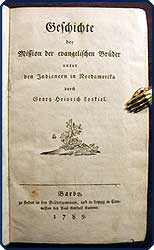
• Important history of the early years of Moravian Church mission
work targeting Native Americans in New York, Pennsylvania, Ohio, and surrounding
regions; Sabin refers to this account as the “best authority, both as
to tradition and facts” on the Moravian efforts in the region from 1735
through 1787. Before recounting the mission's history, the author describes
the customs, languages, and beliefs of various tribes, along with the flora
and fauna prevalent in their territories. A great deal of Loskiel's information
is taken from the accounts of Bishop Augustus Gottlieb Spangenberg and David
Zeisberger, the latter having served for over 40 years as a missionary in North
America.
This first edition does not include the map found in the later English translation;
the six lines of errata (rather than a full page) at the back mark the present
copy as an example of the first issue.
• Howes, U.S.iana, L474; Pilling, Algonquian, 317;
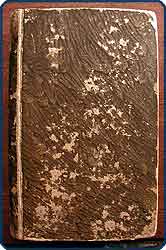
Sabin 42109; Vail 795. Early 19th-century German paper-covered boards, much
worn and abraded, slightly cocked, spine with remnants of paper shelving label.
Some corners dog-eared; scattered small spots of foxing, otherwise internally
clean.

 Sacred Hebrew Poetry
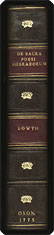
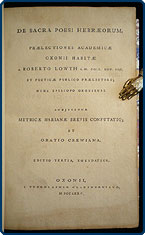
Lowth, Robert. De sacra poesi hebraeorum. Oxonii: E typographeo Clarendoniano, 1775. 8vo (22.5 cm; 8.875"). [4] ff., 515, [1 (blank)] pp., [6] ff.
Sacred Hebrew Poetry
Lowth, Robert. De sacra poesi hebraeorum. Oxonii: E typographeo Clarendoniano, 1775. 8vo (22.5 cm; 8.875"). [4] ff., 515, [1 (blank)] pp., [6] ff.
$360.00
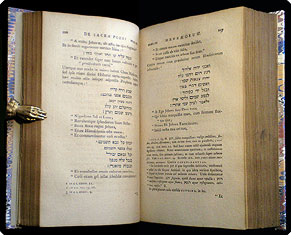
 Click the interior images for enlargements.
• “Editio tertia, emendatior,” the first having appeared
in 1753 and the second in 1763; collected lectures by the Bishop of London on
Hebrew poetry, delivered at Oxford. The volume is printed in Latin, Greek, and
Hebrew; it was later translated into English and published as Lectures on
the Sacred Poetry of the Hebrews. Hannah More praised the work highly in
a letter to Frances Boscawen, and said that it “taught me to consider
the Divine Book it illustrates under many new and striking points of view.”
• ESTC T113648. Recent quarter calf, old style; raised
bands, gilt ruling above and below the bands as accents, gilt center devices
in spine compartments. Deep red spine labels lettered in gilt; marbled paper
sides, with dark wedge of soil crossing bottom 3/4-inch of front cover’s
paper and line of same soil also to turn-ins of back cover. Faint off-setting
to top and bottom margins of early leaves from old binding; medium-light waterstains
in margins of index (i.e., last 6 leaves), and the odd spot or bit of soil
elsewhere. Generally, a very nice clean book. (25318)
 For an OXFORD “shelf,” click here.
For a bit more JUDAICA / HEBRAICA, click here.
For more LITERATURE, click here.
For DICTIONARIES/GRAMMARS, ETC., click here.
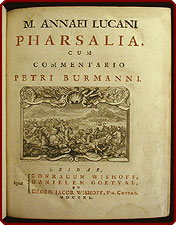
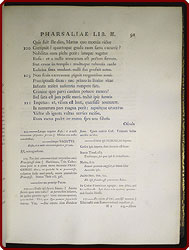
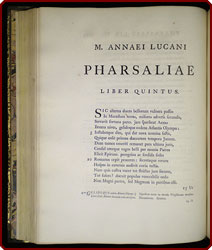
Lucanus, Marcus Annaeus. Pharsalia, cum commentario Petri Burmanni. Leidae: Apud Conradum Wishoff, Danielem Goetval, & Georg. Jacob. Wishoff, 1740. 4to (25 cm, 9.75"). [52], 735, [1 (blank)], [160 (index)] pp.
$500.00
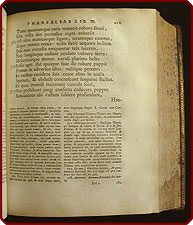
Click the interior images for enlargements.
• First edition of Pieter Burman’s edition of the Pharsalia, Lucan’s account of the Roman Civil War — the greatest epic poem in Latin after the Aeneid. The engraved title-page vignette was done by J. Van der Spyk after a design by J. de Groot.
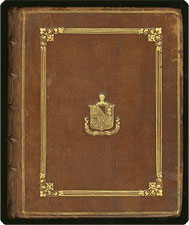
Binding / Provenance: Contemporary calf, framed in gilt triple fillets and panelled in gilt quadruple fillets with gilt-stamped corner fleurons and gilt-stamped central coat of arms of the Wilder family, with the motto “Virtuti moenia cedant.”
• Schweiger, II, 565; Dibdin, II, 186–87. Binding as above, rebacked making use of most of the original spine, spine with gilt-stamped compartments and gilt-stamped leather title-label; edges worn and rubbed, portions of original spine leather cracked and chipped. Front pastedown with small abraded area; front fly-leaf with inked inscriptions dated 1834 and 1938. Some leaves with faint waterstaining in upper margins and lower outer corners.  Attractive.

“The Most Perfect Specimen” — Yep, Strawberry-Hill!
[You can tell, can't you, to look at it??]
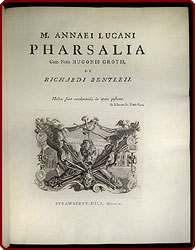
Lucanus, M Annaeus. Pharsalia cum notis Hugonis Grotii, et Richardi Bentleii. Strawberry-Hill [Twickenham]: [Strawberry Hill Press], 1760. 4to. [2] ff., 525, [1 (blank) pp., without the “Ad Lectorem” leaf.
$900.00
Click the images for enlargements.
• First edition, undetermined state of what Hazen labels as “ . . . perhaps the most distinguished piece of printing to come from the Press at Strawberry Hill” (p. 49), and which Dibdin underscores as “the only ancient classical author ever printed there, and. . . the most perfect specimen of that press.” This exquisitely printed edition of Lucan contains the notes of the distinguished scholars Hugo Grotius and Richard Bentley, printed below the text of the Pharsalia in a smaller roman type than the text and with some passages in italics; the notes are laid out in double-column format while the commented-upon original is set in one wide column.  This edition consisted of only 500 copies.
Horace Walpole (1717–97), the 4th earl of Orford, is best remembered as the author of the Gothic novel The Castle of Otranto. Among bibliophiles he is also remembered for his private press, variously known as the Officina Arbutana or the Strawberry Hill Press. Walpole's almost fantastic wealth allowed him the connoisseur's luxury of this noble enterprise, which he operated in the arena of the rebirth of fine printing in Great Britain that was being carried on by the Foulis brothers, Baskerville, and others.
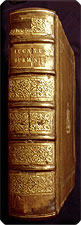
Binding: Contemporary sprinkled calf with a single gilt rule framing covers, rebacked and original spine reapplied; spine with raised bands, each compartment elegantly filled with tooling and each band itself gilt-accented; complementary gilt-tooled bands at top and bottom of spine; the epitome of “gilt extra” without being gaudy. Red leather spine label lettered and ruled in gilt (“LUCAN STRAWBERRY HILL”); gilt roll on board edges and on turn-ins; marbled endpapers.
Provenance: Bookplates of Charles James Packe (British, late-19th century) and H.M. Brower (American, early- to mid-20th century).
• Hazen (1973 ed.), Bibliography of the Strawberry Hill Press, 7; Dibdin (4th ed.), Introduction to . . . Greek and Latin Classics, II, 187; ESTC T11286; Schweiger, II,565. Bound as above, corners rubbed and expertly, even beautifully, rebacked; lacks the “Ad Lectorem” leaf (only). Good paper, wide margins, only the occasional instance of offsetting or soil.  A very good copy. (25974)
For more GREEK & LATIN CLASSICS, click here.
For more LUCAN, click here.
For COLLECTED PRESSES
& TYPOGRAPHY, click here.
Or for more Books with SPECIAL
PROVENANCE, click here.
This book appears in the GENERAL
MISCELLANY — click here.
Lucanus,
Marcus Annaeus. La pharsale..... Paris: Chez Merlin, 1766. 2 vols.
I: 8vo (19.5 cm, 7.75"). Frontis., [1] f., lxxix, [1 (blank)] 304 pp., [1 (errata)]
f.; 5 plates. II: 8vo (19.5 cm, 7.75"). [1] f., 315, [1] pp., [2] ff.; 5 plts.
$600.00 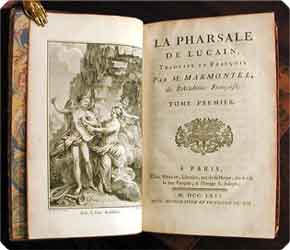
• Lucan's Pharsalia, the greatest epic poem in Latin after
the Aeneid, takes as its subject the civil war between Pompey and Caesar.
Lucan (a.d. 39–65) was born
at Córdoba, Spain, but raised in Rome; he was the grandson of the elder
Seneca, nephew of the younger Seneca, and the brother of the Gallio mentioned
in Acts 18. He published his Pharsalia in a.d.
62 or 63, but it seems likely that his poetic talent aroused the jealously of
the vain Nero, as after its publication the emperor forbade him to write or
even plead in the courts, and then later compelled him to commit suicide for
alleged treason. The illustrated plates in this edition are after Gravelot,
and the French translation is by M. Marmontel.
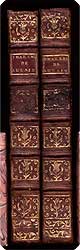 Binding:
Contemporary treed calf, spine gilt extra with badge of a
thistle in compartments; red leather labels. Marbled endpapers. All edges
red.
Binding:
Contemporary treed calf, spine gilt extra with badge of a
thistle in compartments; red leather labels. Marbled endpapers. All edges
red.
Provenance:
Small booklabel of William Salloch on rear pastedown.
• Schweiger, Handbuch der classischen Bibliographie, II,
568. Cohen & DeRicci, Livres à gravure du XVIII siècle,
662. Not in Ray, The Art of the French Illustrated Book 1700–1914.
Binding as above, gilt somewhat dimmed; some chipping of leather to corners
and spine tips, and endpapers rubbed. Internally generally clean, with some
browning from turn-ins and a few spots of soiling. Bookplate on front pastedowns.
Lucanus,
Marcus Annaeus[Lucan]. Pharsalia ejusdem ad Calpurnium Pisonem Poemation
praemittitur notitia literaria studiis Societatis Bipontinae. Editio accurata.
Biponti: Ex typographia Societatis, 1783. 8vo (19.3 cm, 7.625"). [1] f., xxxii,
300 pp.
$200.00
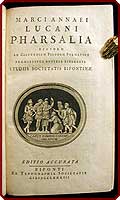
• This unassuming, rather “homey” octavo edition of 1783 was printed in Zweibrücken at the ducal printing office, noted for printing a number of fine editions of the classics. In addition to the usual preliminaries and the advertised notitia literaria, a very useful list and discussion of the editions of Lucan printed up to that point is also included in this, the first Bipontine edition of that author. The volume’s one ornament is a striking engraved vignette on the title-page that shows the head of Pompey being offered to Caesar.
• Schweiger, Handbuch der classischen Bibliographie, II, 565; Dibdin (4th ed.), An Introduction to . . . Greek and Latin Classics, I, 188. Brown paper over light boards, spine with now-illegible paper label; stained and faded, corners bumped. A little foxing and soiling on endpapers and half-title; otherwise internally clean. Bookplate with inked date on front pastedown. All edges heavily speckled red.
 Lucan
for the
Lucan
for the First
Republic
Lucanus, Marcus Annaeus. La pharsale de Lucain.... Paris: De l’imprimerie de Crapelet, 1796. 2 vols. I: 8vo (20.5 cm, 8"). [2] ff., l, 376 pp.; 5 plts. II: 8vo (20.5 cm, 8"). [2] ff., 409, [1 (blank)] pp.; 5 plts.
First
Republic
Lucanus, Marcus Annaeus. La pharsale de Lucain.... Paris: De l’imprimerie de Crapelet, 1796. 2 vols. I: 8vo (20.5 cm, 8"). [2] ff., l, 376 pp.; 5 plts. II: 8vo (20.5 cm, 8"). [2] ff., 409, [1 (blank)] pp.; 5 plts.
$450.00

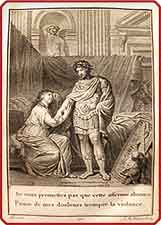
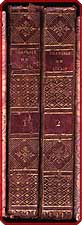
• The illustrated plates in this edition are after Perrin, and the French translation is by Brébeuf.
Binding: Contemporary treed calf, spines gilt extra with red labels and covers gilt-framed; gilt edges and gilt inner dentelles. Marbled endpapers in a French shell pattern. All edges gilt.
Provenance: Small booklabel of William Salloch on rear pastedown.
• Schweiger, Handbuch der classischen Bibliographie, II, 568. Cohen & DeRicci, Livres à gravure du XVIII siècle, 662. Not in Ray, The Art of the French Illustrated Book 1700–1914. Leather on spines and edges of covers dry and chipped; joints open, but sewing holding. Some closed tears to endpapers and front free endpaper of vol. I partially detached; paper generally clean with occasional spots of light browning or foxing. Bookplate on front pastedowns.  Plates clean and charming.
Luis, de Granada. Los seis libros de la rhetorica eclesiastica, o de la manera de predicar.... Quinta impresion. Barcelona: En la Imprenta de Juan Jolis y Bernardo Pla, 1778. 4to (20.8 cm, 8.25"). [1] f., xxxvi pp., [6] ff., 562 pp.
$325.00
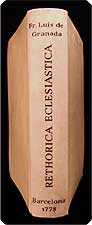
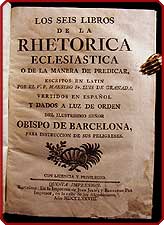
• Luis de Granada (1504–88) was a Dominican friar noted for his theological learning. As is appropriate for a member of the Order of Preachers, he here treats of homiletical rhetoric, giving his readers advice on how to prepare sermons, frame an argument, and adorn their language for the maximum effect. First published in Latin in 1576, this work was translated into French, then into this Spanish version by Bishop José Climent of Barcelona (1770).
• Palau 108151. Recent neat vellum over light boards, spine lettered in black. Paper cockled with light to moderate waterstaining and small spots of soiling, not impeding legibility. Some marginal chipping with tissue paper repair on front fly- and title-leaf, a few shallow marginal tears elsewhere, and a wormhole in lower inner margin of final 22 leaves and rear fly-leaf; rear fly-leaf with some holing. Overall actually in very good condition.

PLACE
AN ORDER |
E-MAIL US |
PRB&M HOME
 North
America
North
America For more PRE-1820 AMERICANA,