 18TH-CENTURY BOOKS
Aa-Al • Am-Az • Ba-Beq • Ber-Bo • Bibles • Bp-Bz
Ca-Cb • Cc-Coq • Cor-Cz • Da-Di • Dj-Dz
Ea-England • English-Ez • F • Ga-Gp • Gr-Gz • Ha-Hb
Hc-Hz • I-K • La-Lel • Lem-Log • Loh-Lz • Maa-Mar
Mas-Mz • N-O • Pa-Pi • Pj-Pz • Q-R • Sa-Sch
Sci-Se • Sf-Sol • Som-Sz • Ta-Th • Ti-U • Va-Wil • Wim-Z
 Establishment,
YES!
Establishment,
YES!
 Ibbetson, James. A plea for the subscription of the clergy
to the thirty-nine Articles of Religion. London: B. White, James Fletcher, and J. Fletcher & Co., 1767. 8vo (21 cm, 8.3"). [4], 48 pp.
Ibbetson, James. A plea for the subscription of the clergy
to the thirty-nine Articles of Religion. London: B. White, James Fletcher, and J. Fletcher & Co., 1767. 8vo (21 cm, 8.3"). [4], 48 pp.
$575.00
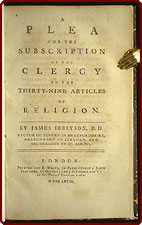
• First edition of an Anglican clergyman's response to Francis Blackburne's controversial Confessional, encouraging “men of interest and spirit . . . to act together, as occasion may require, for the dignity and support of the present Establishment.”
 Click the image for an enlargement.
Uncommon: A search of OCLC and ESTC locates only two U.S. holdings.
• ESTC T4843. Recent marbled paper–covered boards, spine with gilt-stamped leather title-label. Very slight offsetting, pages otherwise clean. (21087)
 For more RELIGION, click here.

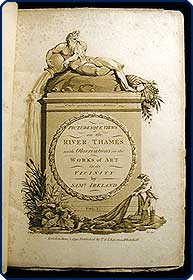
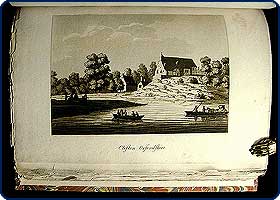
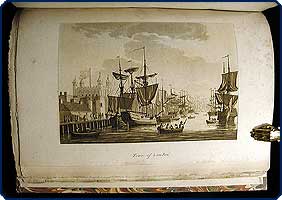
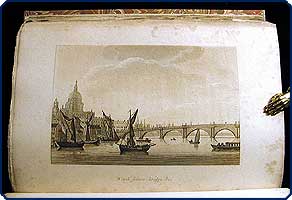
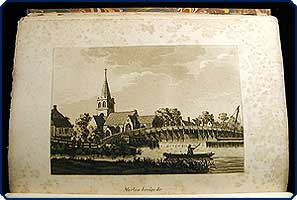
Ireland, Samuel. Picturesque views on the river Thames, from its source in Glocestershire to the Nore; with observations on the public buildings and other works of art in its vicinity. London: T. & J. Egerton, 1792. 4to (25 cm, 9.8"). 2 vols. I: Add. engr. t.-p., xvi, 209, [3] pp.; 1 map, 27 plts., illus. II: Add. engr. t.-p., viii (incl. t.-p.), 258, [4] pp.; 1 map, 25 plts., illus.
$1875.00
Click any image where the hand appears on
mouse-over, for an enlargement.
• First edition of Ireland’s guidebook to the architectural, botanical, artistic, and historical pleasures to be found along the Thames, featuring assorted poetical digressions as well as descriptions of the splendor of Blenheim Castle and other castles and manors, the disrepair of London Bridge, and paintings by Rubens and Holbein. The two volumes are copiously illustrated with 52 aquatint plates engraved by C. Apostool after drawings by Ireland, 2 maps, and
a number of in-text cuts.
52 aquatint plates engraved by C. Apostool after drawings by Ireland, 2 maps, and
a number of in-text cuts.
• ESTC T2691; Abbey, Scenery, 430. Period-style quarter calf over marbled paper–covered sides, spines with gilt-stamped leather title and author labels, gilt-ruled raised bands, and gilt-stamped decorations in compartments. Versos only of half-titles, title-pages, and a few other leaves stamped by a now-defunct institution. Plates lightly to moderately spotted, with some instances of light offsetting to pages around plates. Pages faintly age-toned, with edges untrimmed; one leaf with lower outer corner torn away, not touching text.  This supplies both handsome, interesting pictures and good, now quaint reading.

Exam
Time in 1790
Querétaro
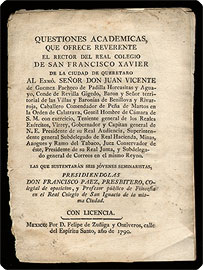
Iturriaga, Manuel. Questiones academicas, que ofrece
reverente el rector del Real Colegio de San Francisco Xavier de la ciudad de Queretaro al Exmo.
Señor Don Juan Vicente de Guemez Pacheo de Padilla Horcasitas y Aguayo.... Mexico: Por D.
Felipe de Zuñiga y Ontiveros, 1790. 8vo (20 cm; 8"). [1] f., 12 pp., 1 plt.
1790
Querétaro
Iturriaga, Manuel. Questiones academicas, que ofrece
reverente el rector del Real Colegio de San Francisco Xavier de la ciudad de Queretaro al Exmo.
Señor Don Juan Vicente de Guemez Pacheo de Padilla Horcasitas y Aguayo.... Mexico: Por D.
Felipe de Zuñiga y Ontiveros, 1790. 8vo (20 cm; 8"). [1] f., 12 pp., 1 plt.
$775.00
Click the images for enlargements.
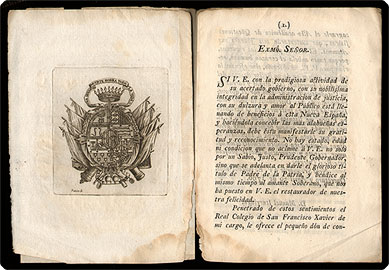
• Apparently previously unknown printing of the examination
questions put to “seis jóvenes seminaristas” of the school
in Querétaro specified in the title of the work, with observations on
the elements that would be appropriate in acceptable answers. Interestingly
for anyone interested in what was taught in such a school in such a place at
this date, the second part of the exam lays considerable emphasis on “Física,”
“esta nobilisima Ciencia,” and “Medicina.”
The plate is a very fine copper engraving of the viceroy's coat of arms and is signed in the
plate “Garcia.” (There is also one handsome headpiece.)
• Not in Medina, Mexico;
not in CCILA; not in Catálogo Colectivo del Patrimonio Bibliográfico Español; not in Catálogo
Colectivo del Patrimonio Bibliográfico Mexicano. Never bound, never
stitched; irregular at the lower area of the inner margin of all leaves with rodent-gnawing visible.
Light waterstaining in lower inner corners as well. Some finger soiling; light chipping along top
edges. Title-page lightly dust-soiled. (26879)
MEXICO is one of our great specialties.
For our MEXICANA, click here.
 For CHILDREN / EDUCATION, click here.
This also appears in the HISPANIC
MISCELLANY — click here.

Once Thought to Be by Benjamin Franklin
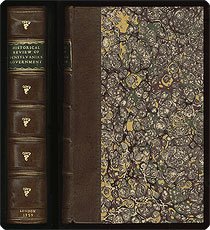
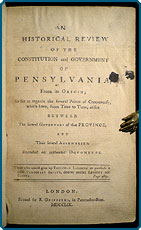
Jackson, Richard. An Historical Review of the Constitution and Government of Pensylvania [sic]. London: Pr. for R. Griffiths, 1759. 8vo. viii pp., [9] ff., 444 pp.
Benjamin Franklin
Jackson, Richard. An Historical Review of the Constitution and Government of Pensylvania [sic]. London: Pr. for R. Griffiths, 1759. 8vo. viii pp., [9] ff., 444 pp.
$975.00
Click the images for enlargements.
• The anonymously published first edition of this important source on the history of the Pennsylvania constitution and the colony's government, treating the terms of the colonial governors chronologically — but not drily. The very table of contents here breathes drama in organization and diction, and the appendix consists of transcriptions of documents relating to conflicts between Pennsylvania proprietaries and representatives of the Crown: a handy compendium of irritations (and worse) that would be remembered 17 years later, in 1776, in the Pennsylvania State House that would come to be called “Independence Hall.”
This was long most commonly attributed to Benjamin Franklin, but recently, on the basis of new scholarship, authorship has been ascribed to Richard Jackson, a London barrister and colonial agent with whom Franklin collaborated in other publications. Franklin and his son, William, certainly supplied many of the materials that formed the basis of the book, which was published during Franklin's first mission to England.
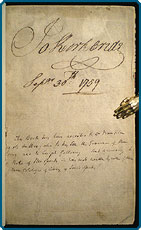
Provenance: Large signature of “Jo. Kirkbride” dated “Septr 30th 1759" on front free endpaper.
Manuscript additions: Under this ownership signature, in a later, much smaller hand, are five lines of speculation as to the work's authorship; a date is corrected on p. 263. Between leaves B3 and B4, a leaf is bound in containing, on its two sides, a handwritten “List of Governors of Pennsylvania — continued”; this, with one addition to the printed list on p. 262, takes the chronology through John W. Geary, inaugurated in 1867.
• Sabin 25512 (noting that the editor of the second edition (Philadelphia, 1812) “had no doubt as to [Franklin's] authorship” and supplied his name); Sparks, Franklin, III, 109 (affirming that the volume “was prepared under [Franklin's] direction, and doubtless from copious materials furnished by him”); ESTC T117618. Recent quarter calf, old style, with raised bands accented with gilt beading on each band, a gilt center device in each spine compartment, and a green leather title label. Boards covered with a stone pattern marbled paper. Title-page with two old ink blots; text lightly and uniformly age-toned. Inscriptions/additions as noted. (25085)
For more PRE-1820 AMERICANA, click here.
For more ANGLO-AMERICAN LAW, click here.
For more of PHILADELPHIA
interest, click here.
For more Books with SPECIAL
PROVENANCE, click here.
This also appears in the GENERAL
MISCELLANY — click here.

“Investigating Our Scottish Dialect”
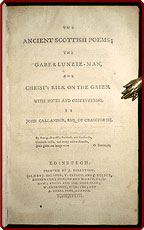
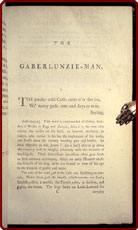
James V, King of Scotland; Callander, John, ed. Two ancient Scottish poems; The Gaberlunzie-man, and Christ's kirk on the green. Edinburgh: Pr. by J. Robertson, 1782. 8vo (21 cm, 8.25"). [2], 179 (i.e., 193), [1] pp. (1 prelim. f. lacking).
Our Scottish Dialect”
James V, King of Scotland; Callander, John, ed. Two ancient Scottish poems; The Gaberlunzie-man, and Christ's kirk on the green. Edinburgh: Pr. by J. Robertson, 1782. 8vo (21 cm, 8.25"). [2], 179 (i.e., 193), [1] pp. (1 prelim. f. lacking).
$250.00
Click either image for an enlargement.
• First edition. Attributed by Callander to James V of Scotland, these two poems here appear with extensive annotations and footnotes, including a great deal of speculative etymology. The editor, a lawyer, served as Secretary for Foreign Correspondence of the Society of Scottish Antiquaries, and a review quoted by Allibone cites his “uncommon erudition as a philologist.”
ESTC notes that one institution reports a frontispiece, but most other listings cite a preliminary leaf (not present here) rather than a plate. No, this does NOT photograph well! — but it is very interesting in the hand, under the eye.
• ESTC T146717; Allibone 328. 19th-century half morocco and pebbled cloth–covered sides, spine with gilt-stamped title; rubbed and sides sunned. Front pastedown with private collector's bookplate. Lacking one preliminary leaf; title-page partially separated, with faint pencilled annotation beneath author's name. Occasional light spotting, confined to inner and outer margins; one early inked annotation in the addenda to the first poem. (24880)
For SCOTLAND & SCOTS, click here.
For more LITERATURE, click here.
For DICTIONARIES/GRAMMARS,
ETC., click here.
This book also appears in the GENERAL
MISCELLANY — click here.
(Jewish–Jewish Controversy). Nieto, David. [Hebrew title-page romanized as] Mateh Dan ve-kuzari helek sheni: yokhiah...amitut Torah shebe-‘al peh [and Spanish title-page opposite] Matteh Dan y segunda parte del Cuzari.... Londres: Thomas Ilive, 5474 [A.D. 1714].
4to. [10], 254 ff.
$9500.00 • London’s Sephardim had at the beginning of the 18th century achieved the building of a synagogue (1701, Bevis Marks) and the leadership of a distinguished haham—David Nieto. A native of Venice who was both a rabbi and a medical doctor in Livorno before moving to London, he was fluent in Spanish, Portuguese, Italian, Hebrew, and Latin—a brilliant and cosmopolitan man who was ideal to lead the diverse Sephardic community in England’s capital.


Mateh Dan is written in Hebrew with parallel Spanish text, presented in double-column format, and it begins with two engraved title-pages, one in each language. The text is composed of five dialogues that defend the Oral Law against the teachings of the Karaites, or “Followers of the Bible”—who were (and are) not Biblical literalists in the same sense that Protestant fundamentalists are, but Jews whose exclusive dedication to the Torah involves radical rejection of the entire Talmudic, Rabbinic tradition.
Single-click any image of this book, for an enlargement.
Works of Jewish controversy written by Jews and published in England in the period to 1720 were few in number and are now very uncommon. Those controversial treatises actually in Hebrew were and are particularly rare. Searches via ESTC, RLIN, OCLC, and NUC Pre-1956 locate fewer than a dozen copies of this text in U.S. libraries.
• Roth, Magna Bibliotheca Anglo-Judaica, 336; Palau 191134; ESTC T210368. 18th-century diced russia. Joints and board edges rubbed with joints tender and starting at tops and bottoms. Some margin pencil marks but a clean, complete copy of a scarce and very important book.
For a bit more JUDAICA / HEBRAICA, click here.
This book also appears in the HISPANIC
MISCELLANY — click here.
And it appears
in the GENERAL
MISCELLANY — click here.
Sin & Salvation — An Allegory
Johnson, John. Mathematical question, propounded by the viceregent of the world; answered by the king of glory. Enigmatically represented, and demonstratively opened, John Johnson. London: George Keith, 1755. 8vo. [2], 106 pp.
$450.00
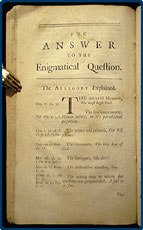
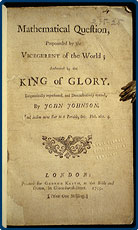
• First edition of this elaborate, in factliterary allegory of the danger of sin and the possibility of salvation. Includes an appendix, on pp. 48–106, titled “The Answer to the Enigmatical Question. The Allegory Explained.” John Johnson (1706–91) was “the founder of a sect called the Johnsonian Baptists. His followers were found for a long time at Wisbech in Cambridgeshire and elsewhere (see Dictionary of National Biography).”
Click the images for enlargements.
Rare: A search of ESTC locates only one copy ONLY; OCLC adds one additional location. Both locations are in the U.S. (Yale and the NYPL), none in the U.K.
• ESTC N66391. Removed from a nonce volume; stitching holes present. Title-leaf repaired; shallow chipping/tearing to first three and final three leaves; one additional tear within text area of pp. 3/4 and 105/106 touching but not costing any text; reading fine throughout. First few leaves detaching. Ink annotations and underlining on p. 70, only. Ex-library, with pressure-stamp on title-page and inked accession number at base and inner margin of p. 3. (23667)
For more RELIGION, click here.
Or for more LITERATURE, click here.
Last Edition with HIS Revisions
Strong & Handsome
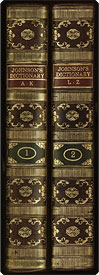
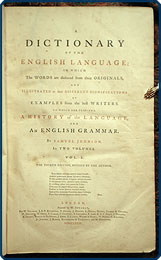
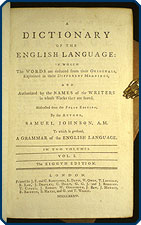
Johnson, Samuel. A dictionary of the English language: in which the words are deduced from their originals, and illustrated in their different significations by examples from the best writers. To which are prefixed, A history of the language, and An English grammar. . . . In two volumes. London: Pr. by W. Strahan, for
W. Strahan, J. & F. Rivington, T. Davies, J. Hinton, L. Davis, et al., 1773. Folio (45.2 cm, 17.75"). 2 vols. I: [553] ff. II: [478] ff.
$5500.00
Click the images for enlargements.
• Fourth edition of Dr. Johnson’s famous dictionary, the final
edition to be revised by the author. The first edition appeared in London, in
1755, also in two volumes folio. Wit and wisdom here abound, as both the definitions
and illustrative passages provide for some highly entertaining reading. This
copy is complete in its two volumes, with the first preceded by Johnson’s
“The History of the English Language” and a “Grammar of the
English Tongue.”
Robert Keating O'Neill, in his English-Language Dictionaries,1604–1900,
notes that 1,250 copies of this edition were printed and that it, “unlike
its two predecessors, was much revised and is considered generally to be the
best edition.”
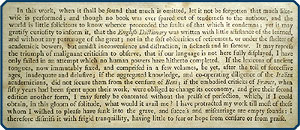 BE
SURE to click THIS image!
BE
SURE to click THIS image!
• ESTC T117232; Brunet, III, 553; O’Neill J-52; Vancil 123;
Printing and the Mind of Man 201 (for the first edition). 18th
century treed calf, with minor surface cracks and chips and small areas rubbed;
strongly and splendidly rebacked with speckled calf, spines gilt extra in
bars and compartments; new leather spine labels bearing volume numbers and
the emblazoned notes, “Johnson's Dictionary. A–K” and Johnson's
Dictionary. L–Z.” Old gilt-tooling around covers and on turn-ins;
nice old marbled endpapers. Title-pages printed in red and black. Occasional
foxing; old waterstaining, generally quite light and inoffensive, in margins
of early and later leaves. Paper flaw on B1 costing 4 letters of the footnotes;
hole in blank area of outer margin of B1–B4. A few page edges chipped and
ragged, with significant portion of paper lost from outer margins of two leaves,
without costing any text; several leaves with a fold-in or dog-ear, paper
quite strong at folds. Good text in a handsome and sturdy binding. (23890)
For more SETS, click here.
For DICTIONARIES/GRAMMARS, ETC., click here.
For more LITERATURE, click here.
For FINE, ATTRACTIVE, & INTERESTING
BINDINGS, click here .
This also appears in the GENERAL
MISCELLANY — click here.
&
it is a PRB&M “FEATURED BOOK” —
for others, click
here.
Johnson,
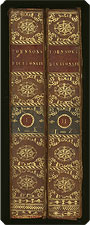
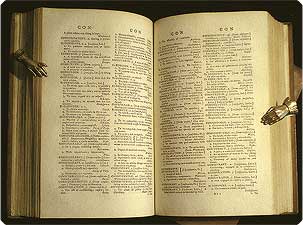
Samuel. A dictionary of the English language: In which the words are deduced from their originals, explained in their different meanings, and authorized by the names of the writers in whose works they are found. Abstracted
from the folio edition ... the eighth edition. London: Pr. for J.F. & C. Rivington, et al., 1786. 8vo (21.8 cm, 8.6"). 2 vols. I: [289] ff. II: [266] ff.
$875.00
Single-click any image where the hand appears on
mouse-over, for an enlargement.
• Eighth edition of Dr. Johnson’s famed dictionary, printed
shortly following the author’s death. Wit and wisdom are combined in interesting
proportions in this most famous lexicon, here in one of the two-volume abridgements
and preceded by Johnson’s “Grammar of the English Tongue.”
• ESTC T83956; Brunet, III, 553; O’Neill J-65; Vancil 123;
Printing and the Mind of Man 201 (for the first edition). Contemporary
speckled calf, spines gilt extra with gilt-stamped leather title and volume
labels; all joints strengthened and bindings otherwise showing only light
wear overall. Front pastedowns with bookseller’s stamp; title-pages
with upper margins excised. An attractively bound abridgment of Johnson’s
magnum opus.
Antiquities
of the JewsILLUSTRATED
[ENGLISH,
Substantial,
& Handsome]
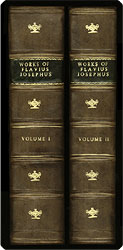
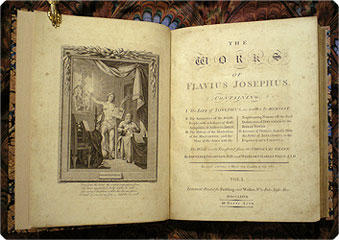
Josephus, Flavius. The works of Flavius Josephus. Containing, I. The life of Josephus, as written by himself. II. The antiquities of the Jewish people; with a defense of those antiquities, in answer to Apion. III. The history of the martyrdom of the Maccabees; and the wars of the Jews with the neighbouring nations till the final destruction of Jerusalem by the Roman power. IV. Account of Philo's ambassy from the Jews of Alexandria, to the Emperor Caius Caligula. London: Pr. for Fielding & Walker by Henri Lion, 1777–78. 4to (27.2 cm, 10.75"). 2 vols. I: Frontis., 719, [1] pp. (lacking list of subscribers); 44 (1 fold.) plts., 7 maps (1 fold.). II: Frontis., [2], 644, [28 (index)] pp.; 16 (of 17) plts.
$875.00
Click the interior images for enlargements.
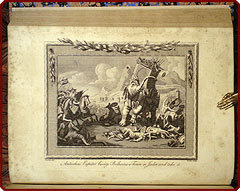
• First edition, “Newly Translated from the Original Greek, by Ebenezer Thompson, D.D. and William Charles Price, L.L.D.” Josephus (b. A.D. 37) provides one of the very few non-biblical sources of Jewish history; the Universal Jewish Encyclopedia, though noting the author's lack of prestige among Talmudic rabbis and his tendency to “omit and add” where he saw fit, says, “Writing a history of the Jews which non-Jews would read and believe, Josephus was an innovator in bringing together references to the Jews to be found in non-Jewish histories” (1942 ed., VI, 200). The 1910 edition of the Catholic Encyclopedia adds that these works are “our only sources for many historical events . . . the value of the statements is enhanced by the insertion of dates which are otherwise wanting, and by the citation of authentic documents which confirm and supplement the Biblical narrative.”
The two volumes are illustrated with a total of 69 copper-engraved plates (out of 70 called for), including a number of maps, all engraved by several different hands after the work of various artists.
• CBEL, II, 1492; ESTC T112662; Lowndes 1236; Schweiger, I, 179. Period-style quarter mottled calf with marbled paper–covered sides, leather edges blind-tooled, spines with gilt-stamped leather title-labels and gilt-stamped compartment decorations. Front fly-leaf of vol. II with 19th-century inked gift inscription. Vol. I lacking list of subscribers; vol. II lacking one plate (“The Death of Caius Caesar”). Light to moderate spotting and staining throughout; some offsetting to and around plates. One leaf torn from outer edge, narrowly missing text. A sound, handsome set fine for working or playing with. (24538)
For more GREEK & LATIN CLASSICS, click here.
For more RELIGION, click here.
For a bit more JUDAICA / HEBRAICA, click here.
For more ILLUSTRATED BOOKS, click here.
For more TRANSLATIONS, click here.
This duo also appears in the GENERAL
MISCELLANY — click here.
ly rubber-stamped, in some cases with light offsetting; first preface page with rubber-stamped numeral. Frontispiece with inner margin reinforced, title-page with outer margin reinforced; portions of lower and outer margins of one map reinforced. Occasional small spots of foxing, pages mostly clean. Pagination erratic, with numerous omissions and gaps, but text complete. (21068)
[Joyce, Jeremiah]. An analysis of Paley's View of the Evidences of Christianity. Cambridge: Pr. by B. Flower for J. Deighton, J. Nicholson, and others. London, 1797. 8vo (20.5 cm, 8"). [2] ff.; pp. [7], 8–84; [2] ff.
$400.00
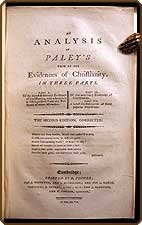
• Jeremiah Joyce (1763–1816) was a Unitarian minister noted for his popular scientific writings who was imprisoned for a while on a charge of treasonable practices before being found not guilty. Here Joyce defends the miraculous elements in
Christianity, summarizing the argument of The Evidences of Christianity by William Paley (1743–1805), Archdeacon of Carlisle. This is the second of two editions listed by ESTC (first, 1795), and it israre. We were able to trace only one copy via ESTC, NUC Pre-1956, OCLC, and RLIN.
• ESTC T77439. On Joyce see: The Dictionary of National Biography, XXX, 219–19. On Paley, see: The Dictionary of National Biography, XLIII, 101–107. Recent wrappers. Lightly age toned with a few instances of shallow chipping.
(Jubilance). Jubilos festivos da corte de Pariz, pella publicaçaõ da paz general que nella celebrou a 20 de Junho de 1763.... Lisboa: Na Offic. de Ignacio Nogueira Xisto, 1763. 4to (20 cm, 7.875"). 15, [1 (blank)] pp.
$400.00

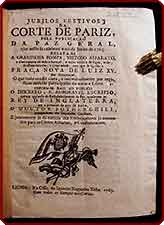
• Account of the celebrations in Lisbon surrounding the announcement of the peace which ended the Seven Years War, including some discussion of the fireworks used, an address to the King of Great Britain, and a list of the newly appointed ambassadors between the former belligerents.
Rare. No copies were traced in the U.S. via NUC Pre-1956, OCLC, or RLIN.
• Plain brown wrappers, shallowly chipped; small paper label on front with rubber-stamped numeral thereon. Small hole in title-page without loss of print. Paper repairs in top margins of pp. 10 and 11. Light soiling. Pencilled notations on title-page and front wrapper.
For more PORTUGAL / PORTUGUESE, click here.
This
also appears in the GENERAL
MISCELLANY — click here.
Juvenalis, Decimus Junius; & Aulus Persius Flaccus. D. Iunii Iuvenalis et Auli Persii Satyrae ad fidem optimorum librorum accurate recensitae. Gottingae: Viduae Abr. Vandenhoeck, 1769. 12mo (13.9 cm, 5.5"). [2], 178 pp.
$150.00
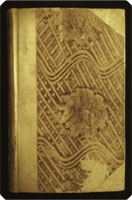
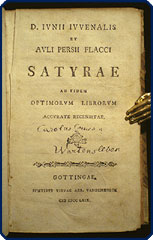
• Satires of Juvenal and Persius, here in an edition printed by the widow of Abraham Vandenhoeck. Juvenal’s bitterly eloquent pieces are often published with and set in contrast to Persius’s gentler, more Stoic-inspired poems, with both authors’ Satyrae being standards of the genre. The present printing follows Vandenhoeck’s edition of 1742, which Schweiger cites very simply as “Correct”; it is extremely uncommon in institutions, with searches of OCLC, RLIN, and NUC Pre-1956 finding only one U.S. and one foreign holding.
• Schweiger, II, 513; this ed. not in Brunet. Contemporary half vellum over paste paper covers, spine with early inked title; sides and edges lightly scuffed, spine with vellum darkened and chipped. Front pastedown with inked ownership inscription dated 1775, lined through; front free endpaper with 19th-century (?) inked inscription; title-page with early inked inscription reading “Carolus Comes a Wartensleben.” Back free endpaper excised. Title-page torn along inner margin and with short tear from outer edge, just touching one letter. One leaf with small ink blots and several leaves with small nicks to outer edges; scattered light foxing. A few small early inked annotations.
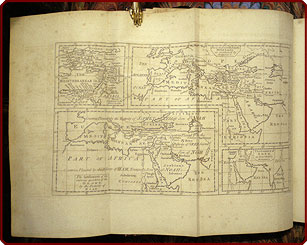
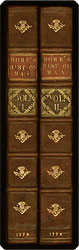
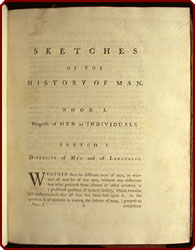
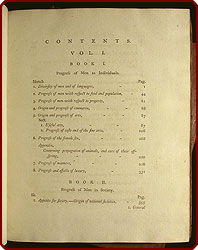
Kames,
Henry Home, Lord. Sketches
of the history of man. Edinburgh: W. Creech, W. Strahan, & T. Cadell,
1774. 4to (27.5 cm, 10.9"). 2 vols. I: xii, 519, [1 (blank)] pp. II: [4], 507,
[1 (blank)] pp.
$4250.00
Click the images for enlargements.
• First edition of this eclectic examination of the history of civilization and humanity (including a chapter on the development of the “American Nations”), in which Lord Kames speculates on the origin of races, provides an account of the progress of morality, and offers arguments against the practicality of polygamy; the appendix focuses more specifically on Scottish legal and economic issues near and dear to the heart of the author, a prominent Scottish judge and gentleman farmer as well as an influential figure of the Scottish Enlightenment. Other topics addressed: Taxes, patriotism, Aristotelian logic, and women.
Provenance: Front pastedown with bookplate “De la bibliotheque de F. Freudenreich.”
• ESTC T48434; Alston, III, 308; Goldsmiths’-Kress 11089; Sabin 32702. Contemporary speckled calf, neatly rebacked preserving original gilt-stamped leather title and volume labels, spines with gilt-stamped thistle decorations; edges and corners rubbed, sides showing small scrapes and discolorations. Residue on pastedowns from sometime removal of bookplates. Pages age-toned, with occasional small spots, and offsetting from binding to in margins of first and last few leaves. All edges speckled.

 Keach
onTropes
of the Bible
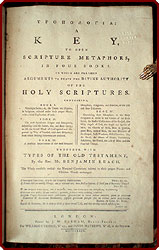
Keach, Benjamin. Tropologia: A key, to open Scripture metaphors, in four books ... together with Types of the Old Testament, by the Rev. Mr. Benjamin Keach. London: Pr. by J.W. Pasham for William Otridge, 1779. Folio (32.7 cm, 12.9"). [8], xxiv, 224, 225*–40*, 225–980, [12 (index)] pp.
Keach
onTropes
of the Bible
Keach, Benjamin. Tropologia: A key, to open Scripture metaphors, in four books ... together with Types of the Old Testament, by the Rev. Mr. Benjamin Keach. London: Pr. by J.W. Pasham for William Otridge, 1779. Folio (32.7 cm, 12.9"). [8], xxiv, 224, 225*–40*, 225–980, [12 (index)] pp.
$750.00
Click the interior images for enlargements.
• Revised edition, with Keach's essay on “Types of the Old Testament” appended to his analysis of Biblical figures of speech and composition. The first book of the Tropologia was originally written by Thomas De Laune, then revised and expanded by Keach, an outspoken Calvinistic Baptist and prolific author who also published The Grand Impostor Discovered and War with the Devil, among other works.
The Tropologia was first printed in 1681, and went through several editions; Lowndes and Allibone both identify this present one as the best of the old issues. Allibone notes how rare it had become by mid-19th-century, and also cites De Coetlogn, who called the work “A most valuable treasure of human composition: a book without which no Christian Minister's Library can be complete.”
• ESTC T194778; Lowndes 1254; Allibone 1008. Contemporary treed sheep, spine with gilt-stamped leather title-label and old paper shelving label; covers scuffed and abraded, minor cracks to spine leather, front joints starting from the weight of the substantial volume. Front free endpaper with early inked presentation inscription: “Presented to the N.Y. Bap. Ed. Socty. by Lewis Leonard, Poughkeepsie.” One leaf with closed tear to center, no loss of text. Pages gently age-toned, with occasional light foxing. (24895)
For more RELIGION, click here.
This book also appears in the GENERAL
MISCELLANY — click here.
Keate, George. Netley Abbey. An elegy...the second edition, corrected and enlarged. London: J. Dodsley, 1769. 4to ( 26.4 cm, 10.4"). 31, [1 (blank)] pp. (lacking the half-title).
$250.00
• Originally published in 1764 under the title Ruins of Netley Abbey (and a different item from the anonymously printed Ruins of Netley Abbey of 1765), this poem features an engraved vignette of the titular ruins, done by C. Grignion, on the title-page; also present is a brief history of the abbey.• ESTC T75210. Marbled paper–covered boards, front cover with printed paper label. Half-title lacking. Upper margin of title-page showing small abrasions and traces of affixed paper; title-page and several others stamped by a now-defunct institution.

 I'll
Mark This Down for an
Incident
in My Comedy
Kelly, Hugh. The school for wives. A comedy. As
it is performed at the Theatre-Royal in Drury-Lane. Embellished with an etching,
by Mr. Loutherbourg. A new edition. London: Pr. for T. Becket, 1775. Frontis.,
xiv pp., [1] f., 96 pp.
I'll
Mark This Down for an
Incident
in My Comedy
Kelly, Hugh. The school for wives. A comedy. As
it is performed at the Theatre-Royal in Drury-Lane. Embellished with an etching,
by Mr. Loutherbourg. A new edition. London: Pr. for T. Becket, 1775. Frontis.,
xiv pp., [1] f., 96 pp.
$125.00
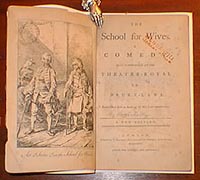
• Speaking of himself, the author says "Tho’ he has chosen a title used by Moliere, he has neither borrowed a single circumstance from that great poet, nor, to the best of his recollection, from any other writer"—but certain situations may nevertheless seem somewhat familiar. The elderly soldier woos a young maid who thinks he is pressing the suit of his handsome young son, and the straying husband’s tête-à-tête at the masked ball turns out to be with his own disguised wife. Kelly tweaks these theatrical conventions by adding a saintly wife who smiles and forgives her husband’s capture in the most compromising of circumstances, then assures her best friend that she’d far rather he had twenty distracting dalliances than one serious—plus a spinster authoress, who throughout the play jots down what she considers the best conversational lines and most passionate utterances for use in her own plays!
With an etched frontispiece of Act 4, Scene 4.
• ESTC T002464; NCBEL 1, 845. In recent wrappers. On Kelly, see: DNB as above. With sewing holes and five pages (including title) stamped by now-defunct library; some pages dog-eared. Frontispiece with a few small discolorations.
For more THEATER/THEATRE, including more by Kelly,
click here.

PLACE
AN ORDER |
E-MAIL US |
PRB&M HOME