 18TH-CENTURY BOOKS
Aa-Al • Am-Az • Ba-Beq • Ber-Bo • Bibles • Bp-Bz
Ca-Cb • Cc-Coq • Cor-Cz • Da-Di • Dj-Dz
Ea-England • English-Ez • F • Ga-Gp • Gr-Gz • Ha-Hb
Hc-Hz • I-K • La-Lel • Lem-Log • Loh-Lz • Maa-Mar
Mas-Mz • N-O • Pa-Pi • Pj-Pz • Q-R • Sa-Sch
Sci-Se • Sf-Sol • Som-Sz • Ta-Th • Ti-U • Va-Wil • Wim-Z
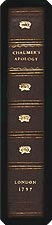
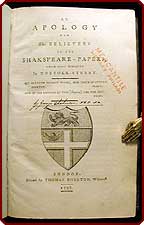
 Chalmers, George. An apology for the believers in the Shakspeare-papers, which were exhibited in Norfolk-Street. London: Thomas Egerton, 1797. 8vo (21.2 cm, 8.4"). iv, 628 pp.; 1 plt.
$600.00
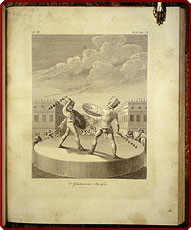
• First edition of this response to Malone’s Inquiry into the Authenticity of Certain Miscellaneous Papers, an analysis of William Henry Ireland’s now-infamous Shakespearean forgeries. Chalmers, though reluctantly conceding the inauthenticity of the documents, here explains in detail why so many were taken in by the scam — providing much material of interest for both Shakespeare scholars and historians of literary frauds. The volume is illustrated with a facsimile of five Shakespeare signatures, engraved by I. Girtin.
 Single-click the image where the hand appears on
mouse-over, for an enlargement.
• ESTC T138271; Lowndes, II, 404; Allibone, 2036. Recent quarter morocco over marbled paper–covered sides, spine with gilt-stamped title and gilt-stamped decorations in compartments. Title-page and a few others stamped by a now-defunct institution; pages slightly age-toned, one with pencilled underlining/emphasis.

Chalmers, George. A supplemental apology for the believers in the Shakspeare-papers: Being a reply to Mr. Malone’s answer, which was early announced, but never published. London: Thomas Egerton, 1799. 8vo (21.2 cm, 8.4"). vii, 654, [2] pp.
$400.00
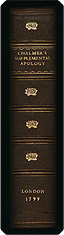
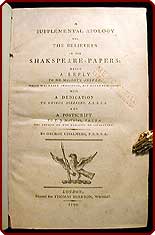
• First edition of another entry in the debate over William Henry Ireland’s now-infamous Shakespearean forgeries: Chalmers’s final response to the numerous items published during the controversy, in which he reminds readers that he is in agreement regarding the inauthenticity of Ireland’s documents, but disagreement with the scholarship (and pugnacity) of Malone and others.
Single-click the image where the hand appears on
mouse-over, for an enlargement.
• ESTCT61515; Allibone, 2036; Lowndes, II, 404. Recent quarter morocco over marbled paper–covered sides, spine with gilt-stamped title and gilt-stamped decorations in compartments. Title-page and a few others stamped by a now-defunct institution; pages age-toned.
 One
Newly Titled — One New Account
One
Newly Titled — One New Account  Entirely
Chamberlayne, John. Magnæ
Britanniæ notitia: Or, the present state of Great Britain, with divers
remarks upon the antient state thereof...the two and twentieth edition of the
south part call'd England, and first of the north part call'd Scotland; with
improvements.... In two parts. London: Pr. for Timothy Goodwin, Matthew Wotton, Benjamin Tooke, Daniel Midwinter,
and George Wells, 1708. 8vo (20 cm, 7.9").
Frontis., [10], x, [10], 756, [27 (index)], [1 (blank)] pp.
Entirely
Chamberlayne, John. Magnæ
Britanniæ notitia: Or, the present state of Great Britain, with divers
remarks upon the antient state thereof...the two and twentieth edition of the
south part call'd England, and first of the north part call'd Scotland; with
improvements.... In two parts. London: Pr. for Timothy Goodwin, Matthew Wotton, Benjamin Tooke, Daniel Midwinter,
and George Wells, 1708. 8vo (20 cm, 7.9").
Frontis., [10], x, [10], 756, [27 (index)], [1 (blank)] pp.
$400.00
• Originally printed under the title Angliæ notitia,
the bulk of this work first appeared in 1669 and was actually written by Edward
Chamberlayne, John's father; several subsequent revisions were made, some by
Edward prior to his death in 1703 and others by John thereafter. This is the
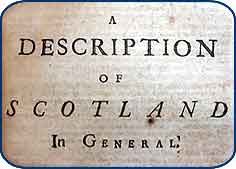
first printing of John Chamberlayne's description of Scotland, and the first
edition of the work overall to bear the title Magnae Britanniae notitia;
the title-page notes that it also contains "more exact and larger Additions
in the List of the Officers, &c. than in any former Impression."
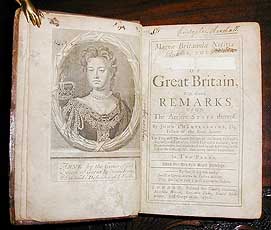
 The
frontispiece portrait, engraved by R. White, depicts Queen Anne.
The
frontispiece portrait, engraved by R. White, depicts Queen Anne.
• ESTC T54583. Contemporary calf,
blind-panelled and spine with printed paper title and shelving labels; worn
and abraded, with loss of leather to head of spine. Title-page
with line reading "Present State" excised, repaired some time ago by backing
upper part of page with similarly colored paper; title-page and one other
with inked ownership inscriptions. Endpapers and pastedowns doodled on in
an early hand, with lower inner portion of front free endpaper torn away;
frontispiece with a few small ink marks. Pages age-toned.
 For
more ENGLISH POLITICS, click here.
For
more ENGLISH POLITICS, click here.
For
more SCOTLAND & SCOTS, click here.

 “On the Welch Tract on [the] Pee Dee River” 1743
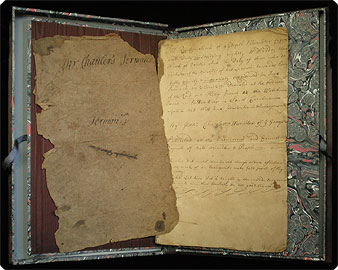
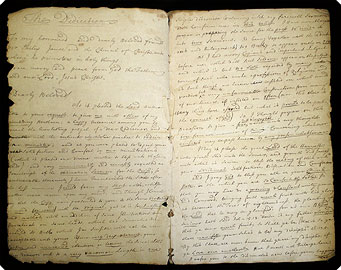
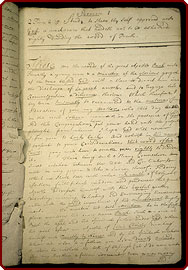
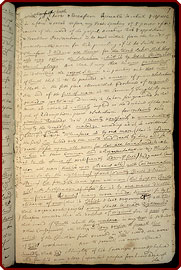
Chanler, Isaac. Manuscript: “The Qualifications of a Gospel Minister for, and Duty in studying rightly to divide [sic] the Word of Truth; and the Duty of those who do partake of the Benefit of his Labours, towards him fully, plainly & impartialy [sic] represented in Two Sermons on 2 Tim: 2.15. Preached at the ordination of the Revd mr. Philip James at the Welch Tract on Pee Dee River in South Carolina April 4. 1743. With some Illustrations & Enlargements.” [South Carolina: 1743]. Folio (31.5 cm; 12.4"). [20] ff.
“On the Welch Tract on [the] Pee Dee River” 1743
Chanler, Isaac. Manuscript: “The Qualifications of a Gospel Minister for, and Duty in studying rightly to divide [sic] the Word of Truth; and the Duty of those who do partake of the Benefit of his Labours, towards him fully, plainly & impartialy [sic] represented in Two Sermons on 2 Tim: 2.15. Preached at the ordination of the Revd mr. Philip James at the Welch Tract on Pee Dee River in South Carolina April 4. 1743. With some Illustrations & Enlargements.” [South Carolina: 1743]. Folio (31.5 cm; 12.4"). [20] ff.
$5750.00
Click the images for enlargements.
• Chanler (1701–49), a native of Bristol, England, was a Baptist minister in the Ashley River region of South Carolina, beginning 1733. He published three works: Doctrines of glorious grace unfolded (Boston, 1744), New converts exhorted to cleave to the Lord (Boston, 1740), and The state of the Church of Christ, both militant and triumphant (Charlestown, S.C., 1744), the latter known in only one copy!
Although the title-page of this manuscript proclaims, “Published at the Unanimous and Earnest Request of Both Minister and People,” this work was never published in the sense of having been printed, or if it was printed, no copy survives, nor has any evidence of its publication.
 This manuscript is apparently the only surviving evidence, and very substantial it is, of an unpublished work by this pioneer minister.
The second sermon mentioned on the title-page was on Galatians 6:6 and is not present here; it may well have never been copied out and sewn to the end of this manuscript. In any case the second sermon is apparently long-lost.
Provenance: Ex-Crozer Theological Seminary.
• Written in a clear hand with numerous corrections. Unbound, on laid paper of the 1740s; now age-toned and a bit brittle, with some fold tears. Edges of paper chipped with some small pieces missing, occasionally costing a letter (only). Now safely housed in a Mylar sleeve within a marbled paper–covered chemise within a red cloth clamshell box. (26309)
 For more PRE-1820 AMERICANA, click here.
For more CAROLINIANA, click here.
For more RELIGION, click here.
For MANUSCRIPTS, click here.
This also appears in the GENERAL
MISCELLANY — click here.
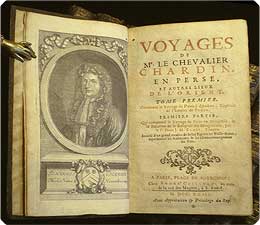
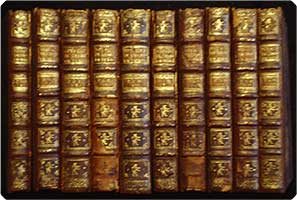
Chardin, John. Voyages de Mr. le chevalier Chardin, en Perse, et autres lieux de l'Orient. Paris: André Cailleau, 1723. 8vo (16.5 cm, 6.5"). 10 vols.
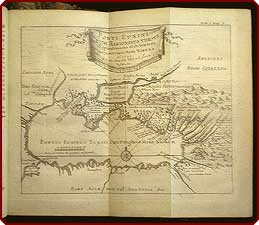
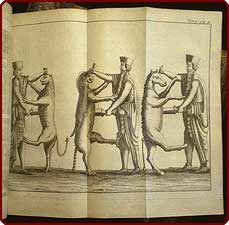
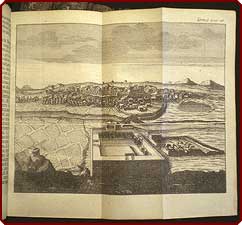
I: Frontis., [10], 254 pp.; 1 fold. map. II: 334 pp.; 4 fold. plts., 5 plts. III: 285, [1 (blank)] pp.; 4 fold. plts., 3 plts. IV: 280 pp.; 2 fold. plts., 3 plts. V: 312 pp.; 4 fold. tables, 5 plts. VI: 328 pp.; 4 plts. VII: [10], 15–448 [i.e.,
446] pp. VIII: 255, [1 (blank)] pp.; 10 fold. plts., 6 plts. IX: 308 pp.; 1 double-spread fold. plt., 8 fold. plts., 19 plts. X: [22], 3–220, [82 (index)] pp.
$4000.00
Single-click any image where the hand appears on
mouse-over, for an enlargement.
• Attractive French edition of Sir John Chardin's Persian travelogue, originally published in 1686. Brunet calls the account, which covers Chardin's voyages through India, Russia, and Persia, "un des plus intéressants que l'on ait publiés" in the 18th century; the work was and continues to be a major source of information on contemporary Persian politics, government, religion, and culture.
The title-pages are printed in red and black, and the 10 volumes are illustrated with a total of 79 plates (many folding) and tables, including one map and one frontispiece.
• Brunet, I, 1802. Contemporary speckled calf, spines extra gilt; edges, joints and extremities rubbed, leather in some cases cracked or starting along joints or chipped at spine extremities, two spines with compartments chipped. All edges speckled. Front pastedowns each with institutional bookplate, front free endpapers rubber-stamped and with inked ownership inscriptions dated [18]67, title-pages except for vol. I rubber-stamped, reverse of map in vol. I rubber-stamped, some vols. with first text page rubber-stamped. Additional plate (creased) laid in, seemingly excised from another work.
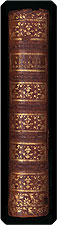
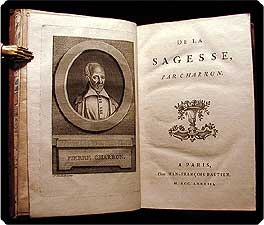
Charron, Pierre. De la sagesse. Paris: Jean-François Bastien, 1783. 8vo (20 cm, 7.9"). Frontis., xviii, 768 pp.; 1 plt. (damaged/censored).
$250.00
 Click the interior images for enlargements.
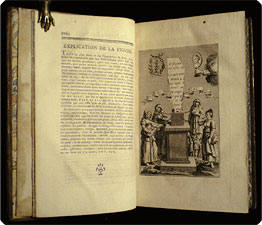
• Later printing of Charron’s final work, a philosophical treatise
which was first published in 1601 and which was strongly connected to Montaigne’s
essays. Although the author was a Catholic priest widely acclaimed for skillful
preaching, he and La Sagesse came under bitter attack by the clergy when
the work first appeared, on the grounds of its promoting skepticism and free
thinking.  This
particular copy seems to have incurred someone’s personal wrath, as the
plate illustrating the allegory of Wisdom has had its central (nude) female
figure excised. The much more staid frontispiece
portrait of the author, done by Pruneau, is undamaged.
This
particular copy seems to have incurred someone’s personal wrath, as the
plate illustrating the allegory of Wisdom has had its central (nude) female
figure excised. The much more staid frontispiece
portrait of the author, done by Pruneau, is undamaged.
• Contemporary mottled calf framed in triple gilt fillets, spine
gilt extra, all page edges marbled; binding with expectable acid-pitting and
minor cracking of the leather over the spine and joints. One (and only one)
signature foxed, leaves otherwise clean. A handsome book, defaced in a way
that is depressing but also interesting.

 American
Conscience — 1771
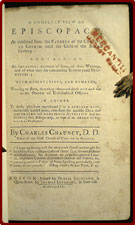
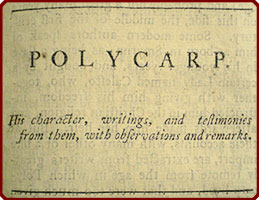
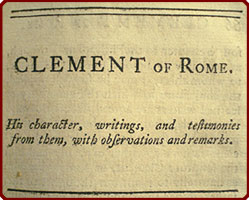
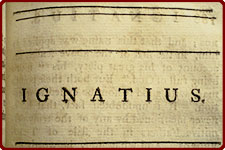
Chauncy, Charles. A compleat view of episcopacy, as exhibited from the fathers of the Christian church until the close of the second century.... Boston: Pr. by Daniel Kneeland, 1771. 8vo. x, 474 pp., [2] ff.
American
Conscience — 1771
Chauncy, Charles. A compleat view of episcopacy, as exhibited from the fathers of the Christian church until the close of the second century.... Boston: Pr. by Daniel Kneeland, 1771. 8vo. x, 474 pp., [2] ff.
$400.00
Click any image where the hand appears on
mouse-over, for an enlargement.
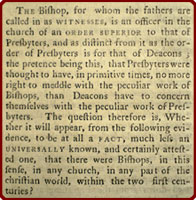
• During his lifetime (1705–87) Charles Chauncy was embroiled in three great controversies: revivalism, episcopacy, and the benevolence of God. Following the revocation of the original charter of Massachusetts, the Church of England and the royal governors advanced more and more claims for the establishment of the Anglican religion (i.e., episcopacy), even urging an American bishop. Chauncy, liberal though he was, staunchly opposed this and his present work is the culmination of his thinking on the subject.
• Evans 12009; Sabin 12314. Modern fine quality cloth with red morocco
spine label lettered in gilt. A sophisticated copy: everything before p. 231
from one copy, p. 231 to end from another. Ex–extinct library with stamps. A
clean copy.
For PRE-1820 AMERICANA,
click here.
Or for more RELIGION, click
here.
Church
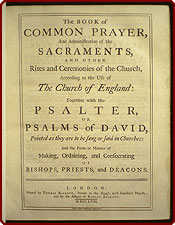
of England. Liturgies. Book of common prayer. Book of common prayer, and administration of the sacraments, and other rites and ceremonies of the Church, according to the use of the Church of England: Together with the
Psalter or Psalms of David, pointed as they are to be sung or said in churches. Oxford: Clarendon Press, 1791. 8vo (25.5 cm, 10"). [196] ff. [bound with] Bible. O.T. Psalms. English. Sternhold and Hopkins. The whole book of psalms, collected into English metre. Oxford: Clarendon Press, 1793. 8vo (25.5 cm, 10"). [60] ff.
$2550.00

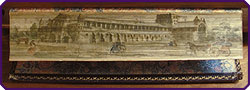
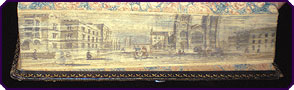
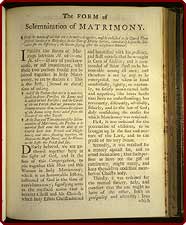
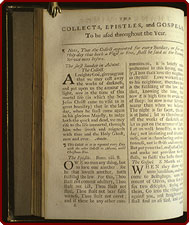
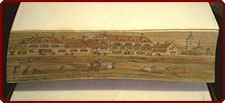
• Highly decorative and sweetly sentimental copy of the Book of Common Prayer and its accompanying psalter. The volume is embellished with a striking double fore-edge painting depicting (in one direction) the medieval Abbey Church of St. Albans in Hertfordshire, with a horse-drawn carriage in the foreground, and in the other direction the western facade of Westminster Abbey, with passing pedestrians.
Single-click any image where the hand appears on
mouse-over, for an enlargement.
Binding: Contemporary black straight-grain morocco, covers framed with a gilt double fillet and a gilt roll of a vine design, spine gilt extra, gilt-tooled board edges, gilt inner dentelles. All edges gilt, front edge with double fore-edge painting as above.
Provenance: The front fly-leaf bears an inked inscription reading “From this Book our 4 Dear Children were Babtized [sic] by the Rev. S. Good, Rector of St. Anns Blk. Friars, And afterwards Christened by their Dear Uncle the Rev. Charles Brown, Rector of Whitestone, near Exeter, Devon.” The children's baptismal dates range from 1806 through 1814.
• ESTC T93069; Griffiths, Bibliography of the Book of Common Prayer, 1791/7. Binding as above, leather slightly worn over joints and extremities. Front fly-leaf with collector's small bookplate, reverse with inscription as above, title-page with owner's name and date (1806) inked in upper margin. Pages clean.
Beautifully
Printed &
with a
Charming
Fore-Edge Painting
Church
of England. Liturgies. Book
of common prayer. Book of common prayer, and administration
of the sacraments, and other rites and ceremonies of the Church, according to
the use of the Church of England: Together with the Psalter, or Psalms of David,
pointed as they are to be sung or said in churches. And the form or manner of
making, ordaining, and consecrating of bishops, priests, and deacons. London:
Thomas Baskett (assigns of Robert Baskett), 1758. 4to (27.5 cm, 10.9"). [232]
ff. [bound with]
Bible. O.T. Psalms. English. Sternhold and Hopkins. The whole book of
psalms; collected into English metre. London: J. Bettenham & H. Woodfall,
1751. 4to. 56 pp.
$1650.00
Click any image where the hand appears on
mouse-over, for an enlargement.
• When properly fanned, the gilt fore-edges of this solid, handsome BCP and Psalter reveal an attractive fore-edge painting of an unidentified country town beside a canal, including boaters under observation by assorted children on the banks of the canal — a very pleasant scene, with a church spire visible on the far right. The text of BCP is set in large, very legible type, and presented in double-column format, while that of the Psalter is in a smaller type and in triple columns. Binding: Contemporary straight-grain dark blue morocco now tending to olive, covers framed with a gilt single fillet; round spine with raised bands, blind roll on each band, and each band defined by gilt rules above and below it. Spine with compartments stamped in blind, gilt-stamped title, and gilt-stamped decorations at head and foot; place and date of publication in gilt at base of spine. All edges gilt; fore-edge painting as above.
• ESTC T081415; Griffiths, Bibliography of the Book of Common Prayer, 1758/1. Binding as above, corners a bit rubbed and joints somewhat more so, with upper and outer cover edges showing some fading. Front pastedown with small shelving number slip and small bookplate of a private collector. Pages very slightly age-toned, otherwise clean save for minor bleed to some outer margins from the fore-edge painting. Beautiful.
For more RELIGION, click here.
For a short “shelf” devoted to
FORE-EDGE PAINTINGS, click here.
Or for more BOOKS OF COMMON PRAYER, click here.
This book also appears in the GENERAL
MISCELLANY — click here.
 He GaveHimself the Last Word
$200.00

• First edition of this poem on the disparities sometimes found between private and public virtue, and the poet's responsibility to write for the country's good.
• ESTC T1702. Recent marbled paper–covered boards, front cover with printed paper label. Half-title lacking. Title-page and two others stamped by a now-defunct institution; leaves with reinforced tears at inner margins.
 Clarendon's Rebellion — Three Folio Vols. from Oxford “at the Theater”
Clarendon, Edward Hyde, Earl of. The history of the rebellion and civil wars in England, begun in the year 1641. With the precedent passages, and actions, that contributed therunto, and the happy end, and conclusion thereof by the King's blessed restoration, and return upon the 29th of May, in the year 1660. Oxford: Pr. at the Theater (by Ro. Mander & Guil. Delaune), 1702–04. Folio (39.7 cm, 15.75). 3 vols. I: Frontis., [4], xxiii, [1], 557, [1] pp. II: Frontis., [14], 581, [1] pp. III: Frontis., [22], 603, [23] pp. (half-titles lacking).
Clarendon's Rebellion — Three Folio Vols. from Oxford “at the Theater”
Clarendon, Edward Hyde, Earl of. The history of the rebellion and civil wars in England, begun in the year 1641. With the precedent passages, and actions, that contributed therunto, and the happy end, and conclusion thereof by the King's blessed restoration, and return upon the 29th of May, in the year 1660. Oxford: Pr. at the Theater (by Ro. Mander & Guil. Delaune), 1702–04. Folio (39.7 cm, 15.75). 3 vols. I: Frontis., [4], xxiii, [1], 557, [1] pp. II: Frontis., [14], 581, [1] pp. III: Frontis., [22], 603, [23] pp. (half-titles lacking).
$2000.00
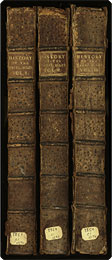
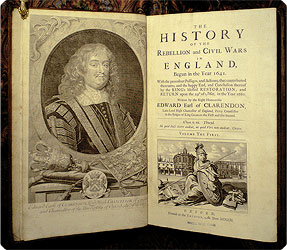 Click the interior image for an enlargement.
• First edition of this crucial account of the tumultuous 1640s and 50s in England, written by an author whom Allibone lauds as “one of the most illustrious characters of English history”; Allibone also quotes the Edinburgh Review's description of the present work as “one of the noblest historical works of the English nation.”
Each volume commences with a copper-engraved frontispiece and title-page vignette, the former done by Robert White after a painting by Lely, the latter signed M[ichael] Burg[hers]. Burghers also engraved a substantial number of head- and tailpieces for the work, as well as decorative capitals.
• ESTC N9847, N9850, T147811; Brunet, I, 81; Allibone 385. Contemporary speckled calf panelled in blind with plain calf, decorated with blind-tooled corner fleurons, spines with gilt-stamped leather title-labels; edges and extremities rubbed, joints cracked or starting, some acid-pitting to speckled portions, spines each with small paper shelving label. Each front pastedown with institutional bookplate over private collector's bookplate, and with early inked gift inscription. Title-pages with small institutional rubber-stamp in lower margin; half-titles lacking. Pages generally clean; occasional minor spotting mostly confined to margins. One instance of early
inked marginalia. (24574)
For more SETS, click here.
For more ENGLISH POLITICS, click here.
For more of MILITARY/NAVAL
interest, click here.
For more ILLUSTRATED BOOKS, click here.
For an OXFORD “shelf,” click here.
This book also appears in the GENERAL
MISCELLANY — click here.
Illustrated IndigenousCustoms & Dress
 FIRST Edition in ENGLISH
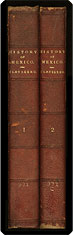
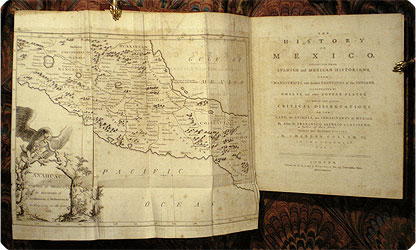
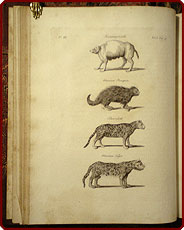
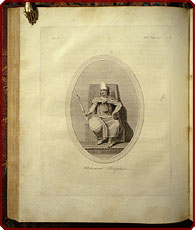
Clavigero, Francesco Saverio. The history of Mexico. Collected from Spanish and Mexican historians, from manuscripts, and ancient paintings of the Indians ... translated from the original Italian, by Charles Cullen. London: Pr. for G.G.J. and J. Robinson, 1787. 4to (28.5 cm, 11.2"). 2 vols. I: [2], xxxii, [4], 440, (441–44), 441–76 pp. (pagination skips v/vi, with text complete); 1 fold. map, 25 plts., 1 table. II: [4], 463, [1 (blank)] pp.; 1 fold. map, 1 plt.
FIRST Edition in ENGLISH
Clavigero, Francesco Saverio. The history of Mexico. Collected from Spanish and Mexican historians, from manuscripts, and ancient paintings of the Indians ... translated from the original Italian, by Charles Cullen. London: Pr. for G.G.J. and J. Robinson, 1787. 4to (28.5 cm, 11.2"). 2 vols. I: [2], xxxii, [4], 440, (441–44), 441–76 pp. (pagination skips v/vi, with text complete); 1 fold. map, 25 plts., 1 table. II: [4], 463, [1 (blank)] pp.; 1 fold. map, 1 plt.
$2750.00
Click the interior images for enlargements.
• First edition: Cullen's translation, the first in English, of Clavigero's Storia antica del Messico, an important description of the country synthesized from a range of sources including Torquemada. Abbé Clavigero, a Mexican-born Jesuit and antiquarian who left the country when the Jesuits were expelled in 1767, also wrote a history of California, but is better remembered for the
often-reprinted present work, which is notably critical of the Spanish and sympathetic to the natives.
Because of his exile, he was forced to write his chief historical treatises in Italy, from such notes and recollections of facts in manuscripts read in Mexico as he was able to carry with him, doing his additional extensive research in libraries and archives in Italy; the works of his exile universally first appeared in Italian, not his native Spanish. Indeed, this translation into English was made from the original Italian and precedes the edition in Spanish, which did not appear until 1826!
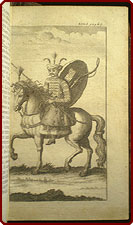
Thetwo oversized, folding maps were engraved by T. Conder; a genealogical chart in vol. I shows the descent of the Mexican kings from the 13th century, while numerous engraved plates depict Mexican artifacts, costumes, activities, flora and fauna, architecture, etc.
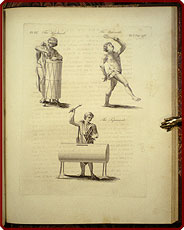
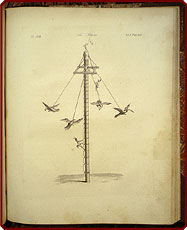
• DeBacker-Sommervogel, II, 1210; Palau 55485; Sabin 13519. Not in Medina, Biblioteca hispano-americana; not in León-Portilla, Tepuztlahcuilolli, but see 624 for the 1868 edition and a lengthy discussion of the work's importance for Nahuatl studies. On Clavigero, see: Charles Ronan, Francisco Javier Clavigero, S.J. (1731–1787), Figure of the Mexican Enlightenment; and Archivo biográfico de España, Portugal, e Iberoamérica, fiche 215, frames 148–218. 19th-century half red morocco, plain style. Scattered light foxing in text, heavy on endpapers. Ex-library with partially eradicated stamps; call numbers faintly visible on spines. In all, a good+ / good++ set of an important work. (24582)
For more SETS, click here.
MEXICO is one of our great specialties.
For our MEXICANA, click here.
For more ILLUSTRATED BOOKS, click here.
For NATURAL HISTORY, click here.
For more of NATIVE AMERICAN interest, click here.
For CLOTHING & FASHION, click here.
For TRANSLATIONS, click here.
For JESUITANA, click here.
Or for more PRE-1820 AMERICANA, click here.
This also appears in the HISPANIC
MISCELLANY — click here.
& it appears in the GENERAL
MISCELLANY — click here.
Coles, Elisha. A practical discourse of God’s sovereignty. With other material points derived thence.... Newburyport [MA]: Edmund M. Blunt, 1798. 8vo (20.5 cm, 8.2"). 372 pp.
$350.00
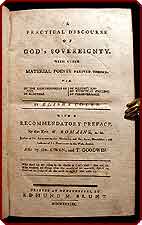 • Second American edition, following a Philadelphia printing in 1796, of this popular religious treatise; the Practical Discourse went through numerous editions due to its success among dissenters. Calvinistic in its tendencies, the work discusses the Doctrines of Election, Redemption, and Effectual Calling (a distinction of Coles’s creation, separating the concept from calling “which is outward only, and prevails not,” p. 225), among other topics.
Single-click the image, for an enlargement.
• ESTC W24802; Evans 33532. Contemporary mottled sheep, spine with gilt-stamped leather title-label; binding abraded with leather cracking over the spine, spine label lettering rubbed. Pages age-toned, with some spots of foxing.
“Ignorance
is the Foundation
of Atheism,
& Freethinking
the Cure”
Collins, Anthony. A discourse of free-thinking, occasion'd by the rise and growth of a sect call'd Free-thinkers. London: 1713. 8vo (19.8 cm, 7.8"). 178, iii–vi pp.
$950.00
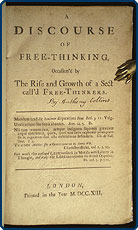
• First edition, early issue of a controversial work that spawned an extensive debate. The author, a close friend of John Locke and of freethinkers John Toland and Matthew Tindal, was a Cambridge-educated philosopher who, despite the furor over his writings, was acknowledged by his contemporaries as “an amiable and upright man . . . [who] made all readers welcome to the use of a free library” (DNB). His Discourse, an argument in favor of individual logical assessment of Christian doctrine and other beliefs, brought forth vigorous rebuttals by Richard Bentley, George Berkeley, Jonathan Swift, and others, but remains a landmark work of
rationalistic religion. Opinions continue to vary, even in modern criticism, regarding whether Collins's work promoted deism or atheism; he himself claimed that increased independent critical thinking was responsible for the decline in belief in witchcraft.
Click the interior image for an enlargement.
This copy has the two preliminary leaves bound in at the back (mispaginated as vi as seen in most copies) , but it is lacking the final advertisement leaf. The catchword on p. 7 is “allow'd.”
• ESTC T31966; Allibone 411–12. Recent marbled paper–covered boards, front cover with gilt-stamped leather title-label. Title-page with author's name inked in an early hand and with very elegant institutional pressure-stamp; title-page verso with shadows of pencilled numerals, first text page with inked numeral in lower margin. Final advertisement leaf lacking. Light offsetting and faint spotting (mostly confined to margins), pages otherwise clean. (20740)
For more RELIGION, click here.
This book also appears in the GENERAL
MISCELLANY — click here.
We are presently cataloguing a good many
RESPONSES to Collins —
if you are interested, please enquire.
[Collins,
Anthony]. A philosophical inquiry concerning human liberty. The second
edition corrected. London: R. Robinson, 1717. 8vo (18.8 cm, 7.375"). [1] f., vi
pp., [1] f., 118 pp.
$800.00
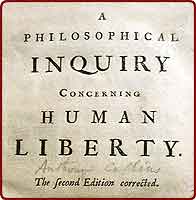
• Anthony Collins (1676–1729) was a deist, determinist, and
follower of Locke, who for all the fire of his anti-Christian polemic, was noted
to be “an amiable and upright man, and to have made all readers welcome
to the use of a free library” (DNB). His Philosophy Inquiry
Concerning Human Liberty, first published in 1717, is an ably argued case
for faith in reason and the exercise of it. This is the second edition, of the
same year—“corrected” and simply printed with a woodcut vignette
and tailpiece.
• ESTC T134533. On Anthony Collins, see: The Dictionary of
National Biography, XI, 363–64. In recent blue-green wrappers; ex-library
with stamps, including a very, very faint one on title-page. Uncut;
traces of soiling in top margins, and occasional light ink-stains elsewhere.
[Combe,
William]. The diaboliad...also, the diabo-lady: Or, a match in Hell. London
pr., Dublin repr., 1777. 8vo (18.7 cm, 7.4"). 97, [1 (blank)] pp.
$225.00
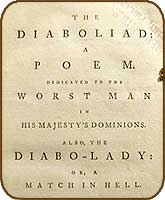
• Combe’s best-known satires, here in one of the earliest Irish
issues of the pair (being one of two Dublin printings from 1777). The poems
are, respectively, dedicated to the “worst man” and the “worst
woman” in His Majesty’s dominions. These works first appeared in
London in 1776 and 1777, achieved instant notoriety, and went through numerous
editions; another sequel eventually followed, the Anti-Diabo-lady.
• ESTC T77101; NCBEL, II, 647. Marbled paper–covered
boards, front cover with printed paper label. Half-title spotted, title-page
and two others stamped by a now-defunct institution, title-page also with
traces of paper affixed to upper margin; pages otherwise clean. One ESTC
listing calls for plates; most holdings, however, do not report any and
OCLC listings do not note any.
PLACE
AN ORDER |
E-MAIL US |
PRB&M HOME

 10 Volumes & 79 Plates