 BLACK-LETTER / GOTHIC
BLACK-LETTER / GOTHIC
BLACK-LETTER / GOTHIC
 His Fellow Novice Was Fra Angelico . . .
  Incunable from the Press of Grüninger
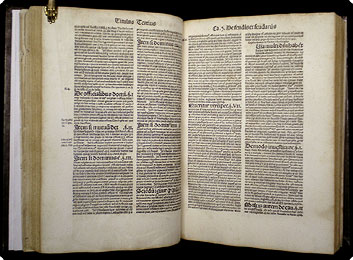
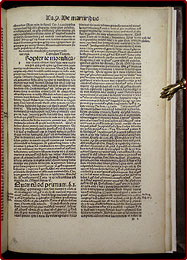
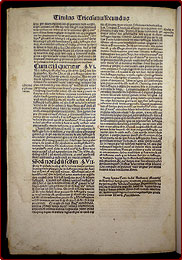
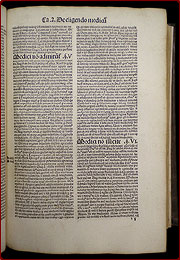
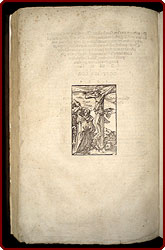
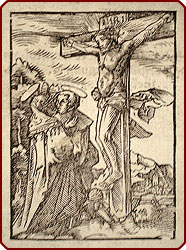
  Antoninus, Saint, Abp. of Florence. Tertia pars totius su[m]me maioris beati Antonini [i.e., Summa theologica, pars tertia]. [Argentinae: Johann Grüninger, 1496]. Folio ( 31 cm; 12/25"). [311 of 312] ff., lacks final blank.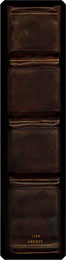
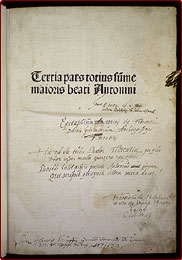
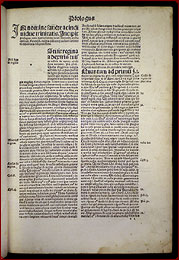
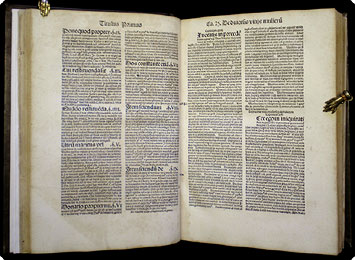
 Click the interior images for enlargements.
 Summa Theologica Moralis is the saint's principal work and was written shortly before his death. Scholars say it marks a new and considerable development in moral theology, as well as containing a fund of matter for the student of the history of the 15th century.
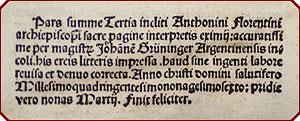
Provenance: 1630 ownership inscription; later in the library of a divinity school, deaccessioned.
 For COLLECTED PRESSES

 Dutch Opinions on the
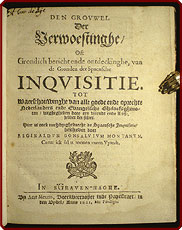
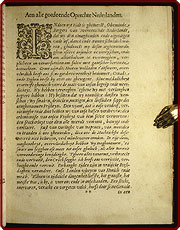
 Spanish Inquisition Avontroot, Johannes Bartholomeus. Den grouwel der verwoestinghe, oft grondich bericht ende ontdeckinghe, van de gronden der Spaensche inquisitie. In s'Graven-haghe: Aert Meuris, 1621. 4to (19.7 cm, 7.75"). [28], 212 pp.
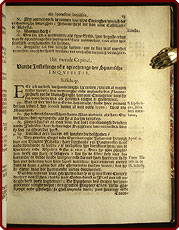
 Avontroot was executed by the Inquisition at Toledo in 1632.
This copy lacks the work by González de Montes, a.k.a. Reginaldus Gonsalvius Montanus, which should follow p. 212. It is largely printed in black letter.
Uncommon. OCLC finds only two holdings in the U.S., one being this copy, now properly deaccessioned, and the other at the John Carter Brown Library. NUC Pre-1956 does not identify any additional copies.
• Vekené, Bib. der Inquisition, 139-140; Boehmer, Bibliotheca Wiffeniana, 290 (identifying the volume as the second Dutch translation of the Montanus work not present here). 19th-century half calf with marbled paper-covered sides; joints and corners rubbed. Front pastedown with institutional bookplate, title-page with early inked ownership inscription in upper margin. Pages age-toned with some mild waterstaining; one leaf with lower outer corner torn away, not affecting text. (19569)
For
more BOOKS IN DUTCH, click here. MEXICO
is one of our great specialties.For
more INQUISITION material, This
also appears in the HISPANIC

The LAST
English
“Breeches”
Bible
Bible. English. Geneva–Tomson–Junius. 1616. The Bible: that is, the Holy Scriptures contained in the Old and New Testament.... London: Robert Barker, 1616. Folio (31.1 cm, 12.25"). [1], 362 (i.e., 365), [7] ff. (t.-p., Apocrypha, & New Testament not present here; foliation extremely erratic); illus.
LAST
English
“Breeches”
Bible
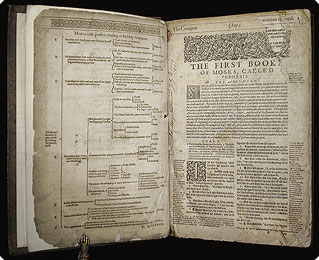
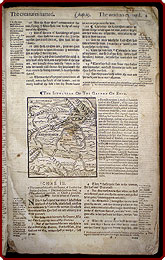
Bible. English. Geneva–Tomson–Junius. 1616. The Bible: that is, the Holy Scriptures contained in the Old and New Testament.... London: Robert Barker, 1616. Folio (31.1 cm, 12.25"). [1], 362 (i.e., 365), [7] ff. (t.-p., Apocrypha, & New Testament not present here; foliation extremely erratic); illus.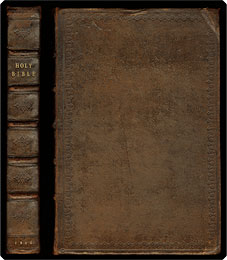
 Click the images for enlargements.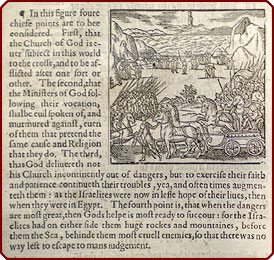
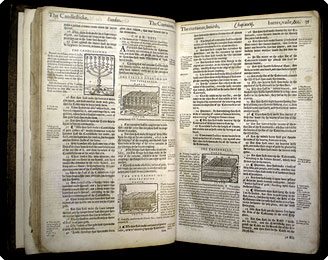
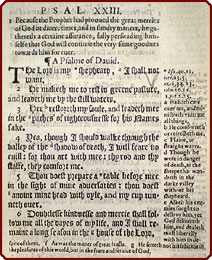
 black-letter folio edition, illustrated with a handful of in-text woodcuts (including the Ark and its paraphernalia, and charts of consanguinity). The copy consists essentially of the Old Testament and some additional matter; it lacks two of the four preliminary leaves (including the title-page, publication information being provided by the colophon) and it also lacks the Apocrypha and New Testament. It begins with “Of the incomparable treasure of the holy Scriptures”; the “Briefe Table of the interpretation of the proper names which are chiefly found in the Olde Testament” and the “Table of the principall things that are conteined in the Bible, after the order of the Alphabet” are both present.
• Darlow & Moule 270; ESTC S1792; Rumball-Petre, Rare Bibles, 130; STC (2nd ed.) 2244. Full later mottled calf, covers framed in double blind fillets and fleuron roll; spine with raised bands, blind-tooled compartment decorations, and gilt-stamped title and date; incomplete, with title-page, Apocrypha, and N.T. lacking. Binding rubbed/bumped at stress points, one compartment scuffed. Front free endpaper, first text page, and several others institutionally pressure-stamped; first page with rubber-stamped numeral in lower margin and early inked annotation regarding date of printing. Front free endpaper with affixed slips documenting gift donation in 1955, and with inked annotation regarding date; back pastedown showing traces of now-absent pocket. Tattering to first leaves not reaching text, and first one with recent repairs, second one with area of loss to upper outer portion affecting a border and ten lines of text, third one with central tear (touching woodcut map) repaired some time ago with tape, four leaves each with short tear from lower margin without loss, one leaf with lower outer corner torn away with partial loss of shouldernotes and image caption, final index leaf with hole affecting six lines. Expectable sorts of age-toning, dust-soiling, and light spotting/staining, only; lower outer corners of first quarter waterstained (often faintly). In sum a survivor; “breeches” in Genesis underlined in ink! (26072)
For more 17TH-CENTURY BOOKS, click here. For more BIBLES & TESTAMENTS, click here. For
more ILLUSTRATED BOOKS, click here.
 TheFamous September Testament — Well Evoked! Bible. N.T. German. (1522) 1883. Luther. Die Septemberbibel: Das Neue Testament deutsch von Martin Luther. Berlin: G. Grote, 1883. Folio (32.4 cm, 12.75"). [4], 9, [9] pp., CVII, [6], LXXVII, [26] ff.; illus.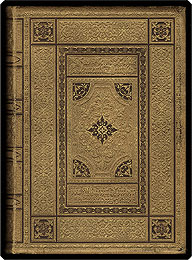
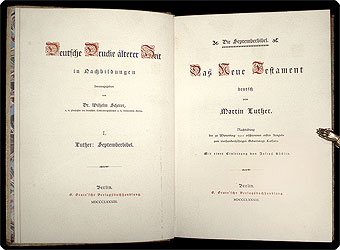 Click the images for enlargements. 21 full-page woodcuts by Lucas Cranach. Illustrating the Book of Revelation, the woodcuts appear here in their original state, before ordinary crowns took the place of the papal tiaras worn by the Antichrist and the Whore of Babylon.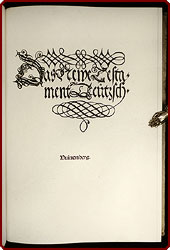
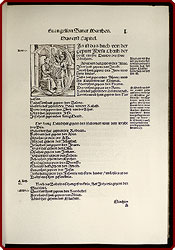
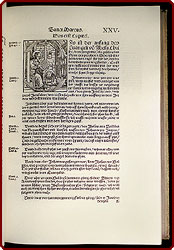
• Binding as above, with light rubbing; front pastedown with Leipzig bookseller's small ticket. Occasional faint smudges; pages mostly clean. A handsome thing. (26301)
 A Black-Letter
17th-Century Folio
BCP
Church
of England. Book
of Common Prayer.
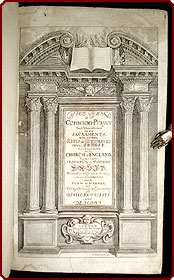
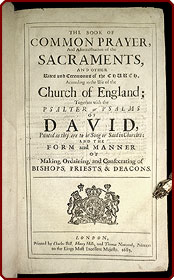
The book of common prayer, and administration of the sacraments, and other rites
and ceremonies of the church, according to the use of the Church of England,
together with the psalter or psalms of David, pointed as they are to be sung
or said in churches [as below].... London: Charles Bill, Henry Hills,
& Thomas Newcomb, 1687. Folio (31.7 cm, 12.5"). Add. engr. t.-p., [231]
ff. (S1 bound in out of order, T6 lacking, Tt2-4 (blank) lacking, H2 of Psalms
signed H3). [with] Bible.
O.T. Psalms. English. Sternhold & Hopkins. The whole book of psalms.
Collected into English meeter ... conferred with the Hebrew, with apt notes
to sing them withal. London: Pr. by J.M. for the Company of Stationers, 1687.
Folio. [64] ff.
A Black-Letter
17th-Century Folio
BCP
Church
of England. Book
of Common Prayer.
The book of common prayer, and administration of the sacraments, and other rites
and ceremonies of the church, according to the use of the Church of England,
together with the psalter or psalms of David, pointed as they are to be sung
or said in churches [as below].... London: Charles Bill, Henry Hills,
& Thomas Newcomb, 1687. Folio (31.7 cm, 12.5"). Add. engr. t.-p., [231]
ff. (S1 bound in out of order, T6 lacking, Tt2-4 (blank) lacking, H2 of Psalms
signed H3). [with] Bible.
O.T. Psalms. English. Sternhold & Hopkins. The whole book of psalms.
Collected into English meeter ... conferred with the Hebrew, with apt notes
to sing them withal. London: Pr. by J.M. for the Company of Stationers, 1687.
Folio. [64] ff.
 Click the images for enlargements.
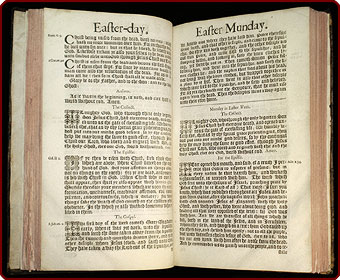
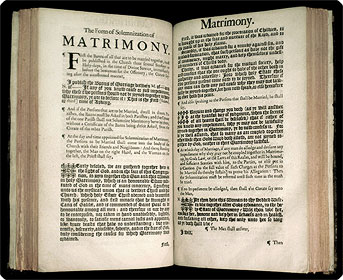 black-letter
Anglican prayer book, with an additional engraved architectural title-page
done by P. Williamson (giving a date of 1686), and a Kalendar printed in red
and black. The Psalter has a separate title-page (dated 1686) but continuous
registration with the BCP; the accompanying Psalms has separate title-page and
registration, and features music. The type is handsome throughout, and generally
is notably LARGE.
black-letter
Anglican prayer book, with an additional engraved architectural title-page
done by P. Williamson (giving a date of 1686), and a Kalendar printed in red
and black. The Psalter has a separate title-page (dated 1686) but continuous
registration with the BCP; the accompanying Psalms has separate title-page and
registration, and features music. The type is handsome throughout, and generally
is notably LARGE.
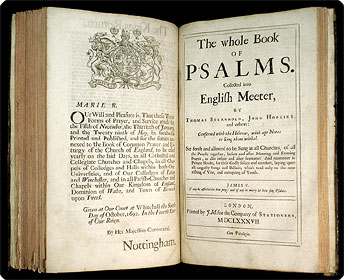
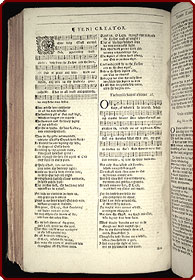
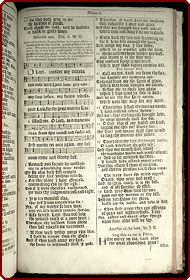
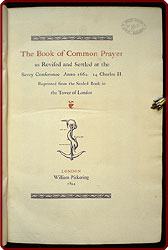
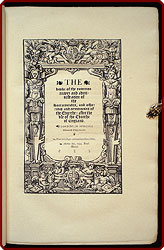
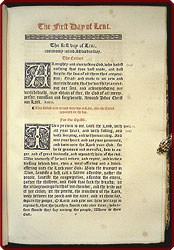
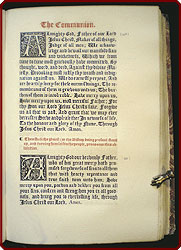
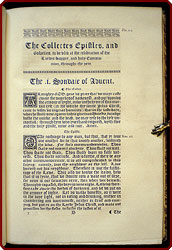
Pickering & Whittingham'sSEVEN BCPs Church of England. Book of Common Prayer. [Seven editions of the Book of Common Prayer, 1549–1844 ]. London: William Pickering (pr. by Whittingham), 1844. Folio (35.8 cm, 14"). 7 vols. I: [264] ff. II: [314] ff. III: [134] ff. IV: [130] ff. V: [142] ff. VI: [140] ff. VII: [154] ff.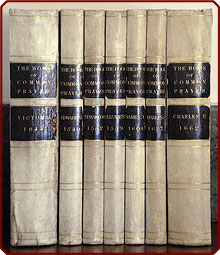
 Click the images for enlargements.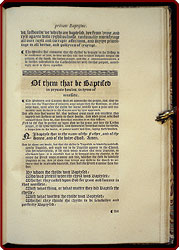
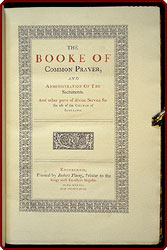
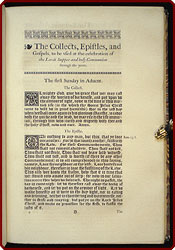
Provenance: Elegant old lozenge-shaped ink-stamp on title-pages: “John Brymer Heir-Loom.”

ELIZABETH
Must Have Loved
HisThinking
on Monarchy
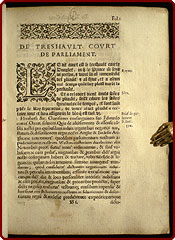
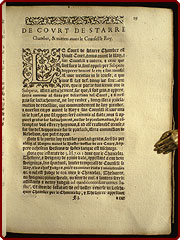
Crompton, Richard, ed. L'authoritie et iurisdiction des
courts de la maieste de la Roygne: nouelment collect & compose, per R. Crompton del milieu Temple esquire. Apprentice del ley. Londini: Caroli Yetsweirti, 1594. 4to. [4], 232 ff.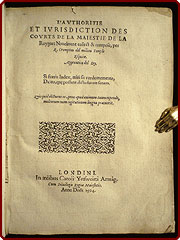
 Single-click any image where the hand appears on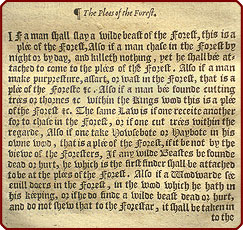
Written in Law French with some Latin, and with extended passages entirely in English in the section on “forrest” law; printed in black letter.
Provenance: Contemporary inked signatures to fly-leaf of Henry Wynn/Wine (Middle Temple?).
• ESTC S109077; STC (2nd ed.) 6050; Lowndes, I, 558. Contemporary limp vellum with remnants of ties. Pinhole or small worming throughout to top margins, touching a few letters in headings; light waterstaining to margins/corners of first/last leaves; one preliminary with just a very little bug-spotting. Paper flaws in margins of ff. 45, 164, and 172; last leaf a little tattered. Overall, very good. (21344)
For
EUROPEAN LAW, click here. For
more BOOKS IN FRENCH, click here. Or
for Books with SPECIAL
AnArch-Opponent of LUTHER'S Eck, Johann. Der viert tail Christenlicher Predigen von den siben H. Sacramente[n] nach aussweysung Christlicher Kirchen vn grund Byblischer gschrifft den alten frummen Christen zu gut, durch Johann von Eck. [colophon: Augspurg: getruckt durch Alexander weyssenhorn, in verlegung D. Iohan Ecken zu Ingelstat], 1534. Folio (31.5 cm; 12.25"). [6], 158, [1] ff. (lacks final blank).
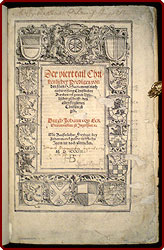
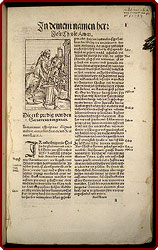
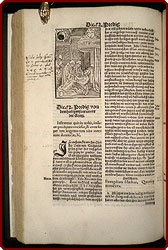 Click the images for enlargements.
 Present here are 76 sermons, being vol. 4 of Eck's Christliche Auslegung der Evangelien. The volumes were all issued separately over the course of several years, by different publishers, and all are treated as stand-alone productions by VD16 and all bibliographies as well as library catalogues.
Provenance: Ownership signature of Joannes Bintengerber (1579); unidentified 16th- or early 17th-century ownership mark in ink on top edge of volume (resembling a brand mark); Howard Osgood (late 19th-, early 20th-century collector and Baptist minister and teacher); later in collection of Colgate Rochester Crozer Divinity School (deaccessioned, with their old circular pressure-stamp partially discernable on title-page).
Evidence of readership: Scattered marginalia (e.g. 68r, 96v, 97r, 120r, 137r, 140v, 155v), usually short but not always.
Rare: Via OCLC and NUC Pre-1956 we trace only 4 copies in U.S. libraries.
• VD16 E288. Full modern calf old style: Round spine with raised bands, accented with gilt rules; red leather title label; rules in blind extending onto covers from each band to terminate in trefoils with blind double fillets beyond. Title-leaf with repairs to foremargin and to small losses in five places at or within the borders; same instances affect four places in the text on the verso. Foremargins of some other early and late leaves a little tattered and irregular, with some repair; endpapers soiled and one other leaf soiled in outer margin; leaf A6 repaired in inner margin. Pin-hole type worming, not serious, in the text at times; waterstain in inner margin of some leaves; outer corners, especially upper ones, bumped/creased in first part. Ownership inscriptions and marginalia as noted. Despite flaws that must be recounted, a sound and handsome book. (25415)
For
more 16TH-CENTURY BOOKS,
Two Works of the Catholic Reformation Eisengrein, Martin. Sechsz Christlicher Leichpredigen. Wie man die Verstorbne glaubigen klagen, Auch Christlich vnd ehrlich zu der Erden bestatten solle. Vnd Ob den Verstorbnen mit Betten, Vigilien, Seelmessen, vnnd andern Caeremonien, ... geholfen seye. Es wirdt auch ... Vom Fegfevr ... ein Bericht gegeben [with another, as below]. [colophon: Gedruckt zu Ingolstat: Durch Alexander und Samuel Weissenhorn gebruder], 1564. [with the same author's] Ein Christliche predig Was vom Heilthumb, so im Papstum[m], in so grossen ehren, zühalten sey. Vnd Ob ain frommer Christ mit güttem gewissen, züdisem oder jänem Heiligen walfarten gehen künde. Zü Jngolstatt in der Pfarrkirchen bey S. Mauritz gepredigt, Durch Martinum Eisengrein, der heiligen Schrifft Licentiatum vnd Probst zü Moßpurg. Gedruckt zu Ingolstatt: Durch Alexander und Samuel Weissenhorn, 1564. 4to (20.5 cm; 8.25"). XL ff. 4to (20.5 cm; 8.25"). [8], XC ff.
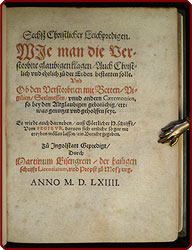
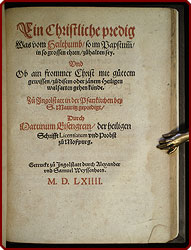 Click the images for enlargements.
 The present two works of preachings are scarce in the U.S., with only two institutions reporting ownership of Sechsz Christlicher Leichpredigen (one copy now deaccessioned) and only one reporting ownership of Ein Christliche predig (that copy also deaccessioned). The Sechsz Christlicher Leichpredigen ends with a two and a half pagepoem by the Dutch humanist and poet Hannard Gamerius, Eisengrein’s colleague at Ingolstadt, where Gamerius taught Greek.
Each work has its title-page printed in red and black; the printing throughout is neat and typical.
• Sechsz: VD16 E817; Index Aurel. 159.363. Ein: VD16 E789; Index Aurel. 159.362. Full dark modern calf old style, with simple blind double fillets bordering covers and a chain rule as vertical accent towards spine; spine without labels and with gilt-touched raised bands accented by blind rules extending onto covers to terminate in trefoils. Text unmarked; light overall age-toning. (26143)
For
more BOOKS IN GERMAN, click here.
Sutton's
Hospital in CharterhouseCharterhouse
School
Herne, Samuel. Domus carthusiana: Or an account of the most noble foundation of the charter-house near Smithfield in London. Both before and since the Reformation. London: Pr. by T.R. for Richard Marriott & Henry Brome, 1677. 8vo (18.2 cm, 7.2"). Frontis., [46], 287, [1] pp.; 2 plts.
CharterhouseCharterhouse
School
Herne, Samuel. Domus carthusiana: Or an account of the most noble foundation of the charter-house near Smithfield in London. Both before and since the Reformation. London: Pr. by T.R. for Richard Marriott & Henry Brome, 1677. 8vo (18.2 cm, 7.2"). Frontis., [46], 287, [1] pp.; 2 plts.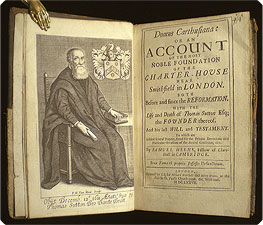
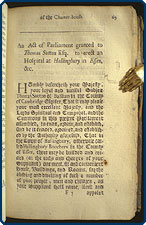
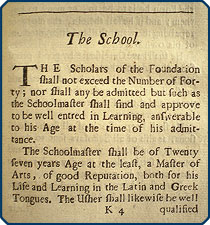 Click the images for enlargements.
 Provenance: Rolle family armorial bookplate.
• ESTC R10688; Wing (rev.) H1578; Allibone 813. Contemporary sheep, covers framed in blind double fillets; leather rubbed and scuffed, partially cracked along front joint. All edges marbled. Pastedowns peeled up, front pastedown with early inked inscription; inside front cover with armorial bookplate. Title-page with inked numeral in upper outer corner. (21012)
For
CHILDREN / EDUCATION,
Missionary Travel tothe Arctic — An Account of LaplandHögström, Pehr. M. Petr. Höchströms Missionarii und Pastoris in Galliwarn Beschreibung von dem unter Schwedischer Crone gehörigen Lappland, in sich fassend einen kurtzen Ünterricht sowohl von des Landes Beschaffenheit überhaupt, als aüch von dem Züstande der Einwöhner, ihrer Haushaltung, Sitten, Manieren, Lebensart, Lastern ünd Aberglaüben .... Stockholm & Leipzig : Beij Johann Friedrich Lochner, 1748. 8vo (17.7 cm, 7"). Engr. t.-p. (double-page), 328 pp.; 1 fold. map, 1 fold. plt.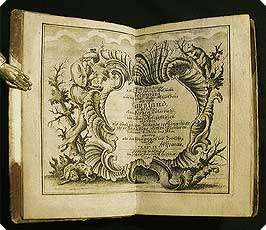
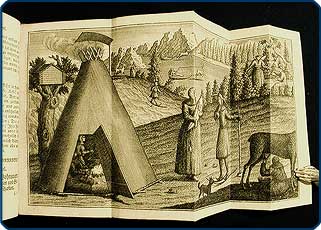
Printed in black-letter, the volume is illustrated with an oversized, folding map of Lapland and a folding plate of Laplanders at work and at play, in addition to the double-page engraved title.
Scarce: Searches of OCLC and RLIN show only two U.S. locations.
Provenance: Front pastedown with bookplate of a 19th-century collector; front fly-leaf with inked ownership inscription dated 1770; title-page with early inscription of J.H. Gronau.
• Not in Howgego, Encyclopedia of Exploration. Contemporary half calf over paper-covered sides, spine with gilt-stamped leather title-label and gilt-stamped decorations in compartments; leather worn, paper discolored, one spine compartment with dark adhesion now chipping. All edges marbled. First text page with inked numeral in lower margin. Free endpapers excised, with offsetting from turn-ins to edges of front and back fly-leaves; back fly-leaf with corners torn away. Engraved title-page, map, and plate browned.
For more VOYAGES, TRAVELS, & books on“EXOTIC”
PLACES, click here. For
NATURAL HISTORY, click here.
For more TRANSLATIONS, click here.
English Incunable Leaf — Crucifixion WoodcutJacobus de Voragine. Golden legend [single leaf]. [Westmynster: Wynkyn de Worde, 1498]. Small folio (27.5 cm; 10.5"). [1] f. .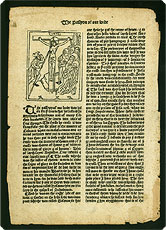
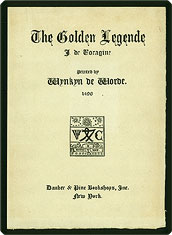 Click the images for enlargements.
 The text is printed in double-column format in English gothic type. The printer, Wynkyn de Worde (a.k.a., Jan van Wynkyn) was England's first typographer and worked with William Caxton, England's first printer. In 1495, he took over Caxton's print shop, but only after a difficult three-year litigation following Caxton's death in 1491.
Provenance: Sold by Dauber & Pine (NY), the firm having dismembered an incomplete copy of the work and offered the individual leaves each with a letter-press leaf serving as ad hoc title-page.
English incunable leaves with woodcuts are increasingly difficult to obtain. That this Golden Legend leaf bears the image at the heart of its matter makes it a particularly desirable one.
• STC (rev. ed.) 24876; ESTC S103597; Duff 411; Copinger 6475; Goff J-151. Irregular in the margins and the recto of the leaf with old ink crossing out. The page with the woodcut in very good condition. (24601)
For
a few more LEAVES, click here. To
consider a 1489, Strassburg “Golden Legend,”
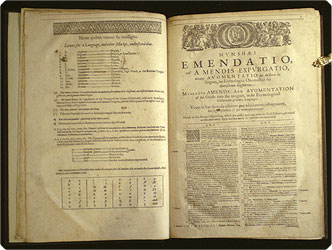
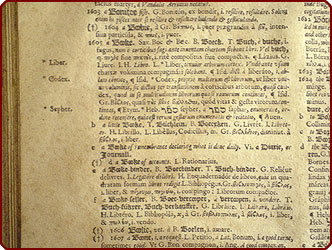
Lexicographical Landmark — Seriously Polyglot! Minsheu, John. Minshaei emendatio, vel à mendis expurgatio, seu augmentatio sui ductoris in linguas, the guide into tongues. London: John Haviland, 1627. Folio (37.6 cm, 14.9"). [4] pp., 760 columns (numbering very erratic in last few leaves).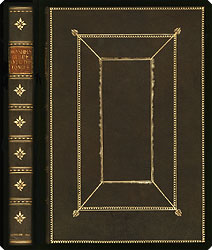
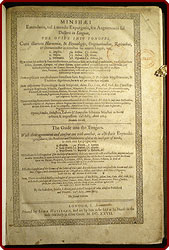
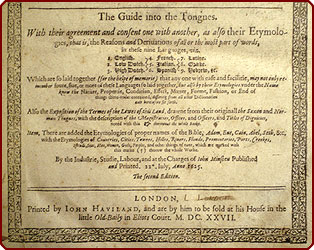 Click the interior images for enlargements. including
black-letter.
Click the interior images for enlargements. including
black-letter.
• STC (rev.) 17947; ESTC S121879; Allibone 1325; Vancil 165. On Minsheu, see: Dictionary of National Biography. Period-style morocco framed and panelled in gilt rolls with gilt-stamped corner fleurons, spine with original gilt-stamped leather title-label, gilt-ruled raised bands, and gilt-stamped decorations in compartments (signed by Grace Bindings in blind at inner area of rear cover, lower turn-in). Title-page institutionally rubber-stamped. Some age-toning and light to moderate spotting; one leaf with tear from outer margin into several lines of text, without loss; last leaf with small hole affecting a few words. (21047)
For
DICTIONARIES/GRAMMARS,

An
Edition that HasEscaped
the Bibliographers?
Nicolaus, de Plove (a.k.a. Nicolaus de Blony). TRactatus [sic] sacerdotalis d[e] sacrame[n]tis: de[que] diuinis officiis et eoru[m] administrato[n]ibus. [Strassburg: Johann Knobloch, 1502–8?]. Small 4to (19 cm; 7.5"). A8C–D4D8F–K4L–M8N–R4S8T6 (-T5); [97 (of 98)] ff. (without the “tabula”).


 Click the images for enlargements.
 The text is complete but it is clear that the next to the last leaf is missing: It would contain the “Tabula” and possibly the colophon. The final blank is present.
Nicolaus's text is printed in double-column format in gothic, black-letter type, with guide letters but the initials unaccomplished.
Evidence of readership: Marginalia throughout; a small area at the beginning of four lines on A6v with early reader's inking over of the lightly printed letters (in a near perfect approximation of the gothic type).
Provenance: Ownership signature of “G. Lunndro, Woodmansey, 1852”; bookplate of Madison University; later bookplate of Colgate University (i.e., Madison changed names in 1890); later transferred to Colgate Rochester Divinity School. Deaccessioned.
• Not in VD16; not in Adams. 19th-century plain boards. Ex-library with bookplates of two different institutions; pressure-stamp on title- and other leaves; five-digit acquisition number stamped in lower margin of first leaf of the prologue; residue of a charge pocket on rear pastedown and ink transfer to rear free endpaper. (26026)
For
CATHOLICA, click here.

SurprisinglyUnbiased for Its Time Otte, Johann Heinrich [a.k.a. Johannes Ottius]. Annales anabaptistici hoc est, historia universalis de anabaptistarum origine, progressu, factionibus & schismatis ... Basileae: Johannis Regis (impressa per Jacobum Werenfelsium), 1672. 4to (20.3 cm, 8"). [40], 360, [24] pp. (pagination skips 226–29, repeats 241–44).


 Click the images for enlargements.
 The title-page is printed in red and black; the text is printed in roman, italic, and black-letter fonts with one large foliate initial, two typographical headpieces, and two woodcut tailpieces.
Provenance: Title-page with 19th-century inked ownership inscription of Howard Osgood (1831–1911), an eminent Baptist minister, scholar, and member of the American Committee on Revision of the Old Testament, as well as a famed collector of Reformation materials.
• VD17 12:119791F; Hillerbrand, Anabaptism, 2456; Rosenthal, Bibliotheca magica et pneumatica, 4650. Period-style full dark calf, covers framed in blind fillets and blind roll, spine with gilt-stamped leather title-label, gilt beading on raised bands with blind-tooling extending onto boards, and blind-tooled decorations in compartments; all edges stained black. Title-page with small inked numeral in upper inner corner, ownership inscription as above, and institutional pressure-stamp. First few leaves darkened; first and last leaf each with small paper adhesions along inner margin; instances of minor to moderate offsetting throughout. One leaf with tear from outer margin, just touching text without loss. A clean, wide-margined, rather pretty. little quarto. (26090)
For
17TH-CENTURY BOOKS, click here. Or again,
for Books with SPECIAL
The Rules CONFORMED to byElizabethan Non-Conformists Travers, Walter. A directory of church-government. Anciently contended for, and as farre as the times would suffer, practised by the first non-conformists in the daies of Queen Elizabeth. London: John Wright, 1644 [i.e., 1645]. 4to (19.8 cm, 7.75"). [24] pp.

 Click the images for enlargements.
 This
is partly in black-letter.
This
is partly in black-letter.
• ESTC R212376; Wing (rev.) T2066. 19th-century half morocco over textured cloth-covered sides, spine with gilt-stamped title; corners and edges showing moderate rubbing, front cover with small unobtrusive scuff. Title-page darkened and with old perforation- and pressure-stamps, old paper adhesions, inner margin reinforced, and small label in lower inner margin; perforation-, pressure-, and rubber-stamps (these last being numbers) to other leaves also. Age-toned, with dust-soiling and the odd spot or marginal tear. (19584)
For
RELIGION, click
here.
German
printers used Black-Letter / Gothic fonts much
Thank
you for your attention!


PLACE AN ORDER | E-MAIL US | GO (BACK) TO TOPIC/INTEREST TABLE | PRB&M HOME
All material © 2010
The Philadelphia Rare Books & Manuscripts
Company