 GENERAL MISCELLANY
GENERAL MISCELLANY
GENERAL MISCELLANY
 Pre–Civil
War Railroad
Map of
Pre–Civil
War Railroad
Map of “the
West”
“the
West” Especially
the MID-West
Especially
the MID-West
 J.H. Colton, Co. Colton's new railroad map of the states of Ohio, Michigan, Indiana, Illinois, Missouri, Wisconsin & Iowa, Minnesota, Nebraska & Kansas. Showing the township lines of the United States surveys. New York: J.H. Colton, 1860. Atlas folio folded to 12mo.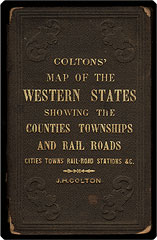
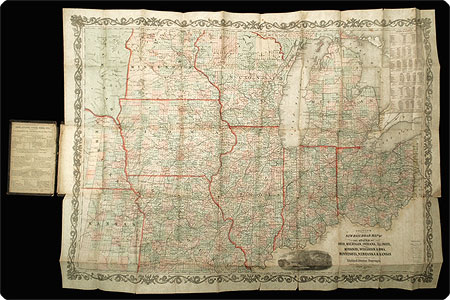
 Click the images for enlargements.
 • Publisher's brown textured case, stamped in gilt on front cover; binding worn, and front cover no longer strongly attached to rear one except via the cloth of the spine. Map with fold tears. (26669)
 For more POST-1820 AMERICANA, click here. For more ILLUSTRATED BOOKS, click here. For more VOYAGES, TRAVELS, & books on“EXOTIC” PLACES, click here.

 Russia & the U.S. — Navigation & CommerceJackson, Andrew (President, 1829–1837). [drop-title] Treaty between the United States and the Emperor of Russia. Message from the President of the United States, transmitting copies of a treaty of navigation and commerce between the United States and his Majesty the Emperor of all the Russias. May 14, 1834. Referred to the Committee on Foreign Affairs. [Washington]: Gales & Seaton, printers, 1834. 8vo (22.7 cm, 8.9"). 10 pp.
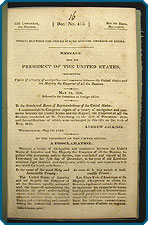
Click the image for an enlargement. This is the first printing of the first treaty of commerce and navigation between the United States and Russia; the only prior convention between the two nations was the convention of 1824 concerning the Pacific Northwest. This treaty establishes
and confirms reciprocal trade, and commercial and navigation rights to vessels of both countries, and also applies the same rights to the kingdom of Poland.
Government document: 23d Congress, 1st Session. Doc. No. 415. Ho. of Reps. Executive.
• Recent paper wrappers. Title-page with inked numeral in upper margin. Light spotting.
For more POST-1820 AMERICANA, click here. For more COMMERCE / TRADE / For MARITIME matters, click here.For TREATIES, click here.
A Human RightsAppeal/Exposé — American Indian Advocacy Jackson, Helen Fiske Hunt. A century of dishonor[.] A sketch of the United States government's dealings with some of the Indian tribes. By H. H. New York: Harper & Brothers, 1881. 12mo. x, 457, [1 (blank)] pp.; 6 pp. (ads).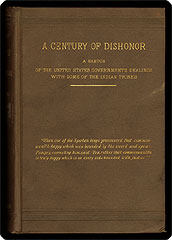
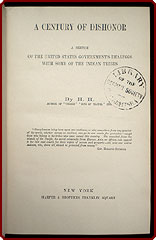 Click the images for enlargements.
 Jackson grew up in Massachusetts and was a close friend of Emily Dickinson. Her marriage in 1852 to a Captain Hunt ended tragically, for he and their two children were dead by 1865. For health reasons she moved to Colorado and in 1875 married a banker named William Jackson. She developed a keen interest in the plight of the American Indian and secured the extraordinary privilege of doing research in the Americana Department of the Astor Library in New York City during the morning hours before the doors officially opened.
She hoped this work would effect a reversal of government policy and herself purchased sufficient copies to send one to every member of both houses of Congress. She then turned to fiction as another avenue of attack: Her best-known novel, Ramona, was her attempt to produce for American Indians a work that would affect their lot as Uncle Tom's Cabin did the plight of black slaves.
 A landmark book.
• BAL 10444. Publisher's brown cloth, lettered in gold. Ex–social club library: 19th-century bookplate, call number on endpaper, rubber-stamp on title-page, no other markings. Two small areas of minor discoloration on spine where paper shelving labels removed. Overall a very nice copy. (26260)
For more POST-1820 AMERICANA, click here. For more of NATIVE AMERICAN interest, click here. For more HUMAN RIGHTS, click here. For more LITERATURE, click here. For more of WOMEN's interest, click here.

 Once Thought to Be byBenjamin Franklin Jackson, Richard. An Historical Review of the Constitution and Government of Pensylvania [sic]. London: Pr. for R. Griffiths, 1759. 8vo. viii pp., [9] ff., 444 pp.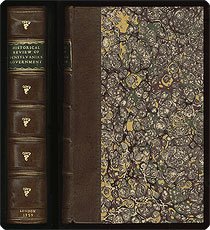
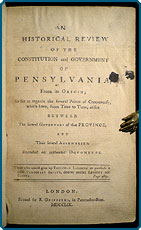 Click the images for enlargements.
 This was long most commonly attributed to Benjamin Franklin, but recently, on the basis of new scholarship, authorship has been ascribed to Richard Jackson, a London barrister and colonial agent with whom Franklin collaborated in other publications. Franklin and his son, William, certainly supplied many of the materials that formed the basis of the book, which was published during Franklin's first mission to England.
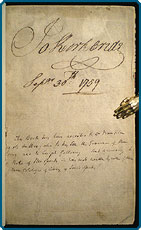
Provenance: Large signature of “Jo. Kirkbride” dated “Septr 30th 1759" on front free endpaper.
Manuscript additions: Under this ownership signature, in a later, much smaller hand, are five lines of speculation as to the work's authorship; a date is corrected on p. 263. Between leaves B3 and B4, a leaf is bound in containing, on its two sides, a handwritten “List of Governors of Pennsylvania — continued”; this, with one addition to the printed list on p. 262, takes the chronology through John W. Geary, inaugurated in 1867.
• Sabin 25512 (noting that the editor of the second edition (Philadelphia, 1812) “had no doubt as to [Franklin's] authorship” and supplied his name); Sparks, Franklin, III, 109 (affirming that the volume “was prepared under [Franklin's] direction, and doubtless from copious materials furnished by him”); ESTC T117618. Recent quarter calf, old style, with raised bands accented with gilt beading on each band, a gilt center device in each spine compartment, and a green leather title label. Boards covered with a stone pattern marbled paper. Title-page with two old ink blots; text lightly and uniformly age-toned. Inscriptions/additions as noted. (25085)
For more 18TH-CENTURY BOOKS, click here. For more PRE-1820 AMERICANA, click here. For more ANGLO-AMERICAN LAW, click here. For more of PHILADELPHIA For more Books with SPECIAL
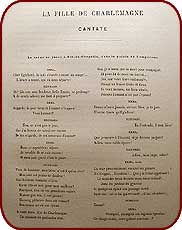
 APearl of a Book of Its EraJacob, P.L. Les perles. Pièces d'écrin artistique et littéraire. Paris: Veuve Jules Renouard, 1867. Folio (35 cm, 13.75"). Add. engr. t.-p., [2], 81, [1] pp.; 22 plts.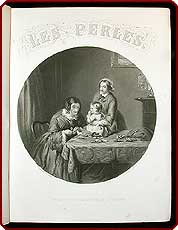
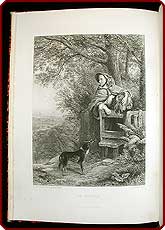
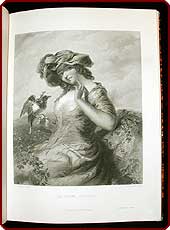 Click any image where the hand appears onundescribed in any major database. Edited and contributed to by the prolific French author Paul Lacroix, best known as “Bibliophile Jacob,” this lovely collection of short stories, poems, and meditations by Lacroix, Balzac, Émile Délerot, Charles Nodier, et al. is illustrated with22 large steel engravings done by J.C. Armytage, W. Greatbach, J.B. Allen, J.T. Willmore, F. Joubert, and others after designs by artists including Turner, Webster, etc.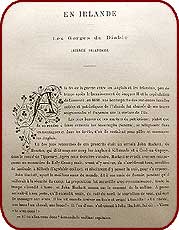
 The
“Laws of the Sea”
at a Time When
England Was!
The
“Laws of the Sea”
at a Time When
England Was! the
Law on the Seas
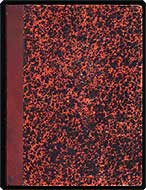
Jacobsen, Friedrich Johann. Laws of the sea, with reference to maritime commerce during peace and war. Baltimore: Edward J. Coale, (J. Robinson, printer), 1818. 8vo (22 cm; 8.75"). xxxv, [1], 636 pp.
the
Law on the Seas
Jacobsen, Friedrich Johann. Laws of the sea, with reference to maritime commerce during peace and war. Baltimore: Edward J. Coale, (J. Robinson, printer), 1818. 8vo (22 cm; 8.75"). xxxv, [1], 636 pp.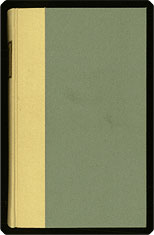
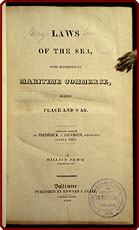
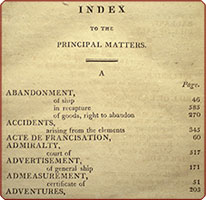
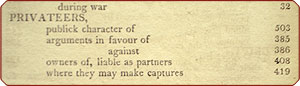
Published at a critical period in America's commercial history, this work presents the then prevailing international law on such matters as shipwreck, salvage, abandonment, blockages, embargoes, delivery, demurrage, and neutrality, to mention just a few topics.
 For PRE-1820 AMERICANA, click here. For more COMMERCE / TRADE / For ANGLO-AMERICAN LAW, click here. For EUROPEAN LAW, click here. For MARITIME matters, click here. Or for more TRANSLATIONS, click here.
English Incunable Leaf — Crucifixion WoodcutJacobus de Voragine. Golden legend [single leaf]. [Westmynster: Wynkyn de Worde, 1498]. Small folio (27.5 cm; 10.5"). [1] f. .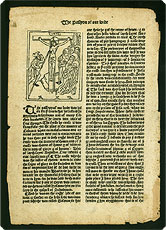
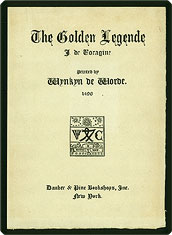 Click the images for enlargements.
 The text is printed in double-column format in English gothic type. The printer, Wynkyn de Worde (a.k.a., Jan van Wynkyn) was England's first typographer and worked with William Caxton, England's first printer. In 1495, he took over Caxton's print shop, but only after a difficult three-year litigation following Caxton's death in 1491.
Provenance: Sold by Dauber & Pine (NY), the firm having dismembered an incomplete copy of the work and offered the individual leaves each with a letter-press leaf serving as ad hoc title-page.
English incunable leaves with woodcuts are increasingly difficult to obtain. That this Golden Legend leaf bears the image at the heart of its matter makes it a particularly desirable one.
• STC (rev. ed.) 24876; ESTC S103597; Duff 411; Copinger 6475; Goff J-151. Irregular in the margins and the recto of the leaf with old ink crossing out. The page with the woodcut in very good condition. (24601)
To view our INCUNABLES, click here. For more BLACK LETTER, click here. For more ILLUSTRATED BOOKS, click here.For more LEAVES, click here. For more LITERATURE, click here. For more RELIGION, click here. Or for CATHOLICA, click here. For more Books with SPECIAL & for COLLECTED PRESSES Incunable “Golden Legend” — From the Printer of the 1483 Jordanus de QuedlinburgJacobus, de Voragine. Lombardica historia que a plerisq[ue] Aurea legenda sa[n]ctorum appellatur. [Arge[n]tine: {Printer of the 1483 Jordanus de Quedlinburg (Georg Husner)}, 1489]. Small folio (27 cm). [260 of 264] ff.

 Click any image where the hand appears onpage
for page reprints. The imprint information is from the colophon
on H5r.
Click any image where the hand appears onpage
for page reprints. The imprint information is from the colophon
on H5r.
This is an uncommon edition in the U.S. though heavily held in Europe; Goff and ESTC locate only two U.S. copies — this being one of them, deaccessioned.


The text is printed in double-column format in gothic type. In
this copy, virtually all of the initials are nicely accomplished in red or
blue.
• Copinger, II, 6452; ISTC ij00122000; Proctor 618; BMC, I, 138; Goff J122. 19th-century quarter German calf with black mottled paper sides. Various waterstaining throughout, with other stray stains; copy missing first two and final two leaves of text, and the leaves at front and back remargined (with some others repaired). Priced according to faults, not pleasures!
To view our INCUNABLES, click here. For more CATHOLICA, click here. For Books for the BUSTED
Bernard & Gordon & Angela James, Henry. Confidence. Boston: Houghton, Osgood & Co., 1880. 12mo (19.4 cm, 7.6"). [2], [5]–347, [1] pp.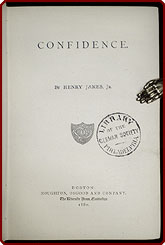
 We have, at the moment, an interesting number of such “first American editions.” Please, enquire!
• BAL 10549; Edel & Laurence, Bibliography of Henry James (3rd. ed.), A11b; Wright, III, 2913. Publisher's terra-cotta cloth, spine with gilt-stamped title; extremities rubbed and cloth with areas of discoloration. Ex–social club library: call number on endpaper, rubber-stamp on title-page, no other markings. Pages with scattered light stains, still a very nice copy. (26637)
For POST-1820 AMERICANA, click here. For LITERATURE, click here.We
have, at the moment, an interesting number
“InvestigatingOur Scottish Dialect”James V, King of Scotland; Callander, John, ed. Two ancient Scottish poems; The Gaberlunzie-man, and Christ's kirk on the green. Edinburgh: Pr. by J. Robertson, 1782. 8vo (21 cm, 8.25"). [2], 179 (i.e., 193), [1] pp. (1 prelim. f. lacking).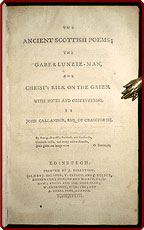
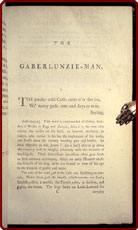 Click either image for an enlargement.
 ESTC notes that one institution reports a frontispiece, but most other listings cite a preliminary leaf (not present here) rather than a plate. No, this does NOT photograph well! — but it is very interesting in the hand, under the eye.
• ESTC T146717; Allibone 328. 19th-century half morocco and pebbled cloth–covered sides, spine with gilt-stamped title; rubbed and sides sunned. Front pastedown with private collector's bookplate. Lacking one preliminary leaf; title-page partially separated, with faint pencilled annotation beneath author's name. Occasional light spotting, confined to inner and outer margins; one early inked annotation in the addenda to the first poem. (24880)
For more 18TH-CENTURY BOOKS, click here. For SCOTLAND & SCOTS, click here. For more LITERATURE, click here. For DICTIONARIES/GRAMMARS,
 Hoe Copy — BalladsBeautifully BoundJamieson, Robert. Popular ballads and songs, from tradition, manuscripts, and scarce editions; with translations of similar pieces from the ancient Danish language, and a few originals by the editor. Edinburgh: Archibald Constable & Co. (pr. by J. Ballantyne & Co.), 1806. 8vo (22.2 cm, 8.75"). I: [6], ii, xix, [1], 352 pp. II: [4], iii, [1], 409, [5] pp.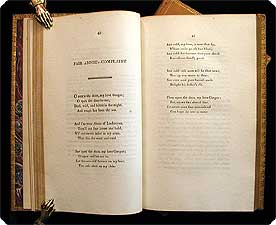
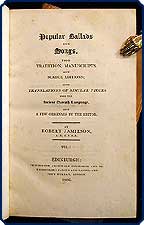 Single-click either image for an enlargement.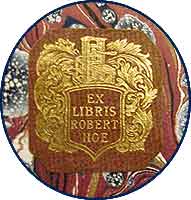
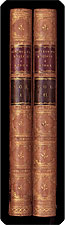 Provenance: Hoe copy, with morocco “Ex libris Robert Hoe” bookplates on both front
pastedowns.
Provenance: Hoe copy, with morocco “Ex libris Robert Hoe” bookplates on both front
pastedowns.
Binding: 19th-century gold calf with covers framed in double gilt fillets, turn-ins gilt-stamped, marbled endpapers. Spines gilt-tooled and with gilt-stamped title and volume labels. All page edges gilt.
• NSTC J236. Leather showing moderate acid-spotting, with some cracking over the spine (one label repaired). One leaf with short tear from bottom edge; pages with a very few scattered spots of foxing only. A very handsome set.
TWO Notable Orientalists — Elzevir Edition Javier, Jerónimo. [two words in Persian, then] Historia Christi Persice conscripta, simulque multis modis contaminata. Lugduni Batavorum: Ex Officina Elseviriana, 1639. 4to (20.6 cm, 8.1"). [24], 636, [4 (index)] pp. [with, as issued, the same author's] [three words in Persian, then] Historia S. Petri Persice conscripta, simulque multis modis contaminata. Latine reddita, & brevibus animadversionibus notata ... Lugduni Batavorum: Ex Officina Elseviriana, 1639. [8], 144 pp. 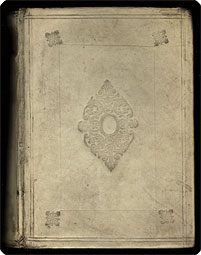
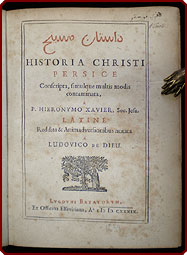 Click the images for enlargements.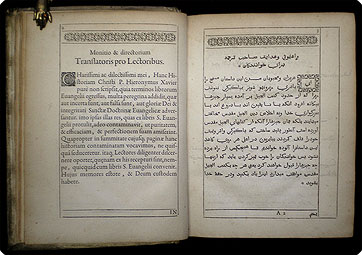
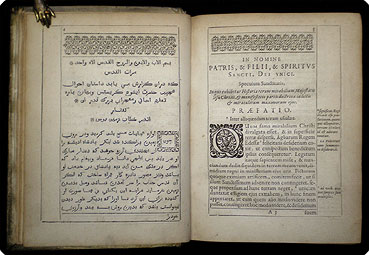
• Willems 490; Copinger 5255; Palau 376807–8; DeBacker-Sommervogel, VIII, 1339. Contemporary vellum, covers framed in blind with blind-tooled central medallion, spine with early hand-inked title; vellum lightly soiled overall, upper outer front corner bumped, splits in spine vellum repaired with Japanese paper and minor (expert) repair to joints. Upper outer corner of title-page with early inked ownership inscription in both Persian and English, possibly by orientalist Henry Pitts Forster (1766–1815); title-page with shadows of other annotations. Pages age-toned, with upper portions darkened; scattered light spotting towards back of volume. Eleven leaves with small spots of worming, affecting a few letters without loss of sense; light to moderate waterstaining to portions of leaves towards back of volume. Last leaf with small tear without loss. One page with pencilled annotations. (25957)
For more 17TH-CENTURY BOOKS, click here. For more PERSIANA, click here. For more RELIGION, click here.For more JESUITANA, click here. For more CATHOLICA, click here. For a few more ELZEVIR PRESS BOOKS, For COLLECTED PRESSES For more TRANSLATIONS,
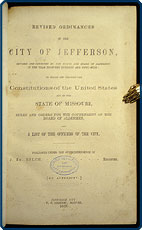
Frontier City inAntebellum America Jefferson City (Missouri). Revised ordinances of the City of Jefferson, revised and digested by the Mayor and Board of Aldermen in the year eighteen hundred and fifty-nine: To which are prefixed The Constitutions of the United States and of the State of Missouri, rules and orders for the government of the Board of Aldermen, and a list of the officers of the city. Jefferson City: W. G. Cheeney, printer, 1859. 8vo. [1 (blank)] f., 145, 14 pp.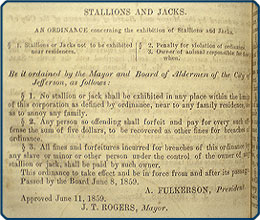
 Click the images for enlargements.
 Provenance: Released as a duplicate from the Library of Congress, with the requisite and expected stamps on the title-page and rear free endpaper.
Rare. We only trace one holding beyond the Library of Congress.
• NSTC 2J3897. 20th-century library binding; quarter red cloth shelfback over black paper boards, paper shelf label on front. Original (?) light-blue wrapper bound in, back wrapper lacking. Moderate foxing throughout. Paper flaw affecting but not costing some letters on p. 123. 19th-century library markings noted above. A very good copy. (24454)
For more POST-1820 AMERICANA, click here. For more ANGLO-AMERICAN LAW, click here.
For
theIngalik
Jetté, Jules. Canotlé Rannaga Kelékak. Délochét Roka. Winnipeg: Free Press no-rodeneletekteyar, 1904. 8vo (14.4 cm, 5.6"). 54 pp.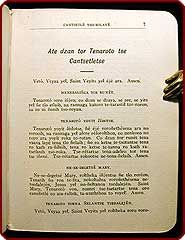
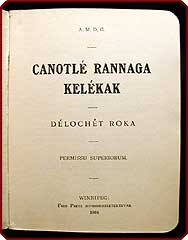
 The Ingalik inhabited the middle part of the Yukon River Valley, Alaska.
Click the image to the right
The Ingalik inhabited the middle part of the Yukon River Valley, Alaska.
Click the image to the right• Cf. Wickersham, 1050, for another title by Jetté with the same imprint. Not in Evans; not in Banks. Original stiff cloth wrappers. Pages very slightly age-toned, otherwise fine.
For more POST-1820 AMERICANA, click here. For more of NATIVE AMERICAN interest, click here. For more of CANADIAN interest, click here. For more RELIGION, click here. For more CATHOLICA specifically,
Contentious Counterpoint — Contemporary Binding Jewel, John. A defence of the apologie of the Churche of Englande conteininge an answeare to a certaine booke lately set foorthe by M. Hardinge, and entituled, A confutation of &c. London: Henry Wykes, 1567. Folio (30.9 cm, 12.1"). [24], 742, [6] pp. (title-page in facsim., pp. 675/76 lacking; pagination erratic).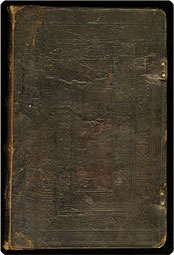
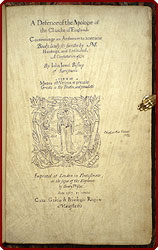
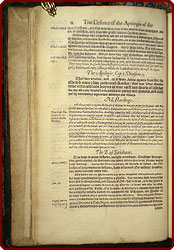
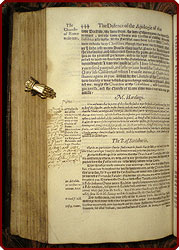 Click the interior images for enlargements.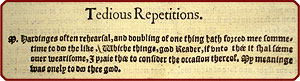
Binding: Contemporary calf over heavy boards, panelled and framed in blind with floral, geometric, and armorial blind-tooling within panels; a pencilled note on the front free endpaper says, “Richardson binding.” There once were clasps, now lost.
Provenance: Title-page with small inked inscription, dated 1836, of Charles Nice Davies (1794–1842), a Welsh linguist, librarian at the Congregational Library, and divinity tutor at Brecon College.
• STC (2nd ed.) 14600.5; ESTC S112182. Bound as above, rebacked preserving original spine; leather cracked, edges and extremities rubbed, clasps now lost, hinges (inside) reinforced some time ago. Institutionally rubber-stamped on lower closed page edges, front pastedown, and first contents page. Title-page provided in early pen and ink facsimile, with inscription as above; last text page with commentary on the book's age, dated 1724 and 1913. Early inked underlining and marks of emphasis throughout; occasional marginalia, two pages dealing with women and the Church having extensive annotations. Pp. 675/76 lacking. One leaf with tear from upper margin extending into three lines of text, without loss; one leaf with large chip from lower margin, not affecting text. Scattered spots of staining only — a clean, strong volume. (24511)
For more 16TH-CENTURY BOOKS, click here. For more RELIGION, click here. For more Books with SPECIAL For FINE, ATTRACTIVE, & INTERESTING For Books for the BUSTED
This
Great English
Rabbi DefendsOral
Law — London,
5474/1714 (Jewish–Jewish Controversy). Nieto, David. [Hebrew title-page romanized as] Mateh Dan ve-kuzari helek sheni: yokhiah...amitut Torah shebe-‘al peh [and Spanish title-page opposite] Matteh Dan y segunda parte del Cuzari.... Londres: Thomas Ilive, 5474 [A.D. 1714].
4to. [10], 254 ff.


 Single-click any image of this book, for an enlargement.
Works of Jewish controversy written by Jews and published in England in the period to 1720 were few in number and are now very uncommon. Those controversial treatises actually in Hebrew were and are particularly rare. Searches via ESTC, RLIN, OCLC, and NUC Pre-1956 locate fewer than a dozen copies of this text in U.S. libraries.
• Roth, Magna Bibliotheca Anglo-Judaica, 336; Palau 191134; ESTC T210368. 18th-century diced russia. Joints and board edges rubbed with joints tender and starting at tops and bottoms. Some margin pencil marks but a clean, complete copy of a scarce and very important book.
For more 18TH-CENTURY BOOKS, click here.For a bit more JUDAICA / HEBRAICA, click here. This book also appears in the HISPANIC
Transcribed from Glagolitic Script into Cyrillic John Chrysostom, Saint. Glagolita Clozianus[,] id est, codicis Glagolitici inter suos facile antiquissimi ... leipsanon ... servatum in bibliotheca Illmi. Comitis Paridis Cloz.... Vindobonae: Prostat apud Carolum Gerold, 1836. Folio (31.5 cm; 12.25"). [1] f., lxxx, [1] f., 86 pp., 2 engr. plates, facsim.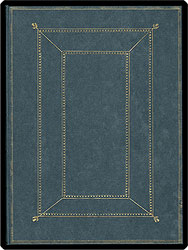
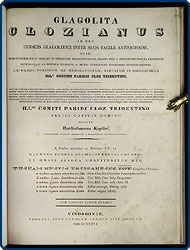
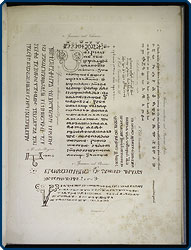 Click the images for enlargements.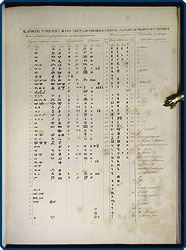
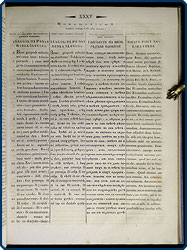
• Recently bound in blue-grey paper over boards, gilt tooling in the 18th-century style on the boards. Scattered foxing. A very good copy of a handsome book. (26002)
For more CATHOLICA, click here. For more RELIGION, click here. For more TRANSLATIONS, click here.
 Marriage Counsel
[Johnson, John]. The advantages and disadvantages of the marriage state: An allegory. Springfield: G. & C. Merriam, 1837 (date from t-p.; cover reading 1842). 16mo (10.7 cm, 4.2"). 60 pp.
Marriage Counsel
[Johnson, John]. The advantages and disadvantages of the marriage state: An allegory. Springfield: G. & C. Merriam, 1837 (date from t-p.; cover reading 1842). 16mo (10.7 cm, 4.2"). 60 pp.
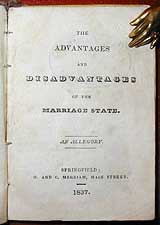
The much-reprinted allegory, which originally appeared some time prior to 1757, is followed here by two brief essays on marriage. The first comes from "James’ Family Monitor" and the second from Taylor’s "Marriage Ring."
Provenance: Merriam Co. archive, with publisher’s shelf label on the cover and ink-stamp on the verso of the title-page.
• Cloth spine over printed paper–covered boards, edges a bit abraded and spine fraying at top; shelf labels as above. Pencilled ownership inscription on front fly-leaf; small tear and dog-ears to two blank fly-leaves. Light waterstaining and foxing.
For
more POST-1820 AMERICANA, click
here.
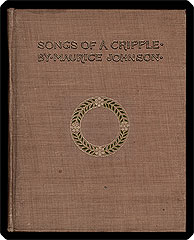
“My Legs A-Bein' Queer, They Never Let Me Walk” Johnson, Maurice. Songs of a cripple. New York: Grafton Press, © 1909. 12mo (15.5 cm, 6.1"). Frontis., xi, [1], 103, [1] pp.; 5 plts.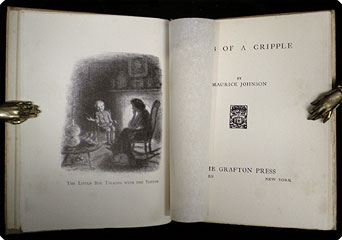
 Click the images for enlargements.
 Signed by the author: With tipped-in typed sheet bearing inspirational message, signed in pencil. Also tipped in is a photograph of the author inan early motorized wheelchair.
• Publisher's tan cloth, front cover with gilt-stamped title and gilt and green laurel wreath, spine with gilt-stamped title and a little sunned; touches of rubbing and some pages with light to moderate spotting. A nice copy. (26621)
For more POST-1820 AMERICANA, click here. For more LITERATURE, click here. For more ILLUSTRATED BOOKS, click here. For more INVENTIONS, click here. For more of CALIFORNIA interest, click here. For more Books with SPECIAL
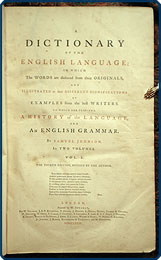
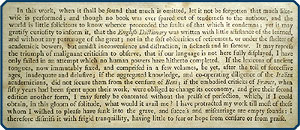
Last Edition with HIS Revisions Strong & Handsome Johnson, Samuel. A dictionary of the English language: in which the words are deduced from their originals, and illustrated in their different significations by examples from the best writers. To which are prefixed, A history of the language, and An English grammar. . . . In two volumes. London: Pr. by W. Strahan, for
W. Strahan, J. & F. Rivington, T. Davies, J. Hinton, L. Davis, et al., 1773. Folio (45.2 cm, 17.75"). 2 vols. I: [553] ff. II: [478] ff.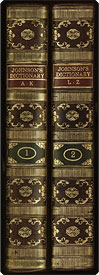
 Click the images for enlargements.
 Robert Keating O'Neill, in his English-Language Dictionaries,1604–1900, notes that 1,250 copies of this edition were printed and that it, “unlike its two predecessors, was much revised and is considered generally to be the best edition.”
 BE
SURE to click THIS image!
BE
SURE to click THIS image! • ESTC T117232; Brunet, III, 553; O’Neill J-52; Vancil 123; Printing and the Mind of Man 201 (for the first edition). 18th century treed calf, with minor surface cracks and chips and small areas rubbed; strongly and splendidly rebacked with speckled calf, spines gilt extra in bars and compartments; new leather spine labels bearing volume numbers and the emblazoned notes, “Johnson's Dictionary. A–K” and Johnson's Dictionary. L–Z.” Old gilt-tooling around covers and on turn-ins; nice old marbled endpapers. Title-pages printed in red and black. Occasional foxing; old waterstaining, generally quite light and inoffensive, in margins of early and later leaves. Paper flaw on B1 costing 4 letters of the footnotes; hole in blank area of outer margin of B1–B4. A few page edges chipped and ragged, with significant portion of paper lost from outer margins of two leaves, without costing any text; several leaves with a fold-in or dog-ear, paper quite strong at folds. Good text in a handsome and sturdy binding. (23890)
For more SETS, click here. For more 18TH-CENTURY BOOKS, click here. For DICTIONARIES/GRAMMARS, ETC., click here. For more LITERATURE, click here. For FINE, ATTRACTIVE, & INTERESTINGThis
is a PRB&M “FEATURED BOOK” —
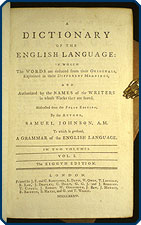
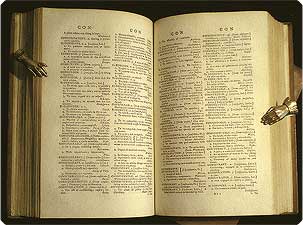
Elegant Two-Volume Abridgement — With the GrammarJohnson,
Samuel. A dictionary of the English language: In which the words are deduced from their originals, explained in their different meanings, and authorized by the names of the writers in whose works they are found. Abstracted
from the folio edition ... the eighth edition. London: Pr. for J.F. & C. Rivington, et al., 1786. 8vo (21.8 cm, 8.6"). 2 vols. I: [289] ff. II: [266] ff.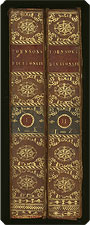
 Single-click any image where the hand appears on
• ESTC T83956; Brunet, III, 553; O’Neill J-65; Vancil 123; Printing and the Mind of Man 201 (for the first edition). Contemporary speckled calf, spines gilt extra with gilt-stamped leather title and volume labels; all joints strengthened and bindings otherwise showing only light wear overall. Front pastedowns with bookseller’s stamp; title-pages with upper margins excised. An attractively bound abridgment of Johnson’s magnum opus.
For more SETS, click here. For more 18TH-CENTURY BOOKS, click here. For DICTIONARIES/GRAMMARS, ETC., click here. For more LITERATURE, click here. For FINE, ATTRACTIVE, & INTERESTING
Important
(Grey Side)
Civil
War Journal
Jones, John Beauchamp. A rebel war clerk's diary at the Confederate States capital. Philadelphia: J.B. Lippincott, 1866. 8vo (21 cm, 8.35"). 2 vols. I: 392 pp. II: 480 pp.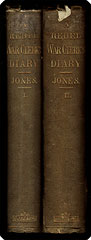
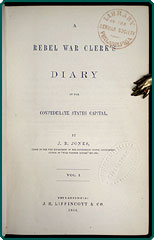
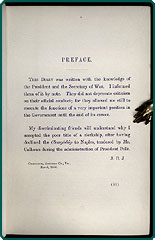 Click the images for enlargements.
 A successful novelist and journalist, Jones was wholeheartedly loyal to the Confederacy, and convinced right up until the end that the North would never conquer a united, determined South; he was also notably anti-Semitic, and there are a number of references here to the Jews being largely responsible for the country's economic woes.
• Howes J220; Nevins I, 115 & II, 173. Publisher's brown cloth, spines with gilt-stamped title; sunned and with some discolorations; corners rubbed and spine heads pulled/chipped. Ex–social club library: front pastedown with inked numerals in a 19th-century hand (partially obscured), title-page pressure- and rubber-stamped, a few other pages rubber-stamped. Front free endpaper of vol. I lacking. Pages with light waterstaining to upper inner portions in vol. I One leaf in vol. II with tear extending into text, without loss. (26297)
For more POST-1820 AMERICANA, click here. For more U.S. CIVIL WAR offerings, click here. For more COMMERCE / TRADE / For more of MILITARY/NAVAL
Irish Insurgency — American Imprint & Provenance Jones, John, of Dublin. An impartial narrative of the most important engagements which took place between His Majesty's forces and the insurgents, during the Irish Rebellion, in 1798; including very interesting information not before published. Carefully collected from authentic letters. Second edition, with additions and corrections. South Newberlin, NY: Levi Harris, 1834. 12mo (18.3 cm, 7.2"). Frontis., 227, [1] pp.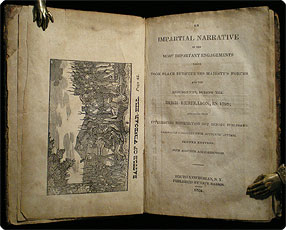
 Click the interior image for an enlargement.
 Provenance: Inked inscriptions of James Mack of Windham, VT (1784–1860) on front free endpaper and rear fly-leaf. Although both inscriptions are dated 1840, one gives “Col. James Mack” and the other “Major James Mack.”
• American Imprints 25154. Contemporary treed sheep, spine with gilt-stamped leather title-label; joints, edges, and extremities rubbed, spine leather darkened and cracked, boards very slightly sprung. Inscriptions as above. Light to moderate age-toning and foxing, more pronounced to frontispiece and title-page. Now housed in a cloth clamshell case with gilt-stamped leather spine label. (25116)
For more POST-1820 AMERICANA, click here. For more of IRISH interest, click here. For more of MILITARY/NAVAL Or for more Books with SPECIAL
First Edition — Uncut Copy Jones, John Paul. Life and correspondence of John Paul Jones, including his narrative of the campaign of the Liman. New York: Stereotyped by A. Chandler [pr. by D. Fanshaw], 1830. 8vo (25.7 cm, 9.9"). Frontis., 8, [13]–555, [1] pp.
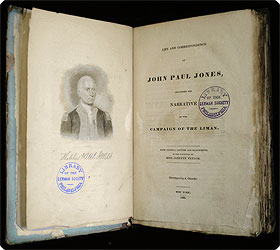 Click the images for enlargements.
 This is an uncut copy; uncut, however, though it may have been, this was carefully opened. It was read cover to cover!
• American Imprints 2078; Howes S91; Sabin 36551. Publisher's quarter brown cloth and light blue paper–covered sides, spine with printed paper label; binding rubbed and moderately stained, with front hinge (inside) reinforced some time ago. Ex–social club library: 19th-century bookplate, call number on endpaper, frontispiece, title-page, and last page rubber-stamped. Inside the occasional spot or blot; page edges uncut. (27106)
For PRE-1820 AMERICANA — click here POST-1820 AMERICANA — click here. For SCOTLAND & SCOTS, click here. For more of MILITARY/NAVAL For MARITIME matters, click here. For more BIOGRAPHIES, mostly 20th-Century
 A Woman Collector's BLOCKBUSTER Collection Jones, Mrs. B.F., Jr. Important paintings by great masters. Superb works by Gainsborough, Hoppner, Romney, Lawrence ... collection formed by the late Mrs. B.F. Jones, Jr. removed from her residence at Sewickley Heights, PA. New York: Parke-Bernet Galleries, 1941. 8vo. [8], 84, [6] pp.; illus.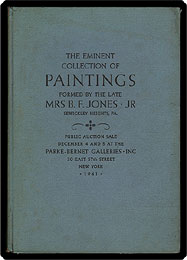
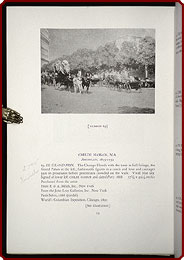 Click the images for enlargements.
 Heavily illustrated; hammer prices pencilled in.
• Original printed boards, scuffed and stained yet volume sound and pleasant enough with interior clean. As noted, most hammer prices pencilled in. (26156)
For more ART REFERENCE, click here. For more ILLUSTRATED BOOKS, click here. For more of WOMEN's interest, click here. For more “GIFTABLES” — mostly $150
A
Methodist Missionary
& Chippewa
Chief's HYMNSChippewa
& English
Jones, Peter, tr. Collection of hymns for the use of native Christians of the Chipeway tongue. [added title-age in Chippewa:] Nahkahmoonun kanahnahkahmoowaudt ekewh ahneshenahpaigk anahmeahchik. Kahahnekahnootahpeungkin owh Kahkewaquonnaby. New York: Printed at the conference office by J. Collord, 1829. 12mo (13.2 cm; 5.125"). [1] f., pp. [1–2], 3, then 37, 37, 38–92 pp.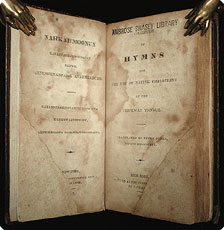
 Click the images for enlargements.
 Peter Jones (1802–56) was a mixed-blood Missisauga chief and a Methodist missionary at New Credit, Ontario.
• Pilling, Proof-sheets, 2024; Pilling, Algonquian, 266; Shoemaker 39161. Not in Sabin; not in Newberry Library, Ayer Indians; not in Boston Athenaeum, Schoolcraft Collection. Contemporary brown calf, modest triple-rule border on covers in blind; rebacked and spine blind-tooled with ruled compartments containing blind-stamped devices. Lower outer corners of both title-pages torn away and paper repairs made, with partial loss of imprint information on each page; old library rubber-stamp to top of English one. Staining, sometimes heavy; chipping of page edges; pp. 39/40 with large semicircular tear with loss of text. Far from a perfect copy, but copies are extremely uncommon in commerce these days. (25853)
For more POST-1820 AMERICANA, click here. For more of NATIVE AMERICAN interest, click here. For more books of CANADIAN interest, click here. For more RELIGION, click here. For more TRANSLATIONS, click here. Or for Books for the BUSTED An Eminently Perusable“Oriental” GrammarJones, William. A grammar of the Persian language...fifth edition, revised. With an index. London: J. Murray & S. Highley (pr. by S. Rousseau), 1801. Folio (25.8 cm, 10.12"). [4], xx, 147, [1 (blank)], [38 (index)] pp.; 1 plt.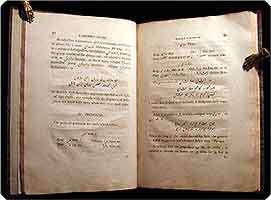 Click the image above for an enlargement.
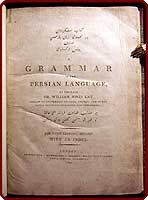
• NSTC J1084 (describing 6th and 7th editions only). On Jones, see: The Dictionary of National Biography, XXX, 174–77. 20th-century half morocco with marbled paper–covered sides, spine with gilt-stamped decorative motifs; binding is clean and all but unworn. Pages foxed, though not nastily so,with occasional pencil and ink marks of emphasis; one leaf with small repair to outer margin.
For
DICTIONARIES/GRAMMARS, ETC., click
here.
Antiquities
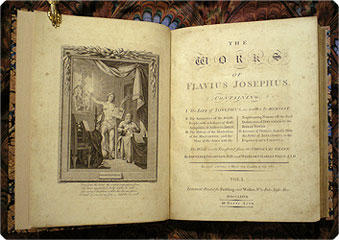
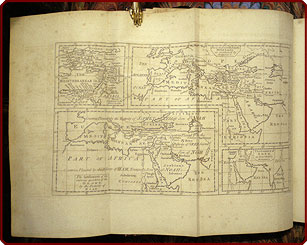
of the JewsILLUSTRATEDJosephus, Flavius. The works of Flavius Josephus. Containing, I. The life of Josephus, as written by himself. II. The antiquities of the Jewish people; with a defense of those antiquities, in answer to Apion. III. The history of the martyrdom of the Maccabees; and the wars of the Jews with the neighbouring nations till the final destruction of Jerusalem by the Roman power. IV. Account of Philo's ambassy from the Jews of Alexandria, to the Emperor Caius Caligula. London: Pr. for Fielding & Walker by Henri Lion, 1777–78. 4to (27.2 cm, 10.75"). 2 vols. I: Frontis., 719, [1] pp. (lacking list of subscribers); 44 (1 fold.) plts., 7 maps (1 fold.). II: Frontis., [2], 644, [28 (index)] pp.; 16 (of 17) plts.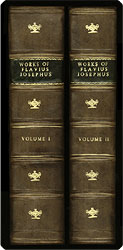
 Click the interior images for enlargements.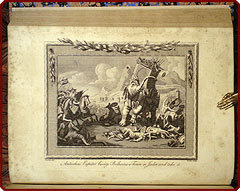
The two volumes are illustrated with a total of69 copper-engraved plates (out of 70 called for), including a number of maps, all engraved by several different hands after the work of various artists.
• CBEL, II, 1492; ESTC T112662; Lowndes 1236; Schweiger, I, 179. Period-style quarter mottled calf with marbled paper–covered sides, leather edges blind-tooled, spines with gilt-stamped leather title-labels and gilt-stamped compartment decorations. Front fly-leaf of vol. II with 19th-century inked gift inscription. Vol. I lacking list of subscribers; vol. II lacking one plate (“The Death of Caius Caesar”). Light to moderate spotting and staining throughout; some offsetting to and around plates. One leaf torn from outer edge, narrowly missing text. A sound, handsome set fine for working or playing with. (24538)
For more 18TH-CENTURY BOOKS, click here. For more GREEK & LATIN CLASSICS, click here. For more RELIGION, click here.For a bit more JUDAICA / HEBRAICA, click here. For more ILLUSTRATED BOOKS, click here. For more TRANSLATIONS, click here.

His
Surviving Oratory
&
The FIRST
BIBLIOGRAPHY
Printed
in the New World
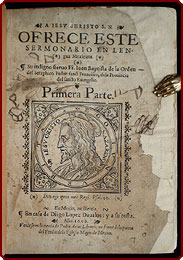
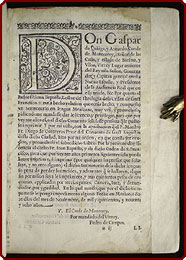
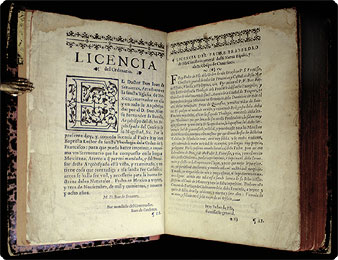
Juan Bautista, fray. A Jesu Christo S.N. ofrece este sermonario en lengua mexicana ... Primera parte. Mexico: En casa de Diego Lopez Davalos, 1606. 4to (21.5 cm; 8.5"). [26] ff., pp. 1–559, ff. 560–99, pp. 600–39, ff. 640–47, pp. 648–55, 664–709, [1] p., [20 of 24] ff., lacks final 4 leaves.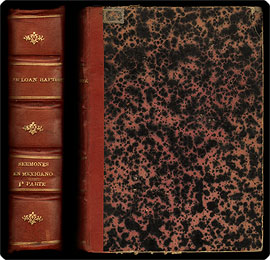
 Click the images for enlargements.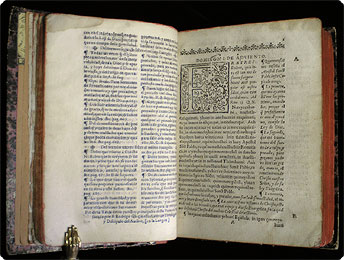
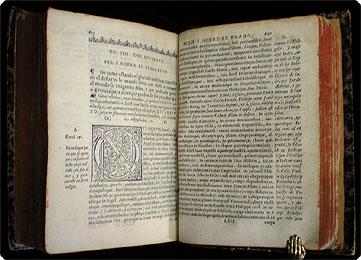
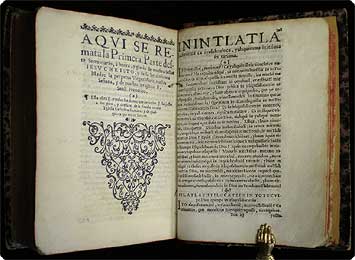
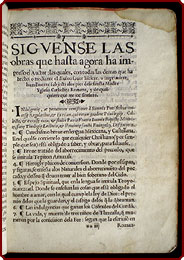
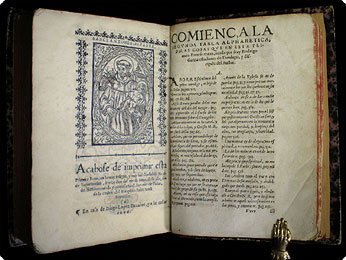
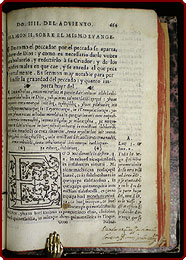
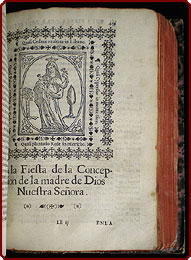
A long unnoticed feature of this book is that it contains the first bibliography published in the New World. On signature **iiii recto and verso is a list of “las obras que hasta agora ha impesso el Auctor” (“the works that until now the author has had published”). The list is not in chronological order nor is it alphabetical by title; nonetheless it is a bibliography and supplies us with information now known only because of its inclusion here. Of the 17 items listed, several have failed to survive in any known copy, including the second part of this sermonario — though at the time of publication of this part one, “de la segunda parte esta ya impresso gran pedaço” (“of the second part a large portion is already printed”).
The volume is enhanced by half-page woodcuts: here, Christ's portrait profile on the title-page, St. Andrew with his Cross, St. Anne with the Virgin as infant (appearing twice), and St. Anthony of Padua. The text is in roman with side- and shouldernotes in italic type. Printer López Dávalos employs an interesting set of very large (5 x 5 cm; 2" x 2") foliated woodcut initials throughout the volume.
Provenance: 18th-century signature in a few margins of Carlos Perez; late 19th- or early 20th-century bookplate of Nicolás León; in the collection of the John Carter Brown Library (deaccessioned).
• Medina, Mexico, 227; García Icazbalceta, Lenguas, 13; H. de León-Portilla, Tepuztlahcuilolli, 342; Viñaza 114; Newberry Library, Ayer Indians, Nahuatl-21; Pilling, Proof-sheets, 235; Palau 23467; Putick & Simpson 154; Schwaller 11. For biographical information on Bautista, see: Archivo biográfico de España, Portugal, e Iberoamérica, fiche 104, frames 339–73. Late 19th-century quarter red Mexican sheep with purple and black mottled paper sides. Title- and following leaf with irregular foremargins, loss of blank areas of old repaired; waterstaining in margins of early leaves. Some worming in text costing letters here and there but not impeding sense for the reader. Last four leaves, one bearing an illustration of the Crucifixion, absent (i.e., from the section of Bible citations used in the sermons); last leaves present a bit chipped/gnawed at lower corners and one fore-edge. Old marca de fuego eradicated from top edge; all edges red and corners elegantly rounded. Some 18th-century marginalia in Spanish explicating words and phrases in the Nahuatl text. (26393)
For more of NATIVE AMERICAN interest, click here. MEXICO is one of our great specialties. For more CATHOLICA, click here. For more ILLUSTRATED BOOKS, click here. For more Books with SPECIAL This book also appears in the HISPANIC
Spanish Statecraft — First English Appearance Juan
de Santa María, fray. Christian
policie: Or, the Christian common-wealth. London: Pr. by Thomas Harper for Richard
Collins, 1632. 4to (22 cm, 8.6"). [18 of 19 (lacks blank {only})], 481, [1]
pp.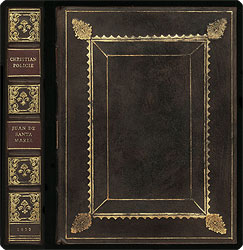
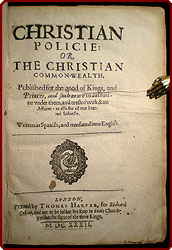
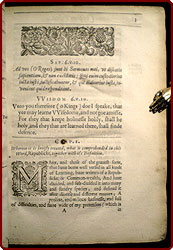 Click the images for enlargements. scholar and poet James Mabbe, known for his translations of Cervantes and other works of Spanish literature and theology.
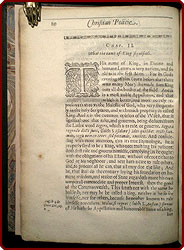
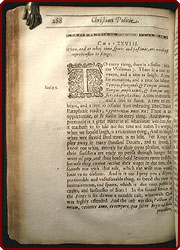
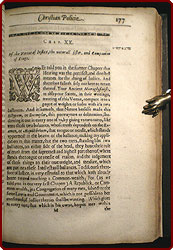
Uncommon: ESTC, OCLC, and NUC Pre-1956 find only 9 U.S. holdings.
• ESTC S107911; STC (2nd ed.) 14831. Period-style calf framed and panelled in gilt fillets with gilt-stamped corner fleurons; spine gilt extra with gilt-stamped leather title and author labels. Lacks initial blank leaf, as is the case with virtually all copies. Two leaves with tattered outer edges, one leaf with small hole affecting a few letters; pages with some moderate offsetting, a few browned. (25084)
For more 17TH-CENTURY BOOKS, click here. For more CATHOLICA, click here. For more RELIGION, click here. For more LITERATURE, click here. Or for more TRANSLATIONS, click here. This appears in the HISPANIC
LISBONCelebrates
the Peace(Jubilance). Jubilos festivos da corte de Pariz, pella publicaçaõ da paz general que nella celebrou a 20 de Junho de 1763.... Lisboa: Na Offic. de Ignacio Nogueira Xisto, 1763. 4to (20 cm, 7.875"). 15, [1 (blank)] pp.
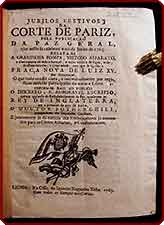
Rare. No copies were traced in the U.S. via NUC Pre-1956, OCLC, or RLIN.
• Plain brown wrappers, shallowly chipped; small paper label on front with rubber-stamped numeral thereon. Small hole in title-page without loss of print. Paper repairs in top margins of pp. 10 and 11. Light soiling. Pencilled notations on title-page and front wrapper.
Ancient
Cults in Holy
Scripture
Jurieu, Pierre. Histoire critique des dogmes et cultes, bons & mauvais, qui ont été dans l'Eglise depuis Adam jusqu'à Jesus-Christ, où l'on trouve l'origine de toutes les idolatries de l'ancien Paganisme, expliquées par rapport a celles des juifs, par Mr. Jurieu. [with Supplement, as below]. Amsterdam: Francois L'Honoré, & Compagnie, 1704. 4to (26 cm; 10.5"). Engr. title, [11] ff., 809, [1] pp., [15] ff. [bound and issued with] Supplement a l'histoire critique des dogmes et cultes, &c. Ou dissertation par lettre de Monsieur Cuper, Bourgemestre de Deventer, ci-devant Deputé aux Etats Generaux par la Province d'Overyssel, sur quelques passages du livre de Monsr. Jurieu. A Amsterdam: Francois L'Honoré, & Compagnie, 1705. 4to (26 cm; 10.5"). Frontis., 70 pp., [2 (ads)] ff.; 3 fold plts.
Holy
Scripture
Jurieu, Pierre. Histoire critique des dogmes et cultes, bons & mauvais, qui ont été dans l'Eglise depuis Adam jusqu'à Jesus-Christ, où l'on trouve l'origine de toutes les idolatries de l'ancien Paganisme, expliquées par rapport a celles des juifs, par Mr. Jurieu. [with Supplement, as below]. Amsterdam: Francois L'Honoré, & Compagnie, 1704. 4to (26 cm; 10.5"). Engr. title, [11] ff., 809, [1] pp., [15] ff. [bound and issued with] Supplement a l'histoire critique des dogmes et cultes, &c. Ou dissertation par lettre de Monsieur Cuper, Bourgemestre de Deventer, ci-devant Deputé aux Etats Generaux par la Province d'Overyssel, sur quelques passages du livre de Monsr. Jurieu. A Amsterdam: Francois L'Honoré, & Compagnie, 1705. 4to (26 cm; 10.5"). Frontis., 70 pp., [2 (ads)] ff.; 3 fold plts.
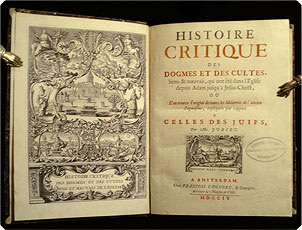
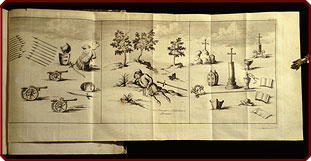
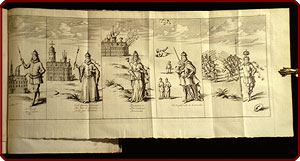 One topic of discussion concerns a prophecy (related by Jurieu) regarding the English succession, which is vividly illustrated on one of the folding plates. Two other folding plates appear in the Supplement, each being rich in symbolism.
The Histoire and the Supplement have their own title-pages, each with an engraved vignette and red and black lettering. Opposite each printed title-page is an engraving. That opposite the Histoire critique des dogmes et cultes is an added engraved title-page, while that opposite the Supplement is a frontispiece; however, both engravings are closely related and bear scenes from Genesis. The text is illustrated with engraved initials, and head- and tailpieces.
• 19th-century quarter sheep over marbled-paper boards, spine with gilt-ruled raised bands, gilt lettering and ornaments within “compartments”; binding a little chipped and abraded; ex-library with white-lettered call number at base of spine, institutional bookplate on front pastedown, pressure-stamp on title-page, rubber-stamp on title-page and several other pages, and inked numeral at base of p. [iii]. Top and bottom paper edges speckled blue. Interior generally clean, with light toning in some margins and occasional small spots of browning or foxing; light orange streaks to four pages of supplement and a small hole within text of pp. 149/150 costing two letters to each page, neither impeding reading. Several page corners chipped, and bottom edges of a few pages of the supplement a little ragged; plates clean and untattered. A solid, satisfying copy. (23743)
For more 18TH-CENTURY BOOKS, click here. For more BOOKS IN FRENCH, click here.For a bit more JUDAICA / HEBRAICA, click here. For more RELIGION, click here. For more ILLUSTRATED BOOKS, click here.
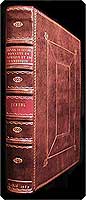
FromNew England to the NILE[Justel, Henri, ed.]. Recueil de divers voyages faits en Afrique et en l’Amerique, qui n’ont point esté encore publiez.... Paris: Louis Billaine, 1674. 4to (23.7 cm, 9.4"). á4ã4A–Z4Aa–Hh4 Ii2Kk4Ll21§–4§45§2 **A–**C4 a2b–g4 *A–*K4L2; [8] ff., 262, 35, [1 (blank)] 23, [1 (blank)], 49, [1 (blank)] pp., [1] f., 81, [1 (blank)] pp., 3 fold. plans, 4 maps (3 fold.), 9 plts.
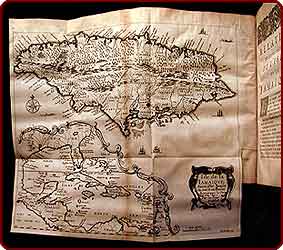
Some of both the voyages and the maps make their first published appearances here—among them the New England map depicting the Maryland and Virginia coastlines, engraved by R. Michault after one contained in Richard Blome’s Description of the Island of Jamaica, part of which work appears here translated into French. Altogether, a volume notable both for its strong African and North American content and for the aesthetic appeal of its plates and pleasingly ornamented typography.

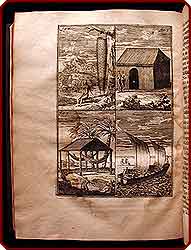 Single-click images where the hand appears on
 • Sabin
36944; Alden & Landis 674/159;
Beinecke Lesser Antilles Collection 68; Baer, 17th-Century Maryland,
78. Recent 17th-century style mottled calf with covers framed in a gilt roll
and double-panelled in gilt fillets with gilt-stamped corner fleurons,; spine
with gilt-stamped leather title and author labels and gilt-stamped decorative
devices. Several pages (not including title) and the versos of a few plates
stamped by a now-defunct institution. Paper slightly embrittled. Light waterstaining
to a number of leaves and plates, mostly in margins; the first map with two
repairs. One leaf (blank?) prior to Colonies Angloises excised; lacking the folding map of the Nile. A good
copy, in a handsome binding of recent vintage and contemporaneous style.
For more 17TH-CENTURY BOOKS, click here. For more BOOKS IN FRENCH, click here. For more VOYAGES, TRAVELS, & books on"EXOTIC" PLACES, click here. For
a bit more AFRICANA, click here. For
a little more CARIBBEANA, click here. For more ILLUSTRATED BOOKS, click here.
• Sabin
36944; Alden & Landis 674/159;
Beinecke Lesser Antilles Collection 68; Baer, 17th-Century Maryland,
78. Recent 17th-century style mottled calf with covers framed in a gilt roll
and double-panelled in gilt fillets with gilt-stamped corner fleurons,; spine
with gilt-stamped leather title and author labels and gilt-stamped decorative
devices. Several pages (not including title) and the versos of a few plates
stamped by a now-defunct institution. Paper slightly embrittled. Light waterstaining
to a number of leaves and plates, mostly in margins; the first map with two
repairs. One leaf (blank?) prior to Colonies Angloises excised; lacking the folding map of the Nile. A good
copy, in a handsome binding of recent vintage and contemporaneous style.
For more 17TH-CENTURY BOOKS, click here. For more BOOKS IN FRENCH, click here. For more VOYAGES, TRAVELS, & books on"EXOTIC" PLACES, click here. For
a bit more AFRICANA, click here. For
a little more CARIBBEANA, click here. For more ILLUSTRATED BOOKS, click here.
NO! Copies of the BOOK in the U.S. Justinianus. A leaf from the Digestum vetus. Venice: Andreas Torresanus, de Asula, 26 March 1491. Folio (42.5 cm; 16.625"). [1] f.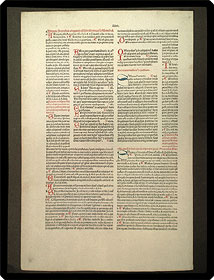 Click the image for an enlargement. In 1479 Torresano acquired the fonts of Nicholas Jenson and in 1505 he acquired Aldus Manutius as a son-in-law!
In the U.S., both Goff and the ISTC only locate only stray leaves of this text: two at Stanford and one at Illinois.
Provenance: Clearly once part of a offering of The Foliophiles Incorporated, and probably from its ad hoc album Pages from the past : a collection of original leaves from rare books and manuscripts [New York: T.F.I., c1926–27].
• ISTC ij00554000; Goff J554; H 9556*; GKW 7675; Pr 4725; BMC, V, 309. Mounted on a brown cardboard backing, with a description (but no bibliographical information) on the verso of the board. Leaf in very good, bright condition. (27100)
To view our INCUNABLES, click here.For more LEAVES, click here. For GREEK & LATIN CLASSICS For EUROPEAN LAW, click here. For Books with SPECIAL For COLLECTED PRESSES For THE ALDINE PRESS, click here. For more “GIFTABLES” — mostly $150
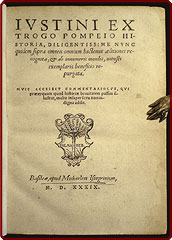
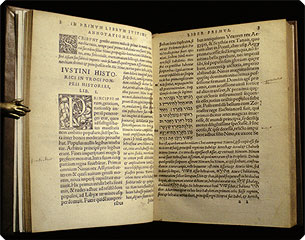
Grynaeus's Edition — Three Maps Justinus, Marcus Junianus; & Pompeius Trogus. Justini ex Trogo Pompeio historia diligentissime nunc quidem supra omnes omnium hactenus aeditiones recognita, et ab innumeris mendis - vetusti exemplaris beneficio purgata. Huic accessit commentariolus. Basilae: apud Michaelem Isingrinium, 1539. Small 4to. [16] ff., 319, [1 (blank)] pp.
 Click the interior images for enlargements.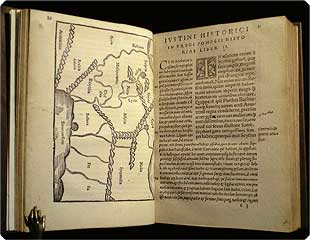
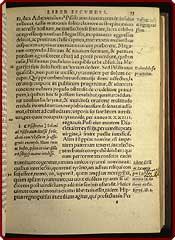
This copy has interesting, early, but now somewhat faded marginalia in a red or sepia ink. The marginalia is scattered and is at times heavy, other times light; in some sections, it is non-existent.
A rare edition: No copy traced via OCLC; VD16 locates only three copies in Europe.
• VD16 T2056. Full rich brown calf old style: Round spine with raised bands, accented in gilt rule; author and title lettered on cream-colored spine label; fillets in blind extending onto covers from each band to terminate in trefoils with blind double fillets beyond. Small rent in upper inner area of title-page with a very old and good repair on verso. Library name stamped on lower edge of closed book. (24808)
For more 16TH-CENTURY BOOKS, click here. For more GREEK & LATIN CLASSICS, click here. For more ILLUSTRATED BOOKS, click here. For more PERSIANA, click here. Or for EGYPT, click here.
Binding Provenance Text Juvenalis, Decimus Junius; & Aulus Persius Flaccus. Iunii
Iuvenalis et Auli Persii Flacci Satyrae, ex doct: viror: emendatione. Amstelodami: Apud Iudocum Hondium, 1625. Narrow 32mo (11 cm; 4.25"). 116 pp.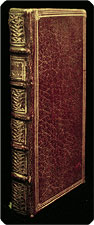
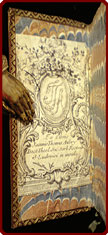
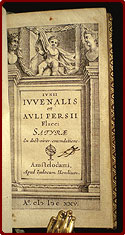 Click the title page image for an enlargement.
 Provenance: 19th-century engraved bookplate of Joannes Thomae Aubry, “Doct. Theol. Soc. Sorb., Rector S. Ludovici in insula.”
Binding: 18th-century crushed red morocco, gilt spine extra; triple fillet gilt border on covers; single gilt rule on board edges; gilt dentelles on turn-ins; French combed pattern endpapers. All edges gilt. Green silk placemarker.
• Not in Schweiger. Binding as above. A very good copy. (22246)
For more 17TH-CENTURY BOOKS, click here. For more GREEK & LATIN CLASSICS, click here. For FINE, ATTRACTIVE, & INTERESTING
In Latin, Printed at The HagueJuvenalis, Decimus Junius, & Aulus Persius Flaccus. D. Iun. Iuvenalis et Auli Persii Flacci Satyrae. Hagae Comitum: Apud Arnoldum Leers, 1683. 12mo (14 cm, 5.5"). 189, [1 (blank)] pp.
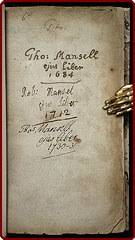
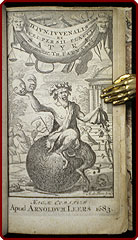
 Click the images for enlargements. apparently the first printing at The Hague of any Latin Classic(s) in their original Latin.
Juvenal was a Roman poet of the early second century A.D. His Satires are a standard of the genre, eloquent, humorous, and rhetorically polished, but revealing a very bitter man. Persius (a.d. 34–62), was a gentler soul than Juvenal, and his poems are more Stoic sermons than satires, preaching a moral life during one of Rome's more corrupt periods and doing so, most remarkably, without a hint of self-righteousness. The two Satyrae are often published together, in contrast and comparison.
This is the first printing at the Hague of this edition with Farnaby's notes, originally printed at London in 1612 and then reprinted in Amsterdam in 1630. The emblematic engraved title-page here was done by A. de Blois; the separate title-page for Persius bears the printer's device.
Provenance: Front fly-leaf with three generations of early, dated, inked ownership inscriptions: Thomas Mansell, first Baron Mansel (1684); Robert Mansel (sic, 1712); and Thomas Mansell (1730–31).
• Brunet, III, 631; Graesse, III, 520; Morgan, Bibliography of Persius, 298; Schweiger, I, 511. Recent marbled paper–covered boards, spine with gilt-stamped leather title-label. Front fly-leaf darkened and engraved title a littlevery little tattered at edges, the first with inscriptions “stacked” as above and the second with old repair. Pages gently age-toned and generally clean, with all edges red. (25952)
For more 17TH-CENTURY BOOKS, click here. For more GREEK & LATIN CLASSICS, click here. For more LITERATURE, click here. Or
for more Books with SPECIAL
An Unusual Edition fromthe Widow VandenhoeckJuvenalis, Decimus Junius; & Aulus Persius Flaccus. D. Iunii Iuvenalis et Auli Persii Satyrae ad fidem optimorum librorum accurate recensitae. Gottingae: Viduae Abr. Vandenhoeck, 1769. 12mo (13.9 cm, 5.5"). [2], 178 pp.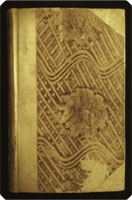
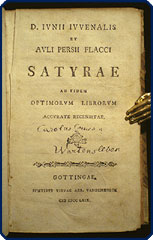
• Schweiger, II, 513; this ed. not in Brunet. Contemporary half vellum over paste paper covers, spine with early inked title; sides and edges lightly scuffed, spine with vellum darkened and chipped. Front pastedown with inked ownership inscription dated 1775, lined through; front free endpaper with 19th-century (?) inked inscription; title-page with early inked inscription reading “Carolus Comes a Wartensleben.” Back free endpaper excised. Title-page torn along inner margin and with short tear from outer edge, just touching one letter. One leaf with small ink blots and several leaves with small nicks to outer edges; scattered light foxing. A few small early inked annotations.
For more 18TH-CENTURY BOOKS, click here. For more GREEK & LATIN CLASSICS, click here. For more LITERATURE, click here. For more of WOMEN's interest, click here. For more “GIFTABLES” — mostly $150
 TO Part XIX TO Part XIX |