 GENERAL MISCELLANY
GENERAL MISCELLANY
GENERAL MISCELLANY
 German
 RENAISSANCE Caesar — Lushly Illustrated
 Caesar, Julius. Julius der erst römisch Keiser von seinem Leben und Krieg, erstmals uss dem Latein in Tütsch gebracht vnd mit andrer Ordnung der Capittel und uil zusetz nüw getruckt. [Strassburg: Durch Joannem Grüninger, vff sant Adolffs des heiligen Bischoffss, 1508]. Folio (31 cm; 11.5"). A6 Aa8 B6 C4 D–N6 O4 P–Z6 Zz6; [148] ff., illus.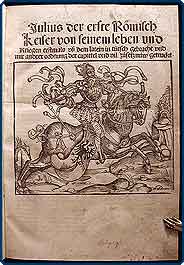
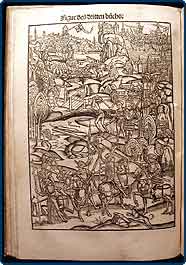
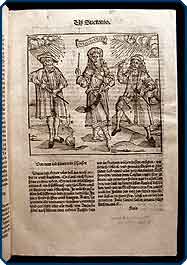
 All images of this book enlarge, via single-click.
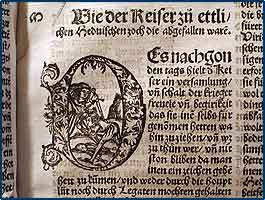
This handsome and SCARCE book is famous for its woodcut illustrations: It has one quarter-page, four half-page, one three-quarter page, and  eleven full-page woodcuts. These include battle scenes, the assassination, camp life, etc., all of the figures being dressed anachronistically in Renaissance garb.
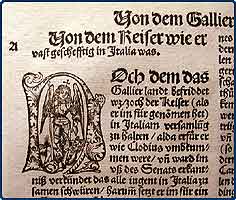 The text is printed in large gothic in double-column format.
 Of the first edition we find only two copies in the U.S. (Harvard and Stanford), and of the second we trace three (Brown, Duke, and Trinity College), all being incomplete except the Brown copy.
• Index Aurel. 128.654; Schmidt, Repertoire bibliographique Strasbourgeois, no. 91, p. 40–41; Schweiger, II, 51; not in Adams (who only lists much later editions in German). Recased in an 18th-century vellum-over-boards binding. Sophisticated copy in all likelihood, with several leaves apparently supplied from a different copy, those leaves being either slightly smaller than the others or more heavily sized. Occasional light waterstains in from a very few margins; two leaves with old scribbling in ink in margins; minor worming in lower margin of last six leaves.  A very nice copy of a very scarce book that is clearly difficult to find complete, incomplete, or sophisticated.
 For more 16TH-CENTURY BOOKS, click here. For more GREEK & LATIN CLASSICS, click here. For more ILLUSTRATED BOOKS, click here. Or for more BOOKS IN GERMAN, click here.
 FIRST to
 Timbuktu & Back Caillié, René Auguste. Journal d'un voyage a Temboctou et
a Jenné, dans l'Afrique Centrale, précédé d'observations faites chez les Maures Braknas, les Nalous et d'autres peuples; pendant les années 1824, 1825, 1826, 1827, 1828. Paris: L'Imprimerie Royale, 1830. 8vo (21.1 cm, 8.25"). 3 vols. I: Frontis., [4], xii, 472, [4] pp. II: [4], 426 pp. III: [4], 404, [2] pp. (lacking 5 plates and map).
Timbuktu & Back Caillié, René Auguste. Journal d'un voyage a Temboctou et
a Jenné, dans l'Afrique Centrale, précédé d'observations faites chez les Maures Braknas, les Nalous et d'autres peuples; pendant les années 1824, 1825, 1826, 1827, 1828. Paris: L'Imprimerie Royale, 1830. 8vo (21.1 cm, 8.25"). 3 vols. I: Frontis., [4], xii, 472, [4] pp. II: [4], 426 pp. III: [4], 404, [2] pp. (lacking 5 plates and map).
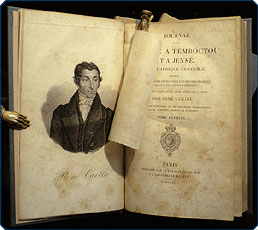 Click the interior image for an enlargement.
 Vol. I opens with a steel-engraved portrait of the author.
• Howgego, II, C2. Period-style quarter tan cloth and light blue paper–covered sides, spines with printed paper labels. Five plates and one map lacking (frontispiece present); two leaves each with tear along inner margin, not touching text; foxed throughout but without embrittlement. (24387)
For more SETS, click here. For more BOOKS IN FRENCH, click here. For AFRICANA, click here. For ARABICA, click here. For more VOYAGES, TRAVELS, & books on“EXOTIC” PLACES, click here. For Books for the BUSTED
 AMERICANS . . . “Never Retreat either in Battle(California Statehood). Report of the Committee on the Judiciary, with the views of the minority of that committee on Bill S.350, for the admission of California into the Union as a state. Washington: Pr. by Wendell & Van Benthuysen, 1849. 8vo (22 cm; 8.5"). 18 pp.
 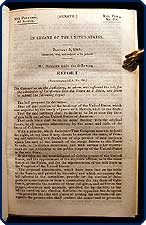 • One of the earliest, if not the earliest, of proposals for admission of California to the Union. The bill failed to obtain majority support, but Committee members do offer suggestions to increase the territory’s chances of acceptance in the future. The minority opinion is strenuous in its support of admission, touting the wealth of the state beyond the obvious gold then causing such a fever in the land.
Single-click the image, for an enlargement.
• One of the earliest, if not the earliest, of proposals for admission of California to the Union. The bill failed to obtain majority support, but Committee members do offer suggestions to increase the territory’s chances of acceptance in the future. The minority opinion is strenuous in its support of admission, touting the wealth of the state beyond the obvious gold then causing such a fever in the land.
Single-click the image, for an enlargement. • Removed from a nonce volume and now in wrappers. A very good copy.

 England, Ireland, & Elizabeth R Camden, William. Annales rerum Anglicarum, et Hibernicarum, regnante Elizabetha ... prima pars emendatior, altera nunc primum in lucem edita. Lugd. Batavorum: Ex officina Elzeviriana, 1625. 8vo (18 cm, 7.1"). Engr. t.-p., [6] ff., xvi, 855, [41 (index)] pp.; 1 plt.
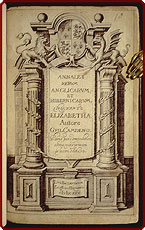
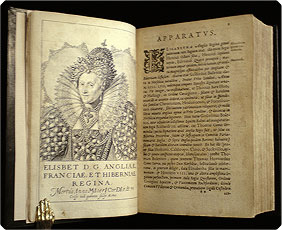 Click the interior images for enlargements.
 The engraved portrait of Queen Elizabeth was done by C. van Queboren.
• Willems 227; Copinger 759. Period-style calf framed and panelled in gilt fillets embellished with blind rolls and gilt-stamped corner fleurons, spine with gilt-stamped title, gilt-decorated raised bands, and blind-tooled patterned bands in compartments; binding signed G.B. (Grace Bindings) in blind at inner area of rear cover, lower turn-in. Pages age-toned. Title-page with inked numeral in upper outer corner; pages with scattered instances of early inked underlining and bracketing. Approximately 50 leaves with light to faint waterstaining in outer portions, extending into text; one leaf with tear from upper margin, extending through first paragraph. (18995)
For more 17TH-CENTURY BOOKS, click here. For more ELZEVIR PRESS BOOKS, click here. For more of IRISH interest, click here. For more ENGLISH POLITICS, click here.
 Life & Letters — A German Neo-Latin Poet Camerarius, Joachim. Narratio de H. Eobano Hesso, comprehendens mentionem de compluribus illius aetatis doctis & eruditis uiris, composita à Ioachimo Camerario Pabebergensi. Epistolae Eobani Hessi ad Camerarium & alios quosdam, familiari in genere .... Norimbergae: Ioanne Montano & Ulrico Neubero, 1553. 8vo (16.3 cm, 6.4"). A–Z8a–b8 (O4 bound in after O5); [200] ff. [bound with] Hessus, Helius Eobanus. Libellus alter, epistolas complectens Eobani et aliorum quorundam doctissimorum virorum, necnon versus varii generis atque argumenti.... Lipsiae: Ex officina Papae, 1557. 8vo. A–K8 (-A8); [79] ff. (last leaf of preface/errata lacking). [and the same author’s]. [Tertius libellus epistolar. Eobani et aliorum.] [colophon:] Lipsiae: M. Ernesti Voegelini Constantiensis, 1561. 8vo. A–T8 (-A1, -T8 [final blank]); [150] ff. (title-page and final blank lacking).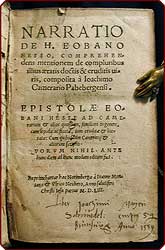
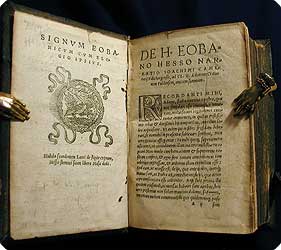 Click the images for enlargements.
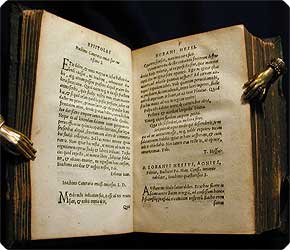
• Narratio: Adams C436; Brunet, II, 1009; VD16 C480 / VD16 C408. Libellus: Brunet, II, 1009; VD 16 C409; not in Adams. Tertius libellus: Brunet, II, 1009; VD16 C410. Binding as above, spine with later hand-inked paper label; binding much darkened and somewhat rubbed, one clasp intact and the other lacking. First title-page with ownership inscription dated 1559 inked in lower margin; Libellus alter lacking last leaf of preface (with errata on reverse) and Tertius libellus epistolar lacking title-page. Some corners dog-eared; two leaves with outer corners torn away, without loss to text. Early inked underlining and lining through of text, with a few marginalia, mostly in Narratio and occasionally in other two works. Last few leaves of final work with light waterstaining to lower outer corners.
For more 16TH-CENTURY BOOKS, click here. For FINE, ATTRACTIVE, & INTERESTING For more BIOGRAPHIES, mostly 20th-Century Or for more LITERATURE, click here.
English Camões in Green Morocco Camões, Luís de. Poems, from the Portuguese of Luis de Camoens. London: J. Carpenter (pr. by C. Whittingham), 1805. 8vo. Frontis., [4], 160 pp.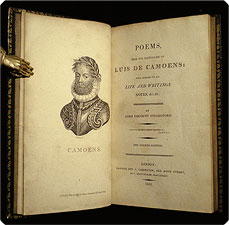
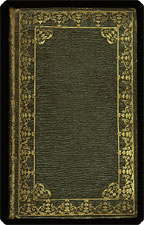 Click the interior image for an enlargement.
 Binding: Contemporary dark green straight-grain morocco, spine with gilt-stamped rules, rolls, and devices. Covers framed with a delicately curly gilt-rolled border; the center panels, within, accented by gilt-stamped corner fleurons. A bit of additional filigree in blind appears both within the rules of the gilt border and within the border on each center panel, to nice subtle effect. Gilt inner dentelles. All edges gilt.
• NSTC C355. Binding as above, leather rubbed at edges and joints, spine a bit dimmed. Front pastedown with armorial bookplate of John Allan Powell; front fly-leaf with inked inscription dated 1922. A few spots of foxing, pages otherwise clean.  A pretty and very English production for this Portuguese poet. A charming volume. (23077)
For more PORTUGAL / PORTUGUESE, click here. For more LITERATURE, click here. For more TRANSLATIONS, click here. For FINE, ATTRACTIVE, & INTERESTING  Des Cartes in Verse — An Attractive FolioCampailla, Tommaso. L'Adamo ovvero il mondo creato poema filosofico.... Siracusa: Nelle stampe di D. Francesco Maria Pulejo, 1783. Folio (32.4 cm, 12.75"). Frontis., LII, 272 (i.e., 294), XX, 16 pp; 1 plt.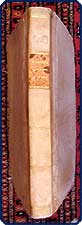
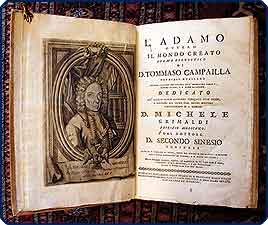 Single-click image at left
 Rare: Only one copy of this edition traced via NUC Pre-1956, OCLC, and RLIN (at the Bancroft Library).
• Quarter vellum with vellum turn-ins. Covers originally covered with gilt or marbled paper, now lost, exposing underlying paste boards—a rather interesting effect. Spine divided into compartments by gilt rolls; a tan leather label, gilt-lettered. Somewhat cockled. Pages untrimmed. Upper outer corner of title-leaf repaired with paper. Two wormholes through frontispiece, plate, and first three printed leaves, with a little loss to illustrations (which yet remain effective) and to parts of individual letters; some additional worming in the margins, not affecting text.
For more 18TH-CENTURY BOOKS, click here. For more BOOKS IN ITALIAN, click here. For a little more SCIENCE, click here.
A Restoration Movement Leader on Believers' Baptism Campbell, Alexander. Christian baptism: Antecedents and consequents. Bethany, VA: Alexander Campbell, 1851. 12mo (18.1 cm, 7.15"). 444 pp.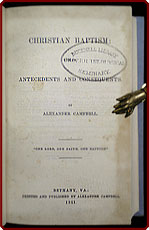

• Norona & Shetler, West Virginia, 236. Not in Sabin. Period-style quarter tan cloth and light blue paper–covered sides, spine with printed paper label. Title-page institutionally rubber- and pressure-stamped, dedication with inked annotations along inner and lower margins, one (blank) page rubber-stamped, last index page pressure-stamped. Light staining to margins of first and last few pages (from a previous binding), otherwise clean. (25839)
For more POST-1820 AMERICANA, click here. For more RELIGION, click here.
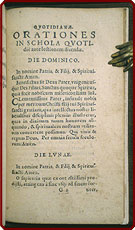
 Canisius' Catechism of theYoungest Children Canisius, Petrus, Saint. Institutiones christianae pietatis. Seu parvus catechismus catholicorum. Coloniae : Apud Maternum Cholinum, 1571. 12mo (13.5 cm; 5.25"). [16] ff., 51, [1] pp., [36] ff.
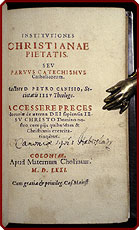
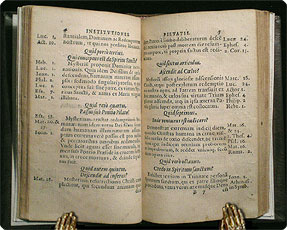
 Click the interior images for enlargements.
 Offered here is an early printing of the version for the youngest students. The title-page and calendar are printed in red and black, and a few headlines in the early section are also in red.
Uncommon. OCLC locates only this now deaccessioned copy in the U.S., and one copy in Europe. Index Aureliensis fails to list this edition at all.
• Not in Index Aurel.; not in Adams. Recent ebony-brown calf old style: Round spine with raised bands, accented in gilt and with blind-tooled devices in compartments; single blind rules extending onto covers from each band to terminate in trefoils, and covers framed in blind double fillets. Author's name and date of printing in gilt on spine. Early underscoring and some minimal marginalia in red ink in a 16th-century hand; ownership note of same era on title-page. Some age-spotting and other light discoloration, not serious. For an early children's book, a very, very nice copy. (24855)
For more 16TH-CENTURY BOOKS, click here. For CHILDREN / EDUCATION, click here. For more CATHOLICA, click here.
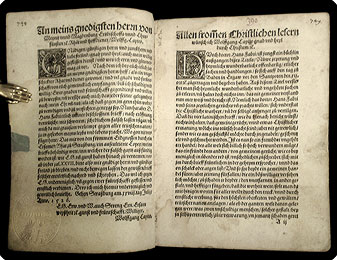
Stolen Letters! Damage Control! — The Reformation Capito, Wolfgang [a.k.a., Wolfgang Köpfel]. Der nüwen zeytu[n]g vnd heymlichen wunderbarlichen offenbarung so D. Hans Fabri jungst vfftriben vnd Wolffgang Capitons brieff gefälschet hat bericht vnd erklerung. Strassburg: No publisher/printer, 1526. Small 4to. [32] ff.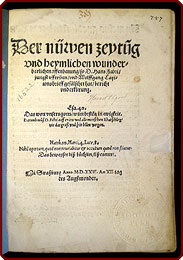
 Click the images for enlargements.
 In his capacity as a leader of the early Reformation he was present at several important “conferences” (the second Zürich and that at Marburg). He coauthored, with Martin Bucer, the Confessio Tetrapolitana.
Capito's archenemy was a Dominican named Hans Faber (a.k.a. Johannes Faber), the vicar general of the bishop of Constance, who at every turn sought to undermine Capito and his relations with authorities and other Reformers, Zwingli in particular. Der nüwen zeytu[n]g is Capito's rebuttal of Faber's Newe Zeittung vnd heimliche wunderbarliche Offenbarung etlicher sache[n] vnd handlungen so sich vff dem tag der zw Baden, in which Faber published distorted versions of letters his agents had stolen that were addressed to Zwingli by Capito and relate to the disputation at Baden in 1526, which Zwingli had decided not to attend.
Schrodt and Vogelstein summarize: “Capito's defense in this tract suggests that he was not altogether comfortable with the language he had used, intended as it was for the eyes of a friend and spiritual comrade in arms. By presenting his original text passage by passage together with Faber's published German version of the same, Capito shows that it given the most offensive turn through the opponent's manner of translation.”
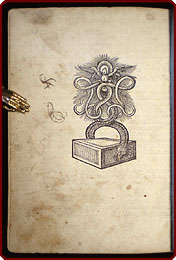
This proffers a large, interesting woodcut device on the verso of its last leaf and two small but nice woodcut initials in text.
Provenance: Ownership signature on title-page of Howard Osgood, noted late 19th- and early 20th-century collector and scholar; old circular pressure-stamp on same page of a seminary (properly released).
WorldCat finds no copies in North America and COPAC finds none in Great Britain.
• Panzer, II, 3051; Kuczynski 381; Index Aurel.; 131.648; VD16 C828; Schrodt & Vogelstein 28–29. In later plain wrappers; title-page torn with small loss of blank foremargin, repaired. Two different sequences of manuscript pagination, one in red, indicating the opusculum was bound at least twice in different sammelbands. Provenance indications as above, and a five-digit number in ink in the inner corner of the title-page; dust-soiling and old staining. (25953)
For more 16TH-CENTURY BOOKS, For more BOOKS IN GERMAN, click here. For more RELIGION, click here. For more Books with SPECIAL
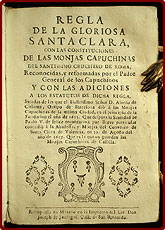
A Nun's CopyThen Another Nun's Capuchin Nuns. Regla de la gloriosa santa Clara,con las constituciones de las monjas Capuchinas del santissimo crucifixo de Roma, reconocidas, y reformadas por el Padre General de los Capuchinos y con las adiciones a los estatutos de dicha regla ... Mexico: Reimpressa en la Imprenta del Lic. Don Joseph de Jauregui, n.d. [ca. 1760–75]. 16mo (15 cm; 6'). [4] ff., 234 pp.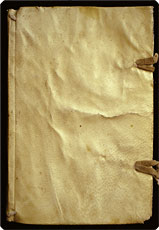
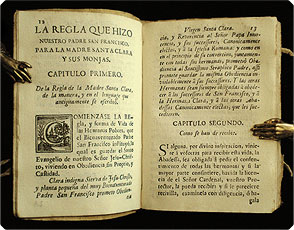 Click the interior images for enlargements. As part of the last, they pray for intervention in medical and mental matters for those suffering from maladies.
Provenance: On front free endpaper in 18th-century hands: “del uso de Sor Maria Coleta,” lined through; below which, “del uso de Sor M[ari]a Juan Nep[umacen]a.
The printer has supplied two charming initials, an “I” and a “C.”
• Medina, Mexico, 9208. Publisher's limp vellum with remnants of ties. Occasional light foxing. Ownership signatures as noted. (23966)
For 18TH-CENTURY BOOKS, click here. MEXICO is one of our great specialties. For MEDICINE, click here. For more Books with SPECIAL Or for more of WOMEN's interest, click here. This book also appears in the HISPANIC
Canal
FeverCarey,
Mathew. [drop title] Canal policy, no.
I–III. Second edition. [Philadelphia, 1824]. 8vo (23.5 cm, 9.25"). 4, 8
pp. [bound with]
Pennsylvania Society for the Promotion of Internal Improvements in the Commonwealth.
Philadelphia, Jan. 13, 1825. The subscribers, the acting committee of ... respectfully
submit the following address on the subject of a canal to connect the waters of
the Susquehannah with those of the Alleghany, to the consideration of their fellow
citizens. [Philadelphia, 1825]. 8vo. 7, [1 (blank)] pp. [with]
Carey, Mathew. Fulton—no. IV.
Canals and railways. [Philadelphia, 1825]. 8vo. 4 pp. [with]
Carey, Mathew. Canal policy —
Fulton — no. V. [Philadelphia, 1825]. 8vo. 4 pp. [with]
Carey, Mathew. Fulton, no. VI. Internal improvement. [Harrisburg,
1825]. 8vo. 6, [2 (blank)] pp. 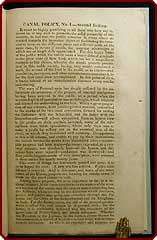
Click
the image for an enlargement.
The Pennsylvania Society for the Promotion of Internal Improvements in the Commonwealth was established in Philadelphia, in December 1824, to disseminate information on the latest improvements in the development of transportation systems including roads, railways, canals, bridges, etc.; William Strickland, Mathew Carey, Richard Peters, Jr., Joseph Hemphill, Stephen Duncan, and Gerard Ralston were among its members.
• Shoemaker 15654, 21855, 19953, 19955, & 19949. Light blue paper–covered boards, spine with printed paper title-label. Light age-toning and spotting, more pronounced in last few leaves. Final (blank) leaf with early inked ownership signature; child’s pencilled drawings on one blank page.
For more PRE-1820 AMERICANA, click here.
HeLiked ItCarr, John. The stranger in Ireland: Or, a tour in the southern and western parts of that country, in the year 1805. Philadelphia: Samuel F. Bradford et al. (pr. by T. & G. Palmer), 1806. 8vo (21.5 cm, 8.5"). xi, [1], 168, *167/68, 169–339, [1 (blank)], 8 (adv.) pp.; 1 plt\.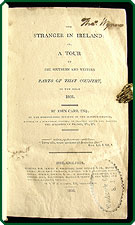
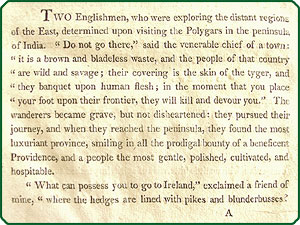
An Englishman through and through, Carr seems sincerely to have liked Ireland and the Irish he met. His book is full of extended and very readable detail — some original, much quoted — on (e.g.) language matters and Irish poetry, Irish agriculture and industry, Irish management of charities, Irish “sights” and ruins, Irish marriage cust marriage customs — and the implications of a potato-based diet.
Provenance: Contemporary inked inscription reading “Tho.s Wynne.”
• Shaw & Shoemaker 10096. On Carr, see: The Dictionary of National Biography. Contemporary mottled sheep, spine with gilt-stamped title-label; leather moderately rubbed, joints cracking and spine label dimmed. Title-page with owner's name as described above; title-page and one other stamped. Pages, except for central leaves, with waterstaining in lower margins; two pages with smeared spots of ink. (11960)
For more PRE-1820 AMERICANA, click here. For more of IRISH interest, click here. For more VOYAGES, TRAVELS, & books on“EXOTIC” PLACES, click here.
One of CHILE’s“Padres de la Patria”Edgar Allan Poe Connection Carrera, José Miguel de. Autograph Letter Signed to Henry Didier. In Spanish, on paper. Montevideo: 12 December 1817. Small 4to (24.5 cm x 9.5"). [2] pp., with integral address leaf.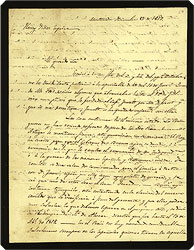 Click the image for an enlargement.
 Writer Carrera: From one of the leading families of Chile, José Miguel Carrera led the successful coup de etat of 15 November 1811 that overthrew the Junta de Gobierno that was established in the political void after the capture of the king of Spain. As sole leader of the nation he created the first Chilean constitution, designed the first Chilean flag and coat of arms, and was responsible for bringing the first printing press to Chile. Disagreement with the Lautaro Lodge of the Masons led to his overthrow by Bernardo O’Higgins and the rift never healed, eventually leading to Carrera’s exile in Argentina, the U.S., and later Uruguay. His brothers fell into the hands of O’Higgins who had them executed.
Recipient Didier: Henry Didier was the godfather of Edgar Allan Poe’s older brother, William Henry; he was to take the boy into his home for some years, though accounts differ as to whether this happened immediately after the death of the Poe children's parents (1811) or after the death of their guardian grandfather (1816). He ran a counting house in Baltimore and William Henry worked there as a young man. Though the Poe brothers' intimacy varied due to circumstances over the years, clearly Edgar knew Didier; he would surely have visited his brother at the Didier house.
On Uruguay: “Las cosas continuan en el mismo estado. Los Portugueses no han recivido refuerzo despues de los 500 Pernambucanos. Artigas se mantiene firme, esta guarnicion no se mueve. El Rey ha escrito para que el Gobierno de Buenos Ayres se desida.”
On Argentina: “Buenos Ayres continua tranquilo, está entretenido en la eleccion del nuevo cavildo que se verificará a fines del presente.”
On Peru: “En el Perú no hay novedad considerable. [L]os españoles tienenel aquella costa 11 buques de guerra, inclusas dos de 44, pero esto no estorbó al Berg.n chileno el Aguila. . . . No pasa de 9000 veteranos el Ex[erci]to en aquel pais, aseguran que llegando los buques de guerra de Estados Unidos piensan atacar a Arequipa y seguir a Lima; no lo creo por ahora.”
On O’Higgins: “O’Higgins sigue mandando el Ex[erci]to y Brayer es sus m[ay]or gene]ral. — Pueyrredon ha mandado a esta un comisionado para que alcance de Leon que se me eche de aqui; Leon constante en su amistad y systema se negó despresiando al comisionado.”
On Prisoners: “Mi viejo Padre, 85 años de edad, ha estado incomunicado 17 dias, y ultimamente sigue su arresto en casa. . . . Mis hermanos presos aun, y lo mismo muchos de nuestros compatriotas. . . . Mr. Handle continua en su prision con todos sus oficiales y tripulacion.”
• Very good condition. Written in a very clear hand. (24646)
For more SOUTH AMERICANA, click here. For more MANUSCRIPTS, click here. For our MSS in SPANISH, click here. For LITERATURE, click here. For more of MILITARY/NAVAL Or for MARYLAND'ia, click here. This also appears in the HISPANIC
Second U.S. Edition: An Influential Classic Carter, Susannah. The frugal housewife: Or, completewoman cook. Philadelphia: James Carey, 1796. 12mo (17.2 cm, 6.75"). 132 pp.; 2 plts.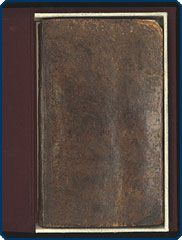
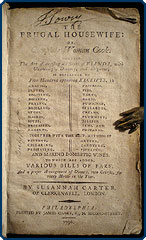
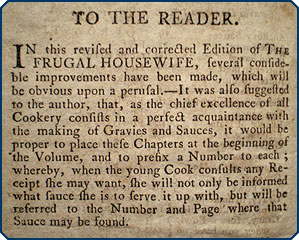 Click the interior images for enlargements.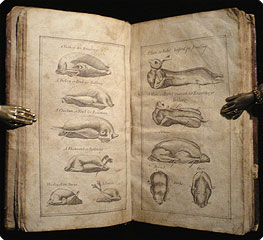
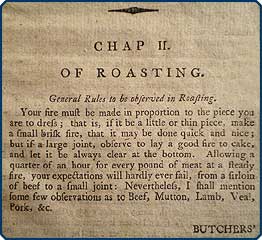
Provenance: Flourishing old signatures of “J. Lowry” to pastedown and title-page.
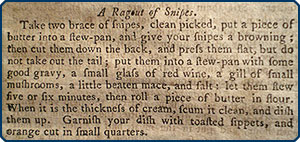 Click the interior images for enlargements. For more 18TH-CENTURY BOOKS, click here. For more PRE-1820 AMERICANA, click here. For more COOKERY, click here. Or for more relating to WINE, click here. For more of PHILADELPHIA For more of WOMEN's interest, click here.
Protestant Refutation of Baronius Casaubon, Isaac. Isaaci Casauboni De rebus sacris & ecclesiasticis exercitationes XVI ... Acceßit versio Latina earum sententiarum & dictionum Gracarum, quarum interpretatio ab authore in prima editione certo consilio fuit praetermissa. Francofurti: Curantib. Ruland. typis Ioan. Bring, 1615. 4to (24.7 cm, 9.75"). [72], 552, [24] pp.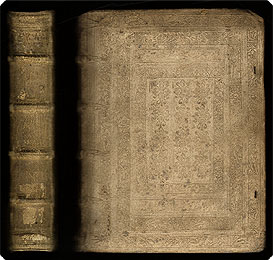
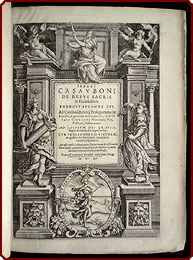
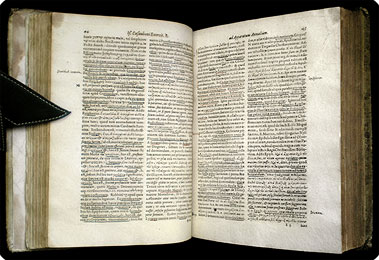
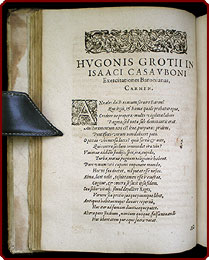 Click the images for enlargements.
 The title-page appears within a very fine copper-engraved architectural and allegorical frame. This copy bearsinteresting evidence of early readership, with inked marginalia in a very neat hand and underlining in both black and red.
Binding: Contemporary alum-tawed pigskin, covers elaborately tooled and embossed in blind with resulting concentric compartments (one roll being pictorial representations of the virtues).
• Brunet 21364; VD17 12:116615R. Binding with some portions darkenedor rubbed, spine leather with numerous small cracks, clasps now absent; front hinge (inside) repaired, and binding strong. Title-page and first dedication page each with reasonably unobtrusive institutional pressure-stamp. Pages age-toned, with annotations as above. A solid, engaging copy. (26927)
For more 17TH-CENTURY BOOKS, click here. For more RELIGION, click here. For more CATHOLICA, click here. For OCCULT matters, click here.
A FAMED but UNLUCRATIVEPolyglot Dictionary Castell, Edmund. Lexicon heptaglotton, Hebraicum, Chaldaicum, Syriacum, Samaritanum, Æthiopicum, Arabicum, conjunctim; et Persicum, separatim. London: Thomas Roycroft, 1669. Folio (44.9 cm, 17.6). 2 vols. in I. Frontis., [8] pp., 44 columns (43 & 44 repeated in numbering), [2] pp., 573 columns (402, 403, 421 & 422 repeated in numbering; 340, 341, 399, & 400 skipped), [1] p., 4008 columns (376–78 & 391–93 incorrectly numbered; 484–86, 538, 1936–38, 3220–25, 3773–78, & 3950–51 repeated in numbering; 487–89, 535, & 3226–3231 skipped).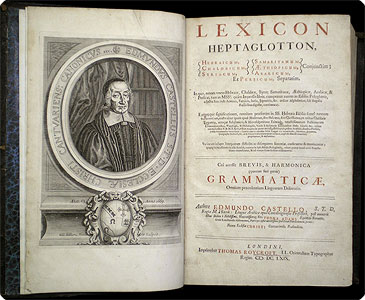
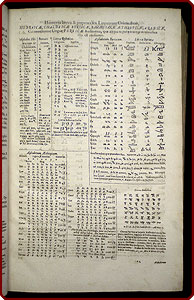
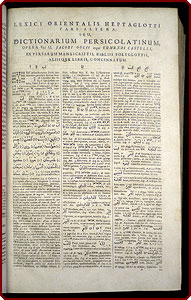 Click the images for enlargements.
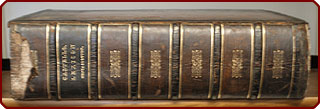
• ESTC R16460; Wing (rev. ed.) C1225; Vancil 46; Lowndes 386; Dibdin, I, 31–35. On Castell, see: Oxford Dictionary of National Biography online. 18th-century speckled calf, covers bordered with a darker calf band blind-rolled and then framed with single gilt fillet; spine with gilt-stamped leather title-label, darker-leather raised bands gilt-stamped/blind-tooled, and compartments gilt- and blind-tooled enclosing gilt-stamped floral decorations. Binding rubbed, with leather significantly lost in top compartment and and lost also at foot. All edges marbled. Front fly-leaf with inked ownership inscription as above dated 1837; title-page with old institutional pressure-stamp. Frontispiece with outer margin reinforced some time ago. One leaf slightly oversized and creased, intermittent soiling in many upper margins, one leaf with text affected but not obscured, small sections with light waterstaining to outer or upper margins; over all, a book both impressive and pleasant. Columns erratically numbered, text complete. (25792)
For more 17TH-CENTURY BOOKS, click here. For DICTIONARIES/GRAMMARS, ETC., click here. For BIBLES, TESTAMENTS, &For a bit more JUDAICA / HEBRAICA, click here. For ARABICA, click here. For PERSIANA, click here. OR for more TRANSLATIONS, click here. For more Books with SPECIAL
Las Siete Partidas — AFolio Set & Handsome Castile (Kingdom). Sovereign (1252-84 — Alfonso X). Las siete partidas del rey d. Alfonso el Sabio, glossadas por el Sr. D. Gregorio Lopez ... En esta impression se representa a la letra el texto de las Partidas, que de orden del Consejo real se corrigió. y publicó el Dr. Bernì en el ano 1758. Se reimprime la glossa del Sr. Gregorio Lopez, por el tenor de la edicion de Salamanca del ano 1555. Se han examinado las citas, cotejado, y puntualizado. Se han corregido las materialas erratas de imprenta. Y colocado en las margenes de los textos las Leyes recopiladas, y Autos accordados. En obedecimiento del Decreto del Consejo real de 4. de noviembre de 1759 por el Dr. Don Joseph Berní y Català. Valencia: Imp. de Benito Monfort, 1767. Folio (14.25", 36 cm). 8 parts in 4 vols. I: [12] ff., 356 pp; II: [5] ff., 280 pp.; III: [9] ff., 436 pp.; IV: [4[ ff., 175, [1 (blank)] ff., 2 plts.; V: [6] ff., 270 pp.; VI: [5] ff., 285, [1] pp.; VII: [6] ff., 251, [1 (blank)] pp.; Index vol.: 164, xvi, 548 pp. 
The first edition appeared in Seville in 1491. In the 1555 Gregorio López issued his influential edition with commentary, which became the standard edition, reprinted several times in subsequent centuries. According to Palau, López "revisó y corregió escrupulosamente los manuscritos y textos anteriores, en los que el descuido de copistas e impresores había llegado a introducir variantes de importancia y a falsear el espiritú del legislador. De modo que esta edición [i.e., la primera] fue declarada como texto único auténtico y legal en la práctica del foro."
In the years following issuance of the 1555 edition, corruptions began to enter the text yet again, and in 1759 a further revision was ordered to bring the text back to its original wording and sense. This is only the second edition of that revision. Its printer was Monfort, one of Spain's best 18th-century practioners of the black art. The main title-page is printed in black and red, the text in clear and precise roman with some italic in double-column format; López's notes are laid in below the text. A fine engraved headpiece adorns the "Prólogo" in vol. I and a handsome woodcut headpiece of a ship under full sail on the open sea introduces each partida. Additionally there is a modest use of historiated initials.
• Palau 7007 (Siete partidas) & 7008 (index). Contemporary mottled calf, round spines, raised bands, gilt spines extra. Minor abrasions on some covers. All edges carmine. Silk place markers. A very few instances of worming, holes filled by means of the 18th-century version of leafcasting (i.e., a paper slurry "painted" onto the paper to fill the opening): a few letters lost in some words, but sense not obscured. A very handsome set of a very important book.
For more SETS, click here. For EUROPEAN LAW, click here. This set also appears in the HISPANIC
The Year in Four Vols. & Beautiful Bindings Catholic Church. Liturgy & ritual. Breviaries. Breviarium romanum ex decreto sacrosancti Concilii tridentini restitutum S. Pii V. pontificis maximi iussu editum, Clementis VIII. ac Urbani VIII. auctoritate recognitum, cum officiis sanctorum novissimis usque ad SS. D.N. Pium VI, pro recitantium commoditate diligenter dispositis. [Romae]: A. Galler , 1781. 8vo (18 cm, 7.1"). 4 vols. I: [20], 632, cclxxxviii, 19, [1] pp.; illus. II: [18], 646, ccliv, 21, [1] pp.; 1 plt. III: [54], 566, cclxxvi, 26 pp.; 1 plt. IV: [20], 608, cclxx, 15, [1] pp.; illus.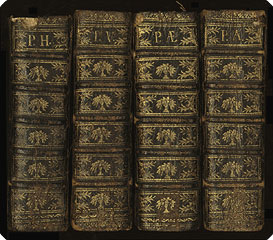
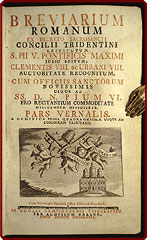
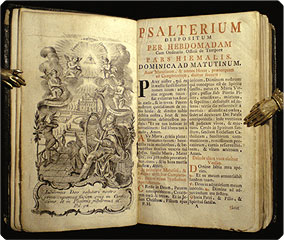 Click the images for enlargements.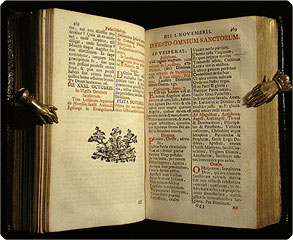
• Not in Weale & Bohatta. Bindings as above, edges and extremities rubbed, spine leather with tiny cracks, one spine head chipped, one joint starting. Ex-library with bookplates, rubber-stamp on lower edges of pages of the closed volumes. One volume with text block separating from spine and sewing loosening; this with the most leather rubbed away and the darkest instances of the usually-light waterstaining and spots of foxing seen occasionally throughout. Endpapers bear early inked ownership inscriptions and annotations. An elegant quartet. (12406)
For more SETS, click here. For more 18TH-CENTURY BOOKS, click here. For more CATHOLICA, click here. For FINE, ATTRACTIVE, & INTERESTING For more ILLUSTRATED BOOKS, click here.
The Armenian Rite Englished & IllustratedCatholic Church. Armenian Rite. The Armenian liturgy translated into English. Venice: Pr. at the Armenian Monastery of St. Lazarus, 1862. 8vo (22 cm, 8.6"). 70, [2 (blank)] pp.; 8 plts.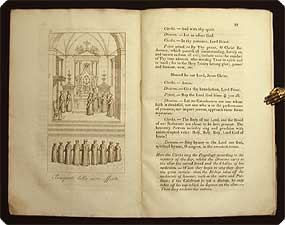
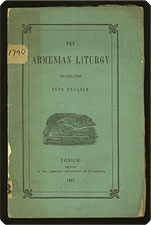
• Publisher’s printed paper wrappers, detached and darkened, front wrapper with tear from inner margin, paper split and chipped along spine, front wrapper with paper shelving label. Title-page with institutional stamp (no other markings). A few plates with very light spots of foxing. Very interesting!
For more RELIGION, click here. For more CATHOLICA, click here. For more ILLUSTRATED BOOKS, click here. For TRANSLATIONS, click here.
Mid-Fourteenth CenturyBifolium Catholic Church. Liturgy & Ritual. Breviary. Manuscript on vellum, in Latin. “In illo tempore dixit Iesus discipulis suis Auditis quia dictum est: “Diliges proximum tuum et odio habebis inimicum tuum.” Germany: ca. 1360. Small 8vo (12.5 x 17.5 cm; 7"x 10"; for the total bifolium). [1] ff.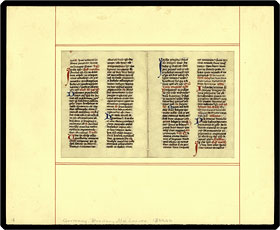 Click the image for an enlargement.
• Very good condtion, in a single-ply mat. (24660)
For more MANUSCRIPTS, click here. For more CATHOLICA, click here. For more LEAVES, click here.
Ojibway
— OTTAWACatholic
Church. Catechism. Ojibway. A short compendium of the Catechism for the Indians, with the approbation of the Rt. Rev. Frederic Baraga, Bishop of Saut Sainte Marie, 1864. Rev. N. L. Sifferath, Missionary of the Ottawa and Otchipwe Indians. Buffalo, N.Y.: C. Wieckmann, (Aurora Printing House.), 1869. 12mo (18.3 cm, 7.2"). 62, 2 pp.
 Click either image above for an enlargement.
• Sabin 80996; Pilling, Algonquian, 462; Pilling, Proof-sheets, 3601a. Not in Banks; not in Evans. Original buckram, showing minor water damage; upper page margins waterstained, obviously to very lightly. Title-page with library stamps and some rough old pen-markings; first two leaves a bit torn at binding.
For more POST-1820 AMERICANA, click here. For more of NATIVE AMERICAN interest, click here. For more RELIGION, click here. For more of CANADIAN interest, click here.
The Pope Lays It Down Here Catholic Church. Pope (1590–1591: Gregory XIV). Declaration de n.s. pere le pape Gregoire XIIII. Sur les lettres qui luy ont esté escrites par la noblesse qui suit le Navarrois. Paris: Robert Nivelle & Rolin Thierry, 1591. 8vo (15.9 cm, 6.25"). 14, [2] pp.
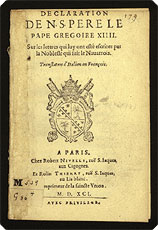 Click the image for an enlargement.
 This little pamphlet appears to be a scarce variant; OCLC finds no holdings, and the title is not listed by Lindsay & Neu.
• Not in Lindsay & Neu, French Political Pamphlets 1547–1648. Disbound. Title-page with paper shelving label, institutional pressure-stamp, and residue from previous nonce binding along inner margin; four other pages also pressure-stamped. Additional inked pagination in upper outer corners, in an early hand. (24463)
For 16TH-CENTURY BOOKS, click here. For BOOKS IN FRENCH, click here. For TRANSLATIONS, click here. For CATHOLICA, click here. For RELIGION, click here.
Extraordinary
Confessors forNUNS
Catholic
Church. Pope, 1740–58 (Benedictus XIV).
[drop-title] Constitutio sanctissimi in Christo patris et domini nostri Benedicti
divina providentia Papæ XIV. Super designationes confessariorum extraordinariorum
pro monialibus. Constitucion del santissimo en Christo padre y señor
nuestro señor Benedicto por la divina providencia Papa XIV, sobre señalamiento
de confessores extraordinarios para las monjas. Madrid: En la imprenta de Phelipe
Millan, [1748]. Folio (28.3 cm, 11.375"). 46 pp. 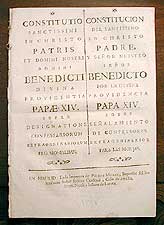
This is printed in Latin with a Spanish translation in the facing column, sidenotes, and a woodcut initial. A search of NUC Pre-1956, RLIN, and OCLC revealed only two copies of the constitution in addition to the one given in Palau.
• Palau 27260. On Benedict XIV, see New Catholic Encyclopedia, II, 278. Removed from a nonce volume. Paper generally clean and crisp with a few small spots of foxing and waterstaining. Paper closely trimmed by binder, shaving some sidenotes.
For
more 18TH-CENTURY BOOKS, click
here. For
more of WOMEN's interest, click
here.
Lives of theFathers with PORTRAITS Cave, William. Apostolici: Or, the history of the lives, acts, death, and martyrdoms of those who were contemporary with, or immediately succeeded the Apostles...the third edition corrected. London: Pr. by B.W. for Richard Chiswell, 1687. Folio (32 cm, 12.6"). Add. engr. t.-p., [34], xxxii, 335, [1] pp.; illus.
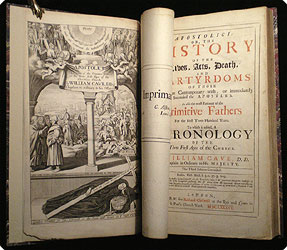
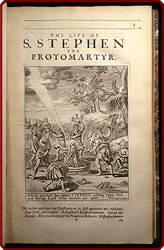 Click the interior images for enlargements.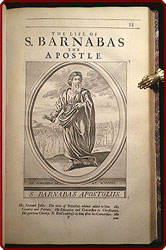
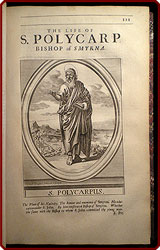 23 total of these in-text engravings, most signed by Burghers.
Burghers (1653–1727) was born in Amsterdam, worked initially at Utrecht, and fled to England after the capture of Utrecht by the French in 1672; he settled in Oxford in 1673. There he worked under David Loggan and succeeded him as engraver to the University.
The volume closes with “A Chronological Table of the Three First Ages of the Christian Church,” which has a separate title-page dated 1686, but is paginated continuously with the preceding work.
Cave, a Church of England clergyman whose scholarly interests were primarily patristic, also wrote Primitive Christianity, or, The Religion of the Ancient Christians in the First Ages of the Gospel as well as Scriptorum ecclesiasticorum historia literaria; the DNB notes that his works “follow the tradition of Christian bio-bibliography that in late antiquity and into the medieval period had such a long and rich history.”
• ESTC R26585; Wing (rev.) C1592; Lowndes 395; Allibone 356–57. On Cave, see: Oxford Dictionary of National Biography online. Recent quarter calf with marbled paper–covered sides, leather edges tooled in blind, spine with gilt-stamped author and title labels and gilt-stamped decorations between raised bands. Half-title with inked ownership inscription in upper outer corner. (24886)
For more 17TH-CENTURY BOOKS, click here. For RELIGION, click here. For ILLUSTRATED BOOKS, click here. For WING BOOKS, click here. For more BIOGRAPHIES, mostly 20th-Century
WHISTCavendish. The laws and principles of whist stated and explained and its practice illustrated on an original system by means of hands played completely through. American edition. New York: Charles Scribner's Sons, & London: Thomas de la Rue & Co., 1895. 8vo. Frontis., x, 318 pp.; illus.
• Publisher's cloth, covers framed in blind, front cover and spine with gilt-stamped title; edges and extremities lightly rubbed, spine darkened with gilt dimmed. Front fly-leaf with inked gift inscription dated [18]96. Pages clean, two with lower corners dog-eared. All edges gilt. (13988)
For a short shelf dedicated to GAMES, click here. For more MATHEMATICS, click here. For more “GIFTABLES”— mostly $150
 TO Part IX TO Part IX |